Category: History

History

  • How Barbadian Planters Survived Emancipation: Administrative Power and the Misread History of 19th Century Barbados

    How Barbadian Planters Survived Emancipation: Administrative Power and the Misread History of 19th Century Barbados

    Introduction: The Puzzle Barbados Poses

    By the middle of the nineteenth century, the British Caribbean offered a clear pattern. Emancipation destabilised plantation regimes; labour withdrew; planter classes fractured; representative institutions were abolished; Crown Colony rule expanded. Jamaica lost its Assembly after Morant Bay in 1866. Similar trajectories unfolded across much of the region. Barbados did not follow this path.

    Emancipation in 1834 did not dismantle the planter class. Sugar production did not collapse; it increased. White planters did not depart en masse. The island retained its elected House of Assembly long after other colonies surrendered theirs. Governance remained local, continuous, and—by the standards of the time—remarkably effective.

    This presents a historical puzzle. Barbados should not have been stable, if the dominant Caribbean narrative holds. And yet it was.

    This article argues that the solution to this puzzle lies not in ideology or benevolence, but in administration. Nineteenth-century Barbados was governed through routine, procedure, and paperwork. That governance left an enormous documentary trace—but one that has been consistently misread because historians have looked for drama where the island produced continuity.


    Barbados as a Comparative Outlier

    F. A. Hoyos’ Barbados: A History from the Amerindians to Independence is essential precisely because it situates Barbados against the wider Caribbean trajectory. Hoyos shows, repeatedly and explicitly, that Barbados diverged from regional norms:

    • Emancipation did not destroy the planter class
    • Sugar output rose significantly in the post-emancipation decades
    • Labour costs were controlled rather than explosively rising
    • Planters were overwhelmingly resident, not absentee
    • Barbados retained its Assembly while Jamaica, Antigua, Dominica, and others moved to Crown Colony rule

    Hoyos is clear that this was not an accident. Barbados was governed by men who were not aristocratic dilettantes but managers: agriculturally knowledgeable, legally fluent, financially cautious, and deeply invested in maintaining constitutional autonomy.

    Crucially, Hoyos documents that imperial officials noticed this. Governors repeatedly praised the Barbadian Assembly for its “business-like qualities of true Parliamentary life,” even while pushing reforms elsewhere. Barbados was treated as administratively exceptional.

    This is the comparative frame without which the Barbadian administrative record—most visibly preserved in its newspapers—does not fully make sense. The record is not merely orderly because stability existed; stability existed because administration was effective.


    Geography as Structural Power

    Barbados was not merely socially distinct; it was geographically constrained in ways that fundamentally shaped governance.

    Unlike Jamaica, Barbados had:

    • no mountainous interior
    • no extensive bush land
    • no crown land available for settlement
    • no viable space for maroonage or autonomous peasantry

    Hoyos emphasises this repeatedly. After emancipation, ex-slaves had nowhere to go. Land was already fully enclosed, intensively cultivated, and privately owned. There was no internal frontier. This mattered enormously.

    In Jamaica, mountainous geography allowed labour withdrawal, maroon communities, and alternative subsistence. In Barbados, withdrawal meant starvation. Labour discipline could therefore be maintained with minimal overt coercion. Exit was structurally impossible.

    This geographic fact explains why the administrative record appears so calm. Violence did not vanish; it became unnecessary to display. Constraint did the work.

    The Strategic Advantage of Administrative Silence: Barbados and Saint-Domingue

    Barbados’s survival becomes clearer when set briefly against Saint-Domingue, where planter power collapsed with extraordinary violence. The contrast is not one of cruelty—both societies were brutal—but of elite strategy under pressure.

    In Saint-Domingue, a large, educated creole population closely followed metropolitan debates during the French Revolution and articulated claims to political equality in the language of universal rights. White authority was defended, challenged, and reformulated in ideological terms. Once domination entered the realm of principle, it became contestable. Appeals to equality fractured white solidarity and opened conceptual space that enslaved people could also occupy. Power, once argued for, became vulnerable.

    Barbados followed the opposite course. Its white elite remained numerically small, racially rigid, and ideologically restrained. There were no manifestos defending planter prerogative, no appeals to natural hierarchy, no local adaptations of Enlightenment theory. Authority was not explained; it was enacted. Rule operated through procedure, property law, labour discipline, and routine administration rather than argument.

    This refusal to theorise power—to make rule visible as rule—proved strategically decisive. Where Saint-Domingue’s creole politics rendered domination thinkable and therefore breakable, Barbadian governance preserved itself by remaining untheorised. Power did not collapse because it never presented itself as an idea to be contested.

    This difference helps explain why Barbados avoided the revolutionary trajectory of Haiti and instead produced the administratively dense, quietly coercive system visible in its newspapers.


    Newspapers as Administrative Infrastructure

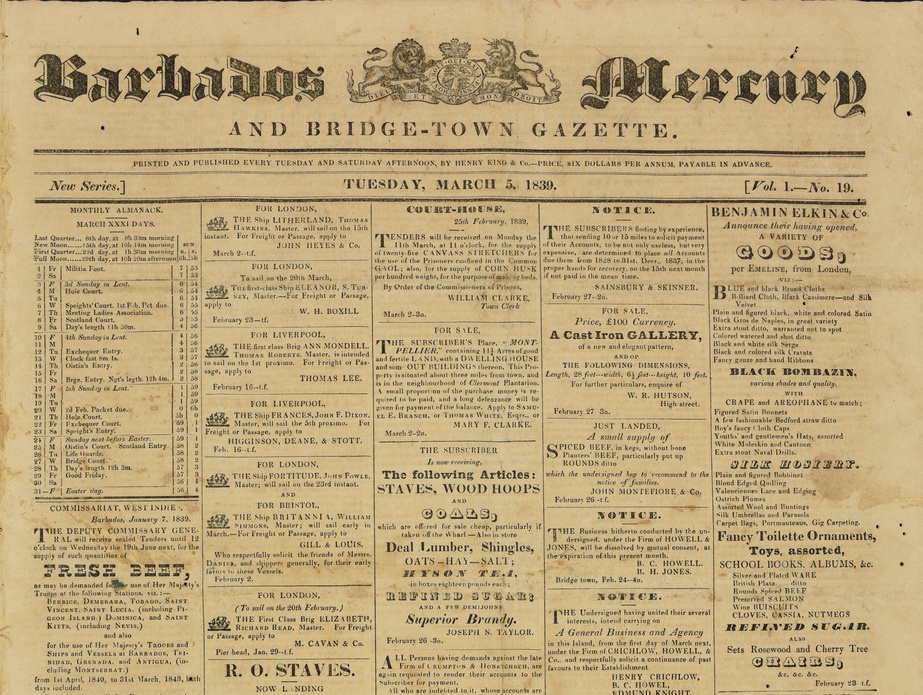
    Against this backdrop, the Barbadian newspapers reveal their true function. Titles such as The Barbadian and Barbados Mercury were not platforms for persuasion. They were operating manuals for governance.

    A typical issue is dominated by:

    • chancery notices
    • land sales
    • probate announcements
    • shipping intelligence
    • Assembly adjournments

    Editorial voice is minimal. Explanation is absent. Authority is assumed.

    This is not political thinness. It is political confidence.


    Assembly Without Drama (A Working Machine)

    On Saturday, June 8, 1839, The Barbadian reported a sitting of the House of Assembly. Present were the Hon. Mr Speaker Hinds and Messrs. Briggs, Barrow, Walcott, Nurse, A. H. Morris, Clarke, Bovell, Goding, Rogers, Taylor, Applewhaite, Sharp, Donovan, and Gaskin.

    The central issue was not emancipation, labour, or imperial reform, but whether the printer of the Liberal should be paid for work already ordered. Motions were made, seconded, resolved. The House adjourned.

    This is not triviality; it is evidence. Governance functioned through routine because the governing class was cohesive. Decisions did not require persuasion because interests were aligned.

    As Hoyos puts it, the Assembly exhibited the “business-like qualities of true Parliamentary life,” a judgment that is decisive here. Short sessions were a sign of success, not disengagement. Barbados governed efficiently because it could.


    Chancery as the Core of Power

    If the Assembly shows form, Chancery shows substance.

    In a single newspaper issue, one might find:

    • Gaskin and Wife v. Gibbes and Wife and Others — Colleton’s Plantation, stock and premises, St Lucy
    • Bovell and Others v. Rollock, the Younger — Chance Hall Plantation, St Lucy
    • Hinds v. Bovell (Administrator) — Hope Plantation, St Lucy
    • Wilson and Others v. Halls — a sugar-work plantation, St Michael

    These are not crises. They are routine reallocations of capital. The same surnames recur in rotating legal roles: litigant, executor, administrator, trustee. Women appear primarily as conduits of property transmission. Labour appears only as “stock.”

    This is elite self-management, not breakdown.


    Geography Becomes Authority: The Gaskin Example

    Land sale advertisements make this visible spatially. When Piggott’s estate in St James is offered for sale, its boundaries are defined not abstractly but relationally:

    “…butting and bounding on the Lands of Benjamin Gaskin, Esq., Sandy Lane, Black Rock, and Holder Plantations…”

    Gaskin is not selling. He is not speaking. He is not explained. His name functions as cartography.

    Power here is so normalized it has become geographical fact.


    Administrative Smoothness and the Displacement of Violence

    The calm of the archive is not moral calm. Hoyos is explicit that apprenticeship was “rigidly and severely administered.” Ex-slaves had no land, no exit, no leverage. Sugar production increased precisely because labour could not withdraw.

    This explains the newspapers’ silence. Violence had been structurally embedded—into geography, property law, wage dependence, and judicial routine. The smoother the administrative record, the more completely coercion had been displaced elsewhere.

    Administrative competence does not mitigate injustice. It explains durability.


    Surnames, Visibility, and the Archive’s Trap

    One methodological warning is essential. The recurrence of surnames—Hinds, Gaskin, Bovell, Walcott—does not indicate demographic continuity. Enslaved people took the surnames of owners. After emancipation, those surnames proliferated among black Barbadians with no blood connection to elite families.

    The archive tracks legal relevance, not lineage. Newspapers show who owned, administered, litigated, and bounded land—not who constituted society.


    Why This History Was Misread

    This history did not vanish. It was misclassified.

    Historians have privileged rupture. Barbados offers continuity. Historians have looked for resistance in print. Barbados displaced coercion into structure. Historians have sought ideology. Barbados governed through procedure.

    The newspapers were read—and dismissed—as boring. In fact, they record power operating at its most effective.


    Conclusion

    Barbados was governed for centuries by an explicitly racist, morally indefensible elite. That elite was also administratively competent, geographically advantaged, and legally sophisticated. Those facts coexist.

    Understanding how domination endures requires understanding how it becomes ordinary. Barbados shows us a system that survived not because it was just, but because it was managed.

    The history did not disappear. It sat in plain sight, printed weekly, waiting for someone to take routine seriously.

    Acknowledgments:

    Barbados archives:

    https://dloc.com/collections/ibarbadosarchdept

    F.A. Hoyos:
  • Vikingisation without Replacement: Elite Incorporation, Cultural Hybridity, and Population Continuity on the Isle of Man

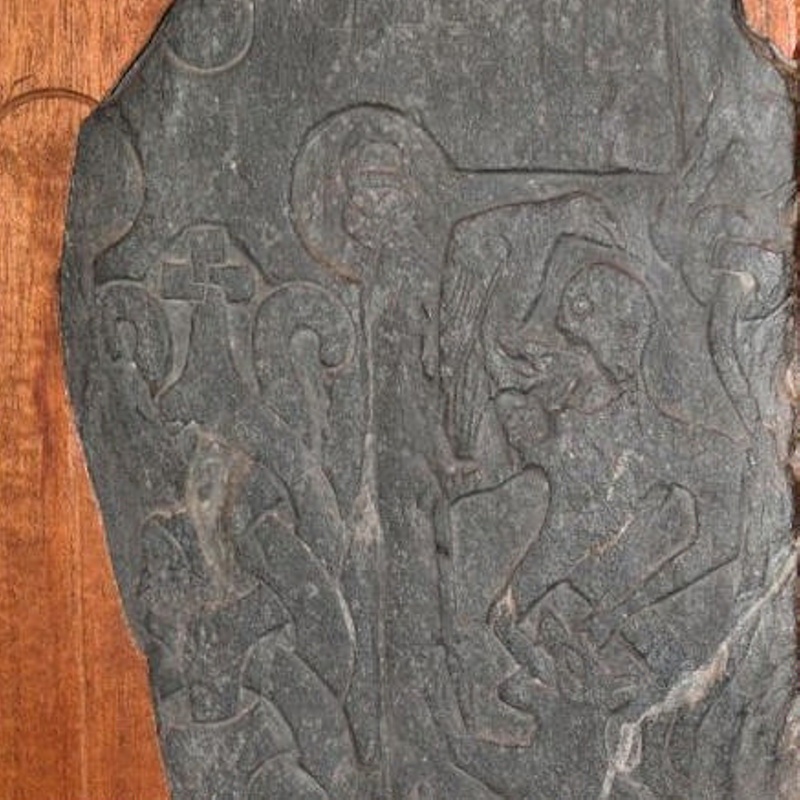
    Thorwald’s Cross, Andreas, Isle of Man

    Abstract

    The Viking Age presence on the Isle of Man has often been interpreted through the prominence of Norse material culture—runic inscriptions, Scandinavian place-names, sculptured crosses, and a Norse-Gaelic kingship—encouraging narratives of deep Scandinavian settlement. This article advances a more constrained and empirically grounded interpretation. Drawing on archaeology, linguistics, place-name scholarship, and recent genetic studies, it argues that Norse rule on the Isle of Man involved real biological incorporation and sustained cultural exchange, but did not result in demographic replacement or language shift. Genetic evidence indicates a substantial Scandinavian-associated male-line contribution, concentrated in a small number of late Viking-Age or early Norse-Gaelic founders, consistent with elite incorporation rather than mass colonisation. Preliminary mtDNA evidence suggests significantly lower Scandinavian female ancestry, supporting a model of male-biased admixture. The Manx case exemplifies Vikingisation without replacement: transformative at the level of rulership and symbolic culture, yet bounded by the resilience of an existing Irish Sea population and its institutions.

    The Manx model further suggests that “Vikingisation without replacement” may represent a broader historical pattern applicable to other marginal or contested zones of Norse influence.

    1. Introduction: Visibility and the Problem of Scale

    The Isle of Man occupies a strategic position in the Irish Sea and was ruled by Norse or Norse-Gaelic elites for approximately three centuries (c. 800–1265). The archaeological visibility of this period—stone monuments, inscriptions, and dynastic traditions—has often been taken to imply extensive Scandinavian settlement. Yet visibility is not equivalent to demographic depth. On small islands, political control may be achieved by occupying coastal, legal, and ecclesiastical nodes without requiring large-scale settler migration.

    The central problem is therefore not whether Vikings ruled Mann—they did—but how that rule scaled socially, biologically, and culturally, and where its limits lay.

    2. Monumental Culture: Hybridity Rather than Erasure

    The most conspicuous Viking-Age artefacts on the Isle of Man are Christian cross-slabs incorporating Scandinavian ornament and Norse mythic scenes. These have often been read as evidence of Norse cultural dominance. A closer reading suggests cultural hybridity within a Christian framework.

    Thorwald’s Cross at Andreas juxtaposes a Ragnarök scene (commonly interpreted as Odin and Fenrir) with explicit Christian symbolism on the opposing face, accompanied by a runic inscription naming the patron. Similarly, the Sigurd cycle slab at Maughold depicts episodes from the Völsunga saga, including the figure identified in antiquarian literature as Loki throwing a stone to kill Ótr.1

    Crucially, these scenes appear within Christian memorial forms. They do not replace Christian monumentality but inhabit it. This pattern may be read in two compatible ways: as Norse elites adapting to local Christian norms, or as already-Christian Norse-Gaels expressing a hybrid identity formed elsewhere in the Irish Sea world. Either reading undermines models of pagan Scandinavian cultural replacement.

    3. Language and Institutions: Continuity with Contact

    The Manx language remained Goidelic throughout and beyond the Viking period. Norse loanwords entered Manx—particularly in maritime, legal, and topographic vocabulary—but there is no evidence of grammatical restructuring or creolisation.2 Ecclesiastical organisation and legal assemblies persisted, evolving through continuity rather than rupture.

    This pattern—lexical influence without structural replacement—is consistent with prolonged elite contact rather than population overturn.

    4. Genetic Evidence: What the Numbers Do—and Do Not—Mean

    4.1 Two non-commensurate genetic measures

    Discussions of Viking genetic impact on Mann often conflate two distinct approaches:

    Admixture modelling, which compares modern Y-chromosome samples to Scandinavian reference populations. Bowden et al. (2008) report a Scandinavian-associated component of 0.39 ± 0.04 for a Manx sample of 62 men3. This figure reflects present-day similarity to Norwegian and Danish reference sets under a particular model.

    Lineage-resolution reconstruction, as undertaken by the Manx Y-DNA Study, which analyses over 560 men bearing documented Manx surnames and reconstructs historical founder lineages.4

    These figures answer different questions and are not numerically interchangeable.

    4.2 Reconciling ~0.39 and ~0.25

    The apparent gap between the two estimates can be resolved straightforwardly. The Manx Y-DNA Study reconstructs a historical peak, estimating that immediately after the end of Scandinavian rule up to approximately one quarter of male lines derived from Scandinavian or North-European founders, while explicitly noting subsequent dilution through later migration.5 By contrast, Bowden et al.’s figure is a present-day admixture estimate, sensitive to sampling variation, shared pre-Viking Germanic ancestry, and the fact that admixture models capture overall similarity rather than discrete founder events.

    The two figures are therefore complementary rather than contradictory.

    4.3 Founder structure and dating

    The most decisive result of the Manx Y-DNA Study is structural. Scandinavian-associated Y-chromosomes are clustered into a small number of founder lineages, rather than diffused across the population. These founders are dated predominantly to c. 1000–1200, based on Y-STR variance, downstream Y-SNP resolution, and correlation with the emergence of hereditary surnames.6

    While such dating is probabilistic and carries uncertainty, the clustering itself is robust. It indicates late Viking-Age or early Norse-Gaelic incorporation rather than ninth-century mass settlement.

    Multiple Manx surname groups descend from single Scandinavian founders: for example, Keig/Skaggs, Oates, Cretney, Curphey, and the southern Cain line all trace to one man of Scandinavian origin who lived on the island circa 1000–1200 CE.7

    4.4 Limits of inference, gender, and patrilineal bias

    Y-chromosome data track only paternal lines. Preliminary mtDNA analysis of Manx matrilines has identified seven lineages (of which four are fully confirmed), with only one showing clear Scandinavian origin—a substantially lower proportion than the approximately 25% observed in patrilines.8 While this mtDNA dataset is far smaller and less methodologically robust than the Y-DNA study, the asymmetry is consistent with male-biased Norse admixture.

    Both Norse and Manx societies were patrilineal in inheritance and naming practices; as a result, Scandinavian female migrants—if present—would be genealogically underrepresented in surname-linked Y-DNA datasets. Nonetheless, Viking-Age genetic studies elsewhere in the British Isles consistently show male-biased admixture,9 and the founder-cluster pattern observed on Mann is most parsimoniously explained by elite Scandinavian men marrying local women rather than by family-group migration.

    Further mtDNA testing is needed to confirm this pattern, but current evidence supports the elite incorporation model.

    5. Mechanism: Why Norse Male Lines Succeeded

    A Scandinavian-associated contribution of roughly a quarter of male lines at peak impact implies genuine reproductive success. The most plausible mechanism is status-mediated incorporation:

    • Viking-Age raiding and trading parties were overwhelmingly male.
    • Elite Scandinavian men controlled maritime mobility, trade, and force.
    • Such men could secure advantageous marriages within local kin networks.
    • Their descendants were then absorbed through surname formation, landholding, and ecclesiastical patronage.

    This mechanism explains both the success of Norse founders and the failure of that success to scale into demographic replacement.

    For comparative context, the Norman Conquest of England appears to have produced a smaller Norman genetic contribution despite far-reaching institutional transformation, while early Anglo-Saxon migration generated Germanic ancestry estimates of roughly 20–40% alongside near-total language shift—illustrating the non-linear relationship between genetic input, political power, and cultural change.

    6. Place-Names: Strategic Settlement and Transmission

    Scandinavian place-names on the Isle of Man are real and significant. Existing scholarship suggests they are disproportionately associated with coastal zones, valleys, and high-status locations rather than evenly distributed across inland agricultural land.10 While detailed quantitative mapping remains limited, this apparent concentration is consistent with strategic settlement, estate allocation, and transmission via Irish Sea networks (including north-west England), rather than uniform agrarian colonisation.

    The contrast with Orkney or Iceland—where Norse place-names dominate the entire landscape—is instructive.

    7. Institutions and Identity: From Norse Rulers to Manx Elites

    The foundation of Rushen Abbey in 1134 by Olaf I, King of Man and the Isles, demonstrates not early Viking statecraft but full integration into European Christian norms.11 By this date, Norse ancestry functioned less as a marker of external domination than as one strand within a Manx elite identity.

    This temporal perspective is essential: over the course of three centuries, Norse rulers became Norse-Gaels and ultimately Manx elites of mixed descent, embedded within the island’s institutional and social fabric.

    8. Comparative Perspective

    Comparative evidence places the Isle of Man between two extremes:

    Regions such as Orkney and Shetland, where Scandinavian settlement produced language shift and broad genetic dominance (Bowden et al. report Scandinavian ancestry proportions around 0.50 ± 0.03 for Orkney)12.

    Regions such as most of Ireland, where Norse impact was politically significant but demographically slight.

    Mann occupies an intermediate position: real Norse incorporation, but bounded, structured, and ultimately absorbed. Geography, timing, and a crowded Irish Sea political environment constrained settler viability.

    9. Conclusion: Transformative without Substitution

    The Viking Age transformed the Isle of Man, but it did not replace its people.

    Genetic evidence indicates a substantial Scandinavian-associated male-line contribution, reconstructed at roughly a quarter at peak impact and appearing higher in present-day admixture models due to methodological differences. This contribution is concentrated in a small number of late Viking-Age or early Norse-Gaelic founders. Preliminary mtDNA evidence suggests significantly lower Scandinavian female ancestry, consistent with male-biased elite incorporation. Archaeology reveals cultural hybridity within Christian forms; language and institutions demonstrate continuity with contact; place-names and settlement patterns indicate strategic occupation rather than blanket colonisation.

    The Isle of Man thus exemplifies Vikingisation without replacement: Norse rule was real, consequential, and transformative, yet it operated within—and ultimately became part of—a resilient Irish Sea society that retained its demographic and linguistic core.


    References

    1. : Kermode, P. M. C. (1907). Manx Crosses. London: Bemrose & Sons. ↩︎
    2. : Broderick, G. (1999). Language Death in the Isle of Man: An Investigation into the Decline and Extinction of Manx Gaelic as a Community Language in the Isle of Man. Tübingen: Max Niemeyer Verlag. ↩︎
    3. : Bowden, G. R., Balaresque, P., King, T. E., Hansen, Z., Lee, A. C., Pergl-Wilson, G., Hurley, E., Roberts, S. J., Waite, P., Jesch, J., Jones, A. L., Thomas, M. G., Harding, S. E., & Jobling, M. A. (2008). Excavating past population structures by surname-based sampling: the genetic legacy of the Vikings in northwest England. Molecular Biology and Evolution, 25(2), 301-309. ↩︎
    4. : Cannell, R. et al. (2020). Manx Y-DNA Study: Results Summary and Analysis. Isle of Man Studies: Proceedings of the Isle of Man Natural History and Antiquarian Society, Vol. XVII. Available at: https://www.manxdna.co.uk/ ↩︎
    5. : Cannell et al. (2020), section 5.2.1: “approximately a quarter of the men of this early population, immediately after the end of Scandinavian rule, of the Isle of Man, with male descendants surviving today, had male ancestors who previously came from Scandinavia and Northern Europe.” ↩︎
    6. : Cannell et al. (2020), sections 5.2.2 and 5.3.2. ↩︎
    7. : Cannell et al. (2020), section 5.3.2: “Keig/Skaggs, Oates, Cretney, Curphey, Cain (southern line), Cormode and Curphey. These male lines are all descended from one man of Scandinavian origin (haplogroup R1a) who must have lived on the Island in the period 1000-1200AD.” ↩︎
    8. : Cannell et al. (2020), Manx Matrilineal DNA Analysis section. The study identifies seven matrilines with only H5a1m showing clear Scandinavian origin: “The genetic origin of this matriline is Scandinavian, making it highly likely that the Manx line originated from a Viking woman who settled on the Island.” ↩︎
    9. : Capelli, C., Redhead, N., Abernethy, J. K., Gratrix, F., Wilson, J. F., Moen, T., Hervig, T., Richards, M., Stumpf, M. P., Underhill, P. A., Bradshaw, P., Shaha, A., Thomas, M. G., Bradman, N., & Goldstein, D. B. (2003). A Y chromosome census of the British Isles. Current Biology, 13(11), 979-984. ↩︎
    10. : Fellows-Jensen, G. (1983). Scandinavian settlement in the Isle of Man and north-west England: the place-name evidence. In C. Fell, P. Foote, J. Graham-Campbell, & R. Thomson (Eds.), The Viking Age in the Isle of Man (pp. 37-52). London: Viking Society for Northern Research; Fellows-Jensen, G. (2013). The mystery of the bý-names in Man. Nomina, 36, 77-94. ↩︎
    11. : University of Liverpool, Rushen Abbey Excavations project. The abbey was founded in 1134 by Olaf I, King of Man and the Isles, as part of bringing the kingdom into alignment with European Christian norms. ↩︎
    12. : Bowden et al. (2008), Table 2 and supplementary materials. ↩︎

    Additional references consulted:

    Cregeen, A. (1835). A Dictionary of the Manks Language. Douglas: Quiggin.

    Duffy, S. & Mytum, H. (eds.) (2015). A New History of the Isle of Man, Vol. 3: The Medieval Period, 1000–1406. Liverpool: Liverpool University Press.