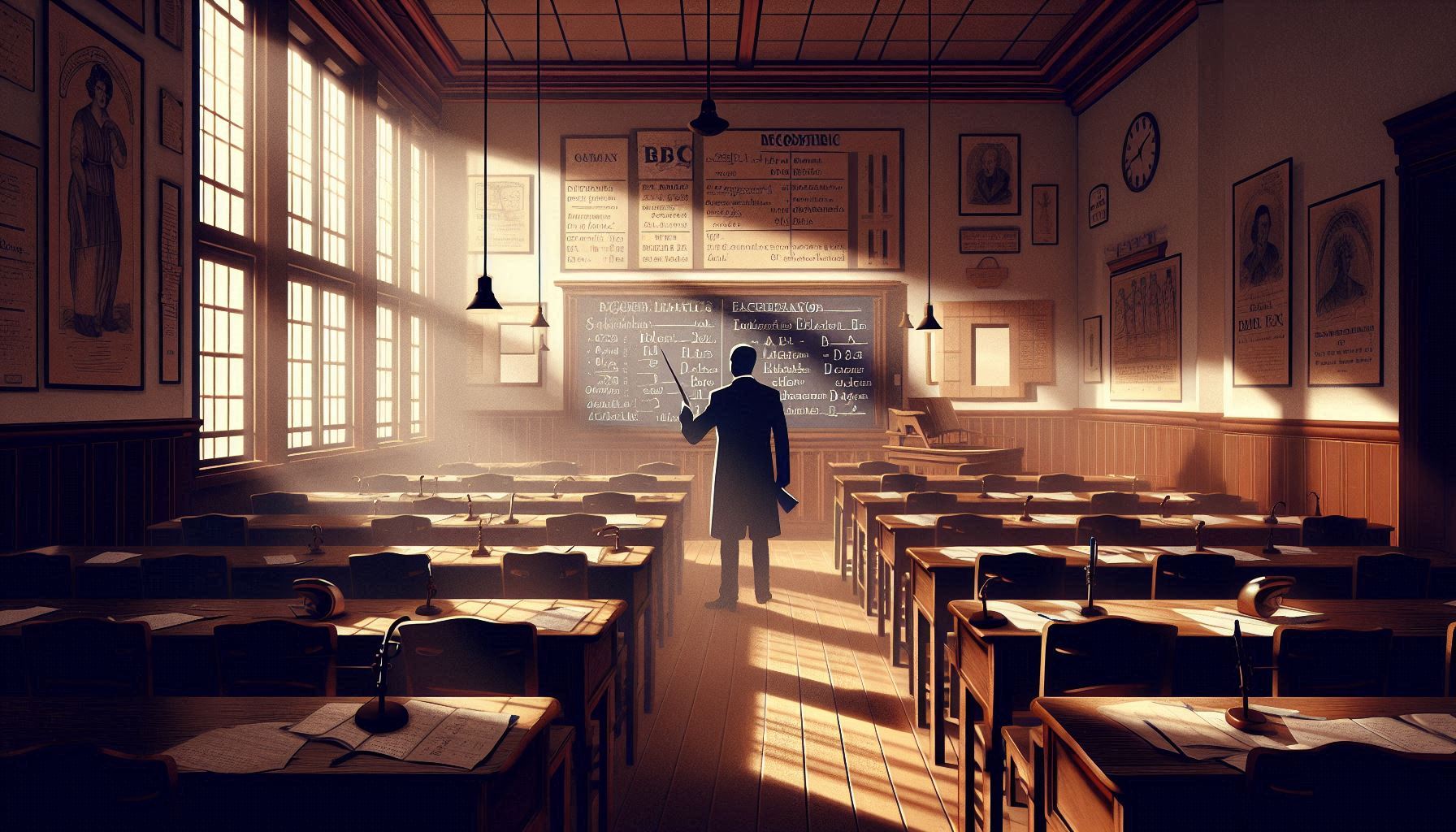
From the 1960s through the 1990s, Britain produced a comic tone so distinctive that it briefly defined the nation’s sense of humour. You can trace the line cleanly:
Waugh → Beyond the Fringe → Python → Cook → Atkinson → Morris → early Iannucci
The continuity isn’t about class, or poshness, or “Britishness.” It’s about a very specific linguistic and institutional training that is now mostly gone.
This humour had three hallmarks:
1. Mock-authoritarian delivery
2. Linguistic precision as a weapon
3. Casual, performative cruelty
It was a voice forged in schools and institutions where people learned the cadence of authority before they learned to parody it. And that’s why it flourished — and why it faded.
1. What This Humour Actually Was
The core mechanic was simple and devastating:
Speak the voice of authority perfectly — and let the perfection reveal the absurdity.
Examples:
- Cleese’s Latin master eviscerating Brian for a grammatical error.
- Peter Cook delivering cosmic boredom with aristocratic detachment.
- Rowan Atkinson’s schoolmaster turning syntax into psychological assault.
- Chris Morris as the newsreader-as-prefect, dispensing nonsense with nuclear gravitas.
The humour wasn’t “posh sneering.” It was the joy of performative, ritualised cruelty delivered with the precision of someone fluent in the machinery of hierarchy.
2. Where It Really Came From
Not privilege. Not class superiority.
But from an educational ecology that rewarded:
- classical instruction,
- grammar knowledge,
- rhetoric,
- debate,
- formal speech codes,
- institutional theatre.
Public schools and grammar schools produced teenagers fluent in:
- mock formality,
- hierarchical cadence,
- performative superiority,
- precision language.
This training created performers who could effortlessly channel:
- headmaster,
- bureaucrat,
- prefect,
- BBC announcer,
- Oxbridge debater.
By the time they reached Footlights, they were already trained comedic killers.
3. Why Audiences Loved It — Even Without That Background
The mystery is why this humour resonated nationally, not just within its originating class structure.
Because its dynamics were universal:
- Everyone has been humiliated by a teacher.
- Everyone knows a petty authority figure.
- Everyone has endured bureaucratic nonsense.
- Everyone recognises smug hierarchy.
You didn’t need Latin to understand being barked at. You just needed to have lived under a boss.
The tone was elite. The experience was not.
4. The Golden Lineage
The style cohered into a continuous tradition:
Beyond the Fringe
The first modern satire: educated voices wielding authority against itself.
Monty Python
Authority as farce, pedantry as violence, languages as toys.
Peter Cook
The ultimate bored tyrant; the aristocrat who knows your place better than you do.
Rowan Atkinson
Precision timing + hierarchical cruelty = devastating.
Chris Morris
The final, weaponised form: the prefect’s fury merged with the newsreader’s authority.
Early Iannucci (The Day Today, On the Hour)
Systems-thinking satire delivered in the old register — but already mutating into something new.
Then the tone receded.
5. Why It Receded (No Culture-War Handwaving Required)
Three structural changes explain everything.
A. The shared curriculum dissolved
When fewer people learn:
- grammar,
- classical references,
- formal rhetoric,
the performance loses its codebook. You can’t parody registers your audience no longer recognises.
B. Authority lost its dominant voice
For a century, Britain had a recognisable “official” tone: BBC RP, legal cadence, headmaster patter.
By the 2000s, national speech diversified. Parodying a style works best when everyone knows the style.
C. Comedy turned inward
Old comedy: “Authority is absurd.”
New comedy: “I am broken.”
The shift from external hierarchy → internal anxiety is the real divide.
- Peep Show is the turning point: Mark Corrigan is the anti-Python — the authority turned inward until it collapses.
- The Office finishes the job: embarrassment replaces pedantry as the primary British comedic lever.
Hierarchy didn’t disappear. But its comic centrality did.
6. It Didn’t Die — It Mutated
The DNA survives:
- Stewart Lee – linguistic sadism slowed to ritual pace.
- The Thick of It – hierarchical brutality, now in political jargon instead of Latin.
- Mitchell & Webb – occasional masterpieces of bureaucratic cruelty.
But this style is now niche — an artistic dialect rather than the national register.
A Note on Macfadyen and Succession
One fascinating outlier: Matthew Macfadyen’s performance in Succession.
Though he plays an American, everything about Tom Wambsgans — the brittle politeness, the clipped authority, the misapplied formality, the prefect’s cruelty turned inward — is pure British institutional cadence. A direct descendant of the Python/Cook/Morris lineage transplanted into HBO prestige drama.
American comedians like Tim Dillon adored it without ever recognising the lineage. They simply recognised the power of the tone.
This is what happens when the old register is placed in a culture that still has ears for hierarchy, even if it doesn’t have the original institutions.
7. Was It Actually a Loss?
The truthful answer reaches deeper than preference.
This humour came from a Britain that was, in its institutions and its self-conception, sharper. More verbally disciplined. More structurally aware. More capable of holding the tension between cruelty and wit, hierarchy and absurdity, formality and ridicule.
When the ecosystem that trained that voice thinned out, part of the national imagination thinned with it. Not just a comic style — but a way of seeing:
- power as theatre,
- language as weapon,
- hierarchy as both ridiculous and revealing,
- authority as something to be dismantled through precision, not outrage.
You can still see flickers of it — in Stewart Lee, in the best of Iannucci, and even in Matthew Macfadyen’s Tom Wambsgans in Succession, a role constructed entirely out of that old British register disguised in American clothing.
But they feel like survivors, not heirs.
The tradition didn’t die because Britain became softer. It died because Britain became blurrier. The institutions that trained people to speak authority fluently enough to parody it disappeared — and with them, a very specific national clarity.
Something was lost. Quietly, structurally, and irreversibly.
Not nostalgia. Just observation.
https://thinkinginstructure.substack.com/p/the-comedy-voice-britain-lost-how