Introduction: The Puzzle Barbados Poses
By the middle of the nineteenth century, the British Caribbean offered a clear pattern. Emancipation destabilised plantation regimes; labour withdrew; planter classes fractured; representative institutions were abolished; Crown Colony rule expanded. Jamaica lost its Assembly after Morant Bay in 1866. Similar trajectories unfolded across much of the region. Barbados did not follow this path.
Emancipation in 1834 did not dismantle the planter class. Sugar production did not collapse; it increased. White planters did not depart en masse. The island retained its elected House of Assembly long after other colonies surrendered theirs. Governance remained local, continuous, and—by the standards of the time—remarkably effective.
This presents a historical puzzle. Barbados should not have been stable, if the dominant Caribbean narrative holds. And yet it was.
This article argues that the solution to this puzzle lies not in ideology or benevolence, but in administration. Nineteenth-century Barbados was governed through routine, procedure, and paperwork. That governance left an enormous documentary trace—but one that has been consistently misread because historians have looked for drama where the island produced continuity.
Barbados as a Comparative Outlier
F. A. Hoyos’ Barbados: A History from the Amerindians to Independence is essential precisely because it situates Barbados against the wider Caribbean trajectory. Hoyos shows, repeatedly and explicitly, that Barbados diverged from regional norms:
- Emancipation did not destroy the planter class
- Sugar output rose significantly in the post-emancipation decades
- Labour costs were controlled rather than explosively rising
- Planters were overwhelmingly resident, not absentee
- Barbados retained its Assembly while Jamaica, Antigua, Dominica, and others moved to Crown Colony rule
Hoyos is clear that this was not an accident. Barbados was governed by men who were not aristocratic dilettantes but managers: agriculturally knowledgeable, legally fluent, financially cautious, and deeply invested in maintaining constitutional autonomy.
Crucially, Hoyos documents that imperial officials noticed this. Governors repeatedly praised the Barbadian Assembly for its “business-like qualities of true Parliamentary life,” even while pushing reforms elsewhere. Barbados was treated as administratively exceptional.
This is the comparative frame without which the Barbadian administrative record—most visibly preserved in its newspapers—does not fully make sense. The record is not merely orderly because stability existed; stability existed because administration was effective.
Geography as Structural Power
Barbados was not merely socially distinct; it was geographically constrained in ways that fundamentally shaped governance.
Unlike Jamaica, Barbados had:
- no mountainous interior
- no extensive bush land
- no crown land available for settlement
- no viable space for maroonage or autonomous peasantry
Hoyos emphasises this repeatedly. After emancipation, ex-slaves had nowhere to go. Land was already fully enclosed, intensively cultivated, and privately owned. There was no internal frontier. This mattered enormously.
In Jamaica, mountainous geography allowed labour withdrawal, maroon communities, and alternative subsistence. In Barbados, withdrawal meant starvation. Labour discipline could therefore be maintained with minimal overt coercion. Exit was structurally impossible.
This geographic fact explains why the administrative record appears so calm. Violence did not vanish; it became unnecessary to display. Constraint did the work.
The Strategic Advantage of Administrative Silence: Barbados and Saint-Domingue
Barbados’s survival becomes clearer when set briefly against Saint-Domingue, where planter power collapsed with extraordinary violence. The contrast is not one of cruelty—both societies were brutal—but of elite strategy under pressure.
In Saint-Domingue, a large, educated creole population closely followed metropolitan debates during the French Revolution and articulated claims to political equality in the language of universal rights. White authority was defended, challenged, and reformulated in ideological terms. Once domination entered the realm of principle, it became contestable. Appeals to equality fractured white solidarity and opened conceptual space that enslaved people could also occupy. Power, once argued for, became vulnerable.
Barbados followed the opposite course. Its white elite remained numerically small, racially rigid, and ideologically restrained. There were no manifestos defending planter prerogative, no appeals to natural hierarchy, no local adaptations of Enlightenment theory. Authority was not explained; it was enacted. Rule operated through procedure, property law, labour discipline, and routine administration rather than argument.
This refusal to theorise power—to make rule visible as rule—proved strategically decisive. Where Saint-Domingue’s creole politics rendered domination thinkable and therefore breakable, Barbadian governance preserved itself by remaining untheorised. Power did not collapse because it never presented itself as an idea to be contested.
This difference helps explain why Barbados avoided the revolutionary trajectory of Haiti and instead produced the administratively dense, quietly coercive system visible in its newspapers.
Newspapers as Administrative Infrastructure
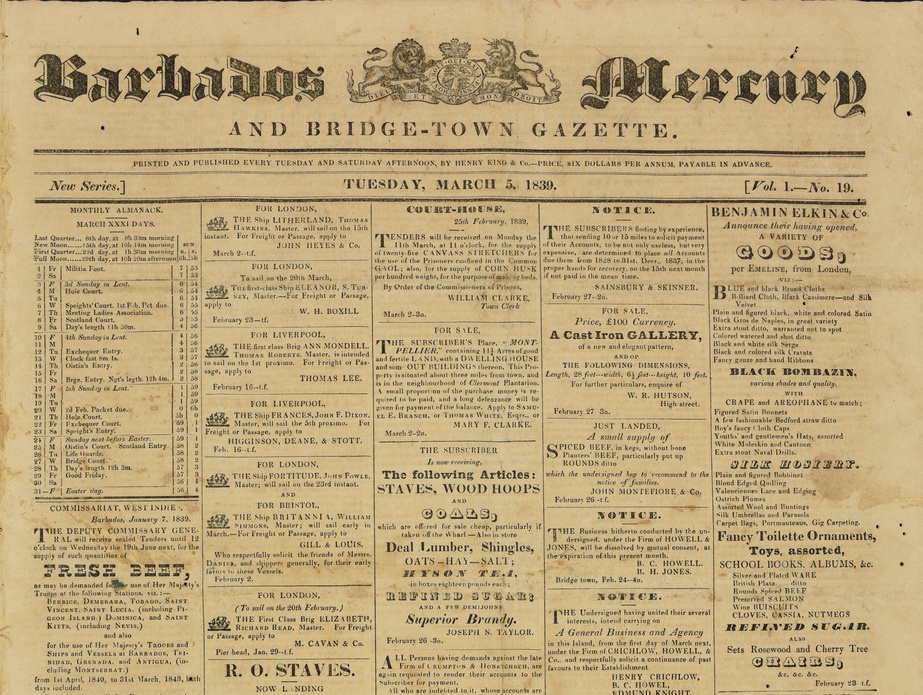
Against this backdrop, the Barbadian newspapers reveal their true function. Titles such as The Barbadian and Barbados Mercury were not platforms for persuasion. They were operating manuals for governance.
A typical issue is dominated by:
- chancery notices
- land sales
- probate announcements
- shipping intelligence
- Assembly adjournments
Editorial voice is minimal. Explanation is absent. Authority is assumed.
This is not political thinness. It is political confidence.
Assembly Without Drama (A Working Machine)
On Saturday, June 8, 1839, The Barbadian reported a sitting of the House of Assembly. Present were the Hon. Mr Speaker Hinds and Messrs. Briggs, Barrow, Walcott, Nurse, A. H. Morris, Clarke, Bovell, Goding, Rogers, Taylor, Applewhaite, Sharp, Donovan, and Gaskin.
The central issue was not emancipation, labour, or imperial reform, but whether the printer of the Liberal should be paid for work already ordered. Motions were made, seconded, resolved. The House adjourned.
This is not triviality; it is evidence. Governance functioned through routine because the governing class was cohesive. Decisions did not require persuasion because interests were aligned.
As Hoyos puts it, the Assembly exhibited the “business-like qualities of true Parliamentary life,” a judgment that is decisive here. Short sessions were a sign of success, not disengagement. Barbados governed efficiently because it could.
Chancery as the Core of Power
If the Assembly shows form, Chancery shows substance.
In a single newspaper issue, one might find:
- Gaskin and Wife v. Gibbes and Wife and Others — Colleton’s Plantation, stock and premises, St Lucy
- Bovell and Others v. Rollock, the Younger — Chance Hall Plantation, St Lucy
- Hinds v. Bovell (Administrator) — Hope Plantation, St Lucy
- Wilson and Others v. Halls — a sugar-work plantation, St Michael
These are not crises. They are routine reallocations of capital. The same surnames recur in rotating legal roles: litigant, executor, administrator, trustee. Women appear primarily as conduits of property transmission. Labour appears only as “stock.”
This is elite self-management, not breakdown.
Geography Becomes Authority: The Gaskin Example
Land sale advertisements make this visible spatially. When Piggott’s estate in St James is offered for sale, its boundaries are defined not abstractly but relationally:
“…butting and bounding on the Lands of Benjamin Gaskin, Esq., Sandy Lane, Black Rock, and Holder Plantations…”
Gaskin is not selling. He is not speaking. He is not explained. His name functions as cartography.
Power here is so normalized it has become geographical fact.
Administrative Smoothness and the Displacement of Violence
The calm of the archive is not moral calm. Hoyos is explicit that apprenticeship was “rigidly and severely administered.” Ex-slaves had no land, no exit, no leverage. Sugar production increased precisely because labour could not withdraw.
This explains the newspapers’ silence. Violence had been structurally embedded—into geography, property law, wage dependence, and judicial routine. The smoother the administrative record, the more completely coercion had been displaced elsewhere.
Administrative competence does not mitigate injustice. It explains durability.
Surnames, Visibility, and the Archive’s Trap
One methodological warning is essential. The recurrence of surnames—Hinds, Gaskin, Bovell, Walcott—does not indicate demographic continuity. Enslaved people took the surnames of owners. After emancipation, those surnames proliferated among black Barbadians with no blood connection to elite families.
The archive tracks legal relevance, not lineage. Newspapers show who owned, administered, litigated, and bounded land—not who constituted society.
Why This History Was Misread
This history did not vanish. It was misclassified.
Historians have privileged rupture. Barbados offers continuity. Historians have looked for resistance in print. Barbados displaced coercion into structure. Historians have sought ideology. Barbados governed through procedure.
The newspapers were read—and dismissed—as boring. In fact, they record power operating at its most effective.
Conclusion
Barbados was governed for centuries by an explicitly racist, morally indefensible elite. That elite was also administratively competent, geographically advantaged, and legally sophisticated. Those facts coexist.
Understanding how domination endures requires understanding how it becomes ordinary. Barbados shows us a system that survived not because it was just, but because it was managed.
The history did not disappear. It sat in plain sight, printed weekly, waiting for someone to take routine seriously.
Acknowledgments:
Barbados archives:
https://dloc.com/collections/ibarbadosarchdept
F.A. Hoyos: