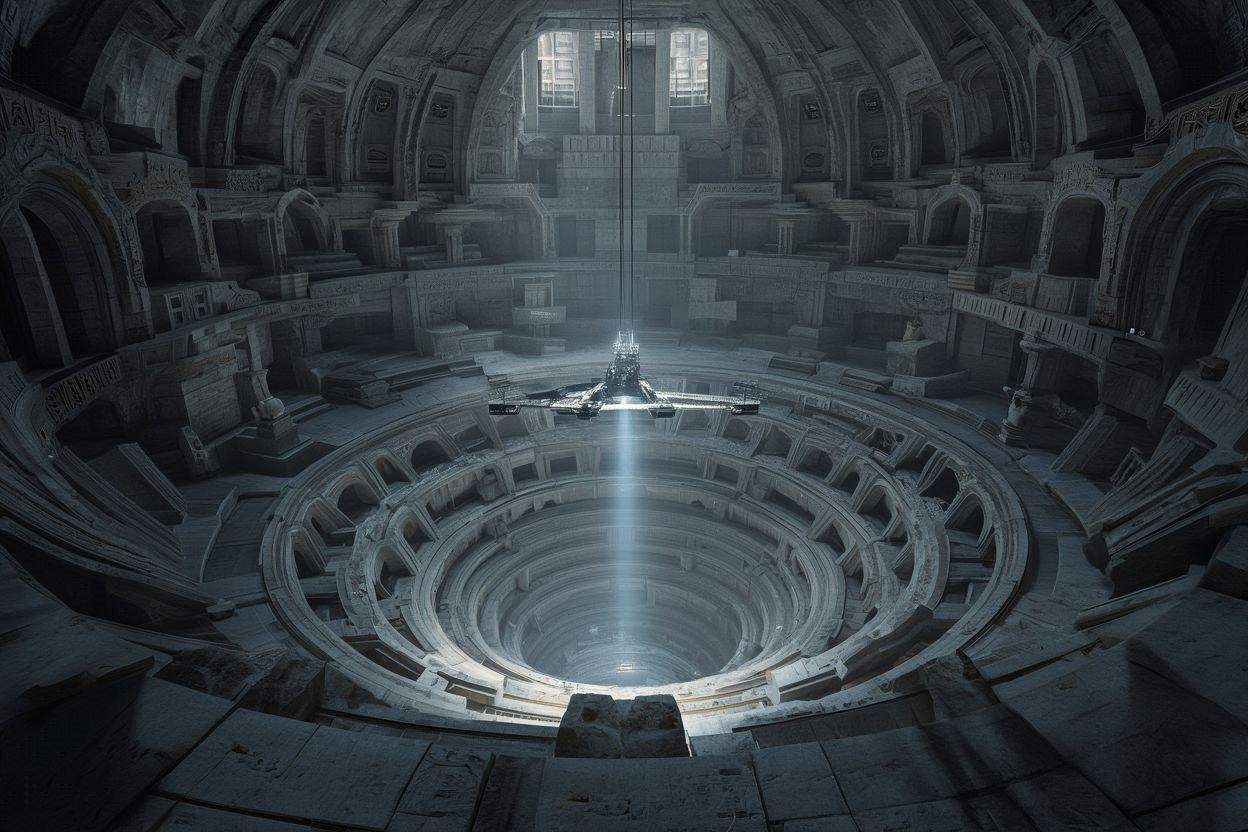
Why Modern Mathematics Perfects Enclosure Instead of Creating Tools
Modern mathematics does not lack intelligence, effort, or technical sophistication. It lacks something more specific and more consequential: institutional conditions that reliably reward coordinate change over internal refinement. This distinction explains why the field can feel simultaneously brilliant and inert—crowded with giants, yet short on transformations that propagate beyond the guild.
1. Two Types of Mathematical Achievement
Mathematical contributions fall into two epistemically distinct classes.
Terminal achievements resolve a specific, historically salient problem within an inherited framework. They are definitive, canonically legible, and evaluable by existing standards of rigor. They represent the closing of a book.
Generative achievements introduce new representational coordinates, collapse multiple problem classes into reusable form, or lower cognitive cost across domains. They do not merely answer questions; they redefine what counts as a question. They function as engines rather than monuments.
Both require depth. Only the second reliably produces leverage beyond a narrow community.
2. The Wiles Paradigm: The Magnetism of Closure
The proof of Fermat’s Last Theorem by Andrew Wiles represents terminal achievement at its most refined. Even where such achievements consolidate powerful machinery—as Wiles’s work did via the modularity theorem—the institutional recognition attaches to the closure, not the machinery. The reward signal points backward, toward the resolution of a centuries-old riddle, rather than outward toward the new landscapes the bridge might reach.
This case is archetypal because it aligns perfectly with modern evaluation: correctness is binary, assessment is local, and prestige is absolute.
3. The Legibility Tax and the Lost Heuristic Bridge
Historically, generativity often preceded terminality. Figures such as Euler or Heaviside introduced new operational coordinates long before those coordinates could be formalized. Their work was initially blurry, illegal by later standards, and indispensable in hindsight.
That heuristic bridge is now largely burnt. If a new coordinate system cannot be immediately expressed in formally closed, axiom-compliant terms, it is treated as non-existent. Because generative tools are typically indistinct at inception while terminal results are sharp, the institutional preference for sharpness suppresses tools before they mature. Exploration velocity has been traded for verification security.
4. Pathological Consequences
A field dominated by terminal optimization will display predictable symptoms:
- Exploding prerequisites: entry costs rise as new researchers must internalize ever-larger monument complexes.
- Diminishing cross-field migration: tools become hyper-specialized and non-exportable.
- Low-variance tooling: methods accelerate existing proof strategies without reducing problem dimensionality.
- Prestige concentration: rewards cluster around definitive closure rather than language creation.
These are not sociological complaints. They are structural predictions.
5. Generativity and the Identity Threat
Generative coordinate change is not merely novel; it is compressive. It reduces the effective dimensionality of a landscape. For a specialist guild, this creates an identity threat: a successful compression can retroactively render decades of expertise redundant.
Tools that re-encode a field without erasing its practitioners are more likely to be adopted than those that redraw the boundary conditions entirely. Generativity is tolerated when it accelerates insiders without invalidating them.
6. Boundary Cases of Generativity
Generative coordinate change has not vanished entirely. It survives in a small number of boundary cases where heuristic power outruns immediate formal closure.
Two canonical examples are Michael Atiyah and Edward Witten. Atiyah’s work repeatedly introduced transportable machinery—most notably index theory—that collapsed distinctions between topology, geometry, and analysis, lowering cognitive cost across multiple fields rather than resolving a single terminal problem. Witten, operating from theoretical physics, injected heuristic structures into mathematics that generated entire toolchains—topological quantum field theory, gauge–geometry correspondences, mirror symmetry—long before they could be canonically sealed.
These figures do not refute the optimization pathology; they delineate its boundary conditions. Both operated under exceptional protection: Atiyah in a period of institutional slack, Witten with physics providing an external legitimacy channel that deferred mathematical verification. Their generativity was tolerated because its validation was displaced in time, space, or discipline.
The relevant observation is not that such figures exist, but that they no longer constitute a stable, reproducible pathway. What once functioned as a pipeline has become an anomaly.
7. Local Verification and Global Coordinate Failure
At its core, the optimization pathology is a failure of topology. Local verification suppresses global coordinate descent. The system is so effective at validating the next step that it forbids the leap to a new coordinate system in which the entire landscape would be simpler to traverse.
Peer review need not be corrupt to be conservative. It need only be local. A truly generative tool collapses hierarchies, and in doing so, threatens the value of the hierarchies themselves.
Conclusion: From Altar to Engine
Modern mathematics has mistaken the altar for the engine. It builds cathedrals of terminal proof—stunning, coherent, and static—while systematically underproducing the machines that once allowed mathematics to remake the world.
Generative coordinate change has not disappeared, but it has become an anomaly rather than an output: dependent on individual insulation, external legitimacy, or historical timing rather than institutional support. Until structures are realigned to reward compression with uptake, mathematics will continue to grow inward—more refined, more complete, and increasingly detached from the transformations that once defined its power.