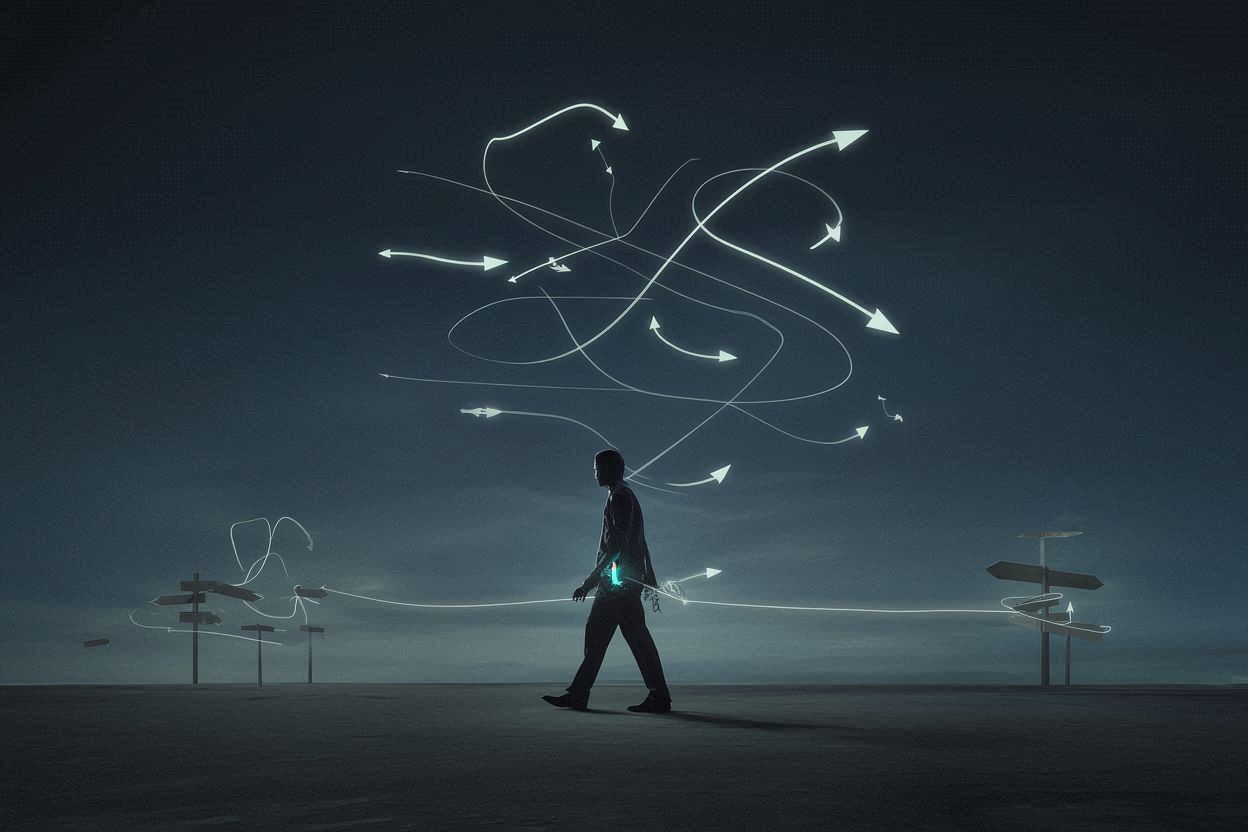
Angles added. Order did not matter. Rules instructed but never resisted.
That world was Abelian.
Now something genuinely new appears.
1. A QUIET UPGRADE OF THE BUCKLE
Up to now, Mario’s buckle behaved like a single angle — a mark on a circle.
That was enough when the internal space had only one direction.
But the internal space has changed.
It now has multiple independent directions, and rotations among them no longer commute.
From this point on, Mario’s “buckle” must be understood differently.
It is no longer just an angle he rotates with. It is a full internal orientation — something with structure, like a small gyroscope that Mario carries as he moves.
Nothing about Mario’s role has changed. Gauge transformations still rotate Mario, the buckle, and the world together.
What has changed is how much structure the buckle can hold.
With that understood, Mario takes his next step.
2. WHEN ORDER STARTS TO MATTER
Mario notices it in the smallest possible experiment.
He takes two tiny steps:
one east, then one north
then the same two steps in the opposite order
He returns to the same point.
But the orientation of his internal gyroscope is different.
This never happened before.
In the earlier world, rotations simply added. Here, the order of rotations matters.
Concretely, this is all non-commuting means.
Rotate the gyroscope 90° around one internal axis, then 90° around another. Now do the same two rotations in the opposite order.
You end up in different orientations.
The steps are identical. Only the order changed.
Rotation order test:
   Start
     |
     v
   [ A ]  then  [ B ]   → Orientation 1
   Start
     |
     v
   [ B ]  then  [ A ]   → Orientation 2
Orientation 1 ≠ Orientation 2
This failure of order-independence is the defining feature of a non-Abelian world.
3. WHAT ACTUALLY CHANGED IN THE FIBRE
Nothing happened to the plane. Nothing happened to Mario.
What changed was the symmetry of the fibre.
The internal space is no longer governed by a commutative rule. Its transformations no longer cancel cleanly.
There are now:
multiple independent internal directions
rotations that interfere with one another
a meaningful distinction between “do A then B” and “do B then A”
This is what “rich internal geometry” really means.
Not extra dimensions. Not abstraction.
Just structure that does not commute.
4. REPRESENTATIONS: WHO CAN PUSH BACK — AND WHO CANNOT
Up to now, Mario has treated all buckles as if they were the same.
They are not.
He realises this when two travellers pass through the same region.
Both carry buckles. Both read the vanes. But only one of them leaves a trace behind.
This difference is not about strength. It is about what kind of buckle they carry.
TWO KINDS OF BUCKLES
Some buckles behave like this:
they read the vanes
they rotate as instructed
they leave the vanes unchanged
Others behave differently:
they read the vanes
they rotate as instructed
their own orientation alters nearby vanes
Mario realises that some buckles are passengers, and some are participants.
In physics language, this distinction is called a representation.
Matter fields carry buckles that transform under the symmetry.
Gauge fields carry buckles that are built from the symmetry itself.
The second kind are special.
They do not merely live in the internal space. They define it.
That is why the vanes can now push back.
5. WHY THE VANES NOW PUSH BACK
In the original world, vanes were passive.
They gave instructions. They never reacted.
Now they do.
Each vane carries internal orientation. Each vane responds to other vanes.
So when Mario walks:
the instructions he receives depend on neighbouring instructions
the rules modify the rules
This is not an added feature.
It is the inevitable consequence of non-commuting symmetry.
The vanes push back because they themselves carry the charge they enforce.
Abelian loop (U(1)):
   → → →
   ↑     ↓     Transport depends only on path
   ↑     ↓
   ← ← ←
Non-Abelian loop:
   → → →
   ↑  ↺  ↓     Transport depends on order
   ↑     ↓     Vanes interfere
   ← ← ←
This is the geometric origin of gauge-boson self-interaction.
6. THE LAST GREAT GEOMETRIC SUCCESS: ASYMPTOTIC FREEDOM
Before geometry reaches its limit, it delivers one final and extraordinary insight.
At very short distances, Mario notices something unexpected.
The vanes crowd together. Their instructions interfere. Their effects partially cancel.
Because the vanes themselves carry charge, their fluctuations counteract the influence of matter fields rather than reinforcing it.
At short distances, the rules undo themselves.
The closer Mario probes, the weaker the effective influence becomes.
This weakening is computed directly from the non-Abelian structure.
It is called asymptotic freedom.
Here, geometry and dynamics align perfectly.
7. WHERE GEOMETRY STOPS
Now Mario tries the opposite experiment.
He attempts to separate two coloured buckles.
He expects the resistance to weaken with distance.
It does not.
The vanes between them do not relax. They reorganise.
Each attempt to pull apart excites more of the internal structure, not less.
Energy accumulates linearly with separation.
A string forms — not as metaphor, but as a real configuration with measurable tension.
[ colour ]=====[ flux tube ]=====[ colour ]
     energy grows with distance
     no isolated charges
This is confinement.
And here, geometry reaches its limit.
8. WHY CONFINEMENT IS NOT GEOMETRIC
Geometry explains why the rules can push back.
It does not explain how hard they push.
The fact that the force does not fall off — that the potential grows linearly — is not a geometric statement.
It is dynamical.
In the infrared regime:
the coupling grows strong
perturbation theory fails
intuition gives way to calculation
Confinement is confirmed numerically.
Lattice QCD computes it directly: the energy of a static quark–antiquark pair rises linearly with separation, with a string tension of order one GeV per femtometre.
A full analytic derivation remains open.
This is not a failure of understanding. It is an honest boundary of current knowledge.
9. WHY COLOUR CONFINES BUT THE WEAK FORCE DOES NOT
Mario notices one last distinction.
In some internal spaces, flags appear. In others, they never do.
The weak vanes encounter a flag. They are anchored. Some gain mass.
The colour vanes never encounter such a flag.
There is no vacuum direction in colour space to align against.
The Standard Model simply contains no fields that carry colour charge and are able to acquire a vacuum expectation value.
In fact, the strong dynamics of colour make such symmetry breaking self-defeating: any would-be coloured Higgs would itself be confined, preventing it from serving as a global vacuum reference.
So the symmetry is never hidden — only enforced more violently.
10. WHAT WE KNOW — AND WHAT WE DON’T
At short distances, the theory is under complete control. At long distances, we calculate rather than derive.
Asymptotic freedom is proven. Confinement is observed and simulated.
An intuitive, geometric introduction to gauge symmetry and the Higgs mechanism Part 1
Physics is often taught algebra-first and intuition-last. Here is the opposite: the geometry first, visible and concrete.
Nothing here is metaphorical handwaving. Mario’s world is what a gauge theory looks like when you can see the fibres.
1. MARIO’S WORLD AND THE WEATHER VANE SIGNPOST
Mario walks on a perfectly flat infinite plane. He wears a belt, and the buckle has an orientation around his waist — a direction in his internal space.
Above every point stands a pole with a weather
↑     ↗     →     ↘     ↓
  ●     ●     ●     ●     ●
Every morning the vanes reorient randomly.
Mario notices something strange:
He can see each vane’s angle, but nothing physical depends on it. Only how he rotates his buckle in response to the vane matters.
The vane is not a force, not a field: it is a signpost, an instruction.
The weather vane is not a physical object. It is a rule telling Mario how to rotate his buckle when he moves.
This rule is the gauge connection A_μ. The buckle’s angle is the internal direction of a field.
1.6 WHAT THE FIBRE REALLY IS
Above every point on the plane is an attached internal circle — the fibre. Mario’s buckle direction is a point on this circle.
The fibre is the circle Mario carries everywhere — the soft round line of his belt.
It is his hidden direction-space, a small private compass he brings from point to point.
Nothing physical lives on this circle at first; only Mario’s buckle direction marks a place upon it.
Gauge transformations simply relabel that circle. They do not change the physics or the buckle itself.
2. WALKING A LOOP: HOW CURVATURE APPEARS
When Mario walks from A to B:
The vane at A tells him: “Rotate your buckle by +δ.”
This instruction is read as Mario departs the point and acts on his buckle during the infinitesimal step itself; it is a local rule for how internal directions are transported along paths.
He obeys.
At B, the next vane gives a new instruction. He continues around a small square:
A: ↑ —— east ——→ B: ↗
|                |
|                |   ← Mario walks this loop
south           north
|                |
↓                ↓
D: → ←— west —— C: ↘
Returning to A, he checks his buckle.
If his buckle is rotated by an amount ε compared to when he started:
That twist is the curvature.
The land is flat. The weather vanes are mere signposts. So the twist must come from the transport rule: the connection.
Mario wonders if chaining neighbour differences might recover a global direction.
He tries: A → B → C → … → Z gives angle α
A → D → E → … → Z gives angle β
α ≠ β.
Different paths give different totals. Curvature prevents a consistent global assignment.
Then he tries binoculars: “I’ll pick one vane as a reference and compare all others to it.”
But binoculars show how a distant vane appears in Mario’s frame, not in its own internal frame.
To compare internal angles, Mario must transport along a path — and different paths disagree.
He realises: Only local comparisons are meaningful. Only transported differences matter. Global orientation is impossible because of geometry, not ignorance.
This is what “local gauge symmetry” means.
3. WHY MARIO CANNOT DEFINE MASS
Mario wants the vanes to have mass — to resist twisting.
He tries:
(a) Prefer one absolute direction
Impossible: rephasing eliminates absolutes.
(b) Resist absolute rotation
Meaningless: there is no absolute angle.
(c) Resist neighbour drift
Wrong: drift is produced by the connection, not the vane.
Conclusion: Mass requires a universal internal direction.
Gauge symmetry forbids universal directions. Therefore gauge bosons must be massless.
The deeper reason:
MASSLESS (2 modes):
↔ transverse x
⊗ transverse y
(no longitudinal mode)
MASSIVE (3 modes): ↔ transverse 1
⊗ transverse 2 ↕
longitudinal ← must come from somewhere
A gauge boson cannot carry the missing longitudinal mode unless something supplies it..
4. THE FLAGS APPEAR (THE HIGGS FIELD)
One morning, Mario sees something new on a pole.
Not a vane. A flag.
Signpost (connection):  ↗
Flag (Higgs field):     ↑
The difference is fundamental:
The weather vane is a rule. The flag is a physical object in the fibre.
The vane tells Mario how to twist his buckle. The flag’s direction is a real internal direction.
The buckle–flag misalignment is physical and has energy.
When many flags appear, they align — because this lowers energy.
This is the Higgs field acquiring a vacuum expectation value.
4.1 THE LEGEND OF THE FLAGS
Mario pauses among the poles and imagines the flags whispering:
“Once, the fibre held nothing. We had no direction, no place to stand.
Then the vacuum deepened and a shape appeared — a ring of equally good directions.
And so we took our positions on that ring. Not because the world forced a choice, but because the geometry allowed it.
The laws remained symmetric — but the vacuum did not.”
Mario understands:
This is spontaneous symmetry breaking.
The laws are symmetric. The vacuum chooses a direction.
4.2 WHY THE FLAG ISN’T JUST A NEW SIGNPOST
A gauge transformation rotates:
Mario’s buckle
every vane
every flag
all by the same amount, everywhere.
Mario looks around.
Everything has turned — but everything has turned together.
The buckle is still aligned with the flag. The vanes still give the same instructions. Nothing physical has changed.
This kind of rotation is just the world quietly re-labelling its internal directions. Mario cannot use any experiment to tell whether it happened.
But flags can also do something signposts never do:
A single flag can twist slightly on its pole, even while the vanes and Mario’s buckle stay put.
Mario feels this immediately:
the buckle and the flag are no longer aligned
the misalignment costs energy
the world “pulls” the buckle back toward the flag’s direction
This is a real, physical effect.
The key distinction:
When everything rotates together → meaningless shift → no physics.
When the flag itself rotates relative to Mario → misalignment → energy → mass.
The flag is not just another rule. It is something with a direction the world cares about. Its position on the internal circle is part of the physical state of the universe.
4.8 WHY ADDING A FLAG DOESN’T BREAK THE RULES OF MARIO’S WORLD
Mario protests:
“Hold on. You told me this world has no preferred internal direction. So how can a flag suddenly point somewhere? Isn’t that cheating?”
But it isn’t.
To see why, Mario has to understand a quiet difference:
**The rules of the world
vs. the state of the world**
The rules have no preferred direction.
They say:
Any angle on the internal circle is just as good as any other.
The equations that govern the world don’t care which way is “up” on the fibre.
No vane, by itself, can pick a direction.
This symmetry is untouched. Still sacred. Still unbroken.
But the state of the world is allowed to choose one.
The rules don’t forbid that the world, when left undisturbed, might settle into a pattern.
Just as:
A perfectly round table has no preferred seat
but once everyone sits down, a chosen seat exists
or:
Water molecules have no preferred direction
but ice crystals do
the rules remain symmetric, while the solution to the rules is not.
**The flag does not impose a direction.
The flag chooses one.**
When Mario first sees a flag, he expects the rules to be broken.
But the flag obeys the rules perfectly:
it is free to point anywhere on the internal circle
every angle is equally good according to the laws
nothing forces its choice
But the world has energy. And there is a shape to that energy. The flag settles into the direction that gives the lowest cost.
Not because the world commanded it — but because the vacuum allows it.
The symmetry is still there — just hidden
Mario runs around the poles and checks: the equations haven’t changed.
He could re-label every direction on the fibre with a gauge transformation, and the laws would look identical.
But the flags would all turn together, still aligned, still choosing some direction.
The symmetry is present, but the world does not display it.
This is spontaneous symmetry breaking.
Mario’s summary
After thinking hard, Mario finally understands:
*“The rules didn’t pick a direction. The world did.
And that is why introducing a flag does not break Mario-world’s fundamental rule against declaring a preferred direction.
The flag obeys the rules. The world simply chooses a way to stand.
5. HOW THE FLAG GIVES MASS
Mario studies the energy of misalignment:
aligned buckle and flag → low energy
small deviation → energy ∝ (misalignment)²
E ∼ (θ_buckle − θ_flag)²
A quadratic cost yields a restoring force — a mass term.
Thus:
Without a flag → free buckle twisting → massless
With a flag → buckle–flag misalignment costs energy → massive
This is the Higgs mechanism in geometric form.
6. GOLDSTONE MODES AND THE “EATING”
The physicists watching Mario’s world think they see a problem.
“Good — flags have appeared, and they all point in the same direction. Misalignment costs energy. We have mass.”
“But wait. The flags themselves can still turn.”
Indeed they can.
Once the flags align, the lowest-energy states do not collapse to a single point. They form a circle in the internal space.
Every point on this circle corresponds to a flag of the same length, pointing in a different direction, all with the same energy.
A small rotation of all flags around this circle costs no energy at all.
This way the flag can change — changing direction but not length — is called a mode.
Because this mode moves around the vacuum circle, it is called the Goldstone mode.
At first glance, this looks disastrous.
“We wanted to fix a direction. Instead we’ve gained a freely sliding degree of freedom.”
So they radio down to Mario.
“Do you see the flags turning?”
Mario replies:
“No.”
This is crucial.
If the Goldstone motion were a physical excitation by itself, Mario would see the flags turning.
Why doesn’t he?
Because a uniform turn of the flags means nothing to Mario. If every flag twists by the same amount, and Mario’s own internal reference twists with them, nothing he can compare has changed. The world has simply relabelled its internal directions.
In principle, Mario could notice small local misalignments — tiny twists where neighbouring flags fail to line up perfectly from pole to pole. But the world can be described in a way where the flags are kept aligned everywhere.
In that description, those twists do not vanish. They reappear as a new kind of motion of the signposts themselves — a stretching and shifting along the paths Mario walks.
The Goldstone motion is not invisible.
It has simply changed where it lives.
THE MOMENT OF REALISATION
Mario is not merely near the flag.
He is coupled to it.
His internal orientation is defined relative to the flag.
Once the vacuum chooses a direction, that direction becomes a reference.
Now reconsider the Goldstone mode.
If the flag rotates by itself, nothing observable happens — this is just a relabelling of internal directions.
But if the flag rotates relative to Mario, misalignment appears.
And misalignment stores energy.
The same motion that once described an unobservable rotation of the vacuum now describes a physical deformation of the system.
WHAT “EATING” REALLY MEANS
Nothing has disappeared. Nothing has been frozen.
The Goldstone mode has not been destroyed.
Its status has changed.
Before symmetry breaking:
motion around the vacuum circle was pure gauge
it could be removed everywhere by relabelling
After symmetry breaking:
the vacuum supplies a reference direction
the same motion changes physical alignment
it can no longer be gauged away
What physicists call “eating” is simply this:
A degree of freedom that was once unphysical becomes physical because the vacuum provides a ruler.
That same directional motion now appears as the longitudinal oscillation of the gauge field.
The gauge boson becomes massive because the vacuum finally gives it something to push against.
The Goldstone mode is the directional motion of the Higgs field; after symmetry breaking, it reappears as the longitudinal motion of the gauge field.
7. THE PHOTON: THE SECOND BELT FROM THE ANCIENT UNIVERSE
Mario realises something he had missed.
The buckle was never a bodily motion. It was always an internal belt — a hidden dial the world carries at each point.
Before the flags appeared, Mario wore many such belts. All of them turned freely. Nothing in the world resisted.
That was the ancient universe.
When the flags appeared, they did not fasten every belt. They reached for most of them — and caught hold.
Turning those belts now created misalignment. Misalignment stored energy. The world pulled back.
That is mass.
But one belt remained untouched.
This belt can still turn freely. The flags do not see it. No misalignment forms. No energy accumulates.
Along this belt, the world behaves exactly as it did before the flags existed.
This surviving belt is electromagnetism.
It is not an exception. It is not a late addition. It is a memory.
In the very early universe, every belt was like this one. No belt was anchored. No weight existed. Only gauge rules and curvature.
When the vacuum changed, most belts were fastened. One was not.
That unfastened belt carries the photon.
This is why the photon is massless. This is why electric and magnetic fields reach across space. This is why Coulomb’s law still holds.
Every electromagnetic field you see today is a trace of the universe before anything learned how to weigh itself.
In the full theory there are several internal belts arising from the gauge symmetries; the Higgs fastens most of them, leaving one combination free — electromagnetism.
Mario smiles.
The world grew heavy — but not everywhere.
One belt still turns as it always did.
Gauge Symmetry & Higgs Lab (edge-based)
Position (x,y)
(0,0)
Buckle phase θ (matter)
0.0°
Local flag phase φ (Higgs)
0.0°
Misalignment energy ~ 1−cos(θ−φ)
0.00 (massless)
Plaquette curvature F (at 0,0)
0.0°
Loop holonomy Δθ (walked square)
—
MARIO’S DICTIONARY
Mario = a probe moving through the base space, carrying an internal direction (the buckle) that the connection transports; in physics terms, a matter field charged under the gauge symmetry.
Weather vane = signpost = connection A_μ
Buckle = internal phase of a field (a point on the fibre circle)
Buckle twist around loop = curvature F_μν
Flag = Higgs field
A small, local wobble in how strongly the flags stick out = Higgs boson
Aligned flags = vacuum expectation value
Buckle–flag misalignment = mass term
Goldstone modes = wiggles around the vacuum circle
Eaten mode = longitudinal polarization of a massive boson
Surviving direction = unbroken U(1)_em → photon
CONCLUSION
The geometry tells the whole story:
the gauge field is a rule, not a thing
the Higgs field is the shape of the vacuum, not a bolt-on particle
mass is misalignment energy
curvature is buckle twisting around loops
symmetry can remain perfect while the vacuum chooses otherwise
The equations of physics formalise these structures. Mario’s world lets you see them.
MARIO’S DICTIONARY
Mario = a probe moving through the base space, carrying an internal direction (the buckle) that the connection transports; in physics terms, a matter field charged under the gauge symmetry.
Weather vane = signpost = connection A_μ
Buckle = internal phase of a field (a point on the fibre circle)
Buckle twist around loop = curvature F_μν
Flag = Higgs field
Aligned flags = vacuum expectation value
Buckle–flag misalignment = mass term
Goldstone modes = wiggles around the vacuum circle
Eaten mode = longitudinal polarization of a massive boson
Surviving direction = unbroken U(1)_em → photon
CONCLUSION
The geometry tells the whole story:
the gauge field is a rule, not a thing
the Higgs field is the shape of the vacuum, not a bolt-on particle
mass is misalignment energy
curvature is buckle twisting around loops
symmetry can remain perfect while the vacuum chooses otherwise
The equations of physics formalise these structures. Mario’s world lets you see them.