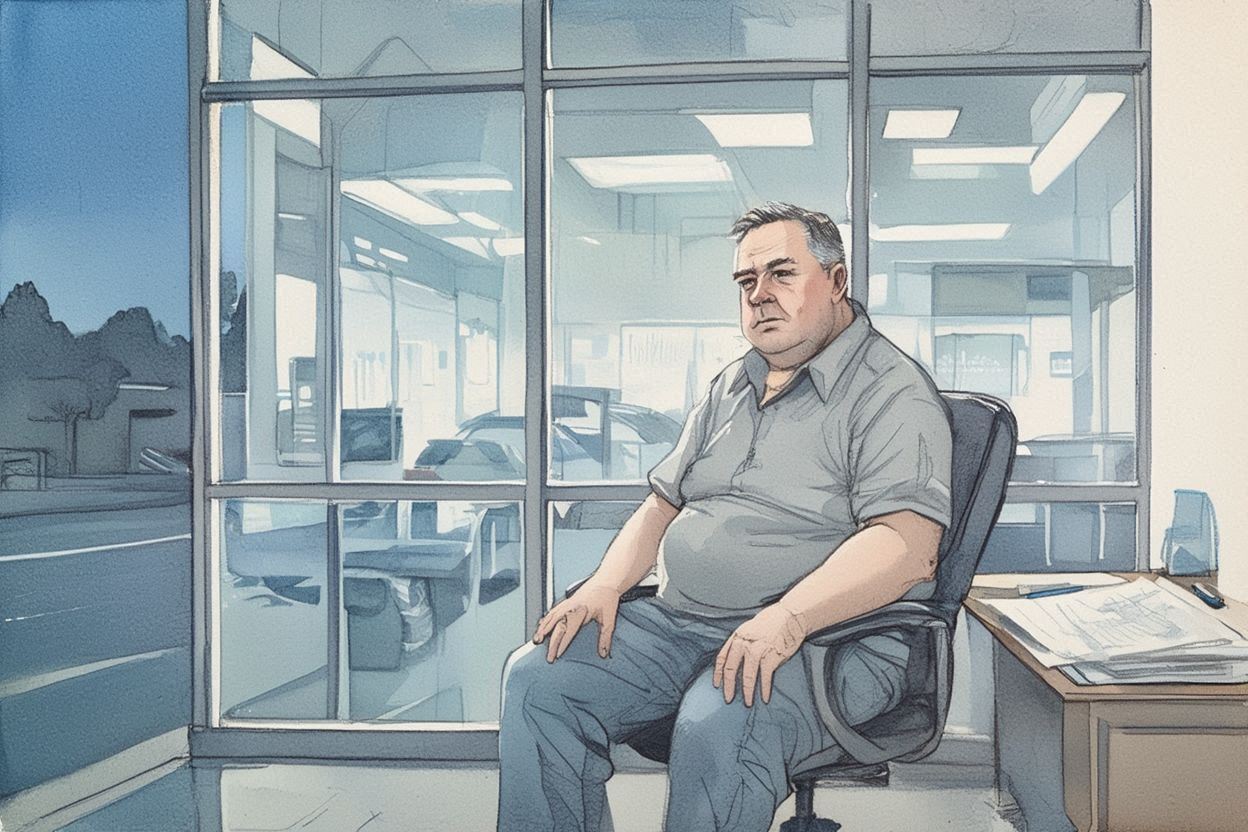
Rereading A House for Mr Biswas, I’m struck by how much of its comedy depends on pressure. Not whimsy, not eccentricity, not the genial observation of human folly that animates so many realist novels of the nineteenth century, but an atmosphere in which small events thicken into crises. Naipaul’s Trinidad is a place where the margin for error is narrow, and where a trivial humiliation can tilt the course of a life. It is precisely this tension that makes the novel’s funniest scenes stay in the memory: they’re comic because they are precarious.
The opening pages set the pattern. The drowned calf, the missing infant, the villagers circling around — superstition and omen, all of it narrated in a quiet, almost official tone, as though the calamity were being described by someone determined not to raise his voice. The humour emerges from the mismatch between the scale of the response and the prose that contains it. But nothing about the villagers’ panic is irrational in context. In a world where subsistence is fragile and the supernatural hovers at the edges of interpretation, a dead calf might very well be a sign. Naipaul does not invite us to laugh at the villagers; he invites us to notice how easily fear can widen into absurdity when the ground beneath a life is already unstable.
Something similar happens in the signboard episode, the great comic set-piece of the novel. On the face of it, nothing could be simpler: a young man is hired to paint a shop sign. But Naipaul builds the scene so that two conversations unfold at once. Biswas believes he is discussing lettering and ornament; the Tulsi household believes it is sounding out a potential son-in-law. Naipaul slides between these interpretive frames with an almost invisible control of perspective — a half-phrase shadowing into Biswas’s pride in his craft, a line of dialogue coloured by the Tulsis’ proprietary curiosity. The humour arises not from misunderstanding but from a surplus of meaning: everything said is doing double duty, and only the reader is aware of the doubled script.
When the comic energy dissipates, what remains is a new form of entanglement. Biswas leaves the conversation with obligations he scarcely recognises, folded into a network of expectations that will take years to loosen. The comedy here is not merely a stylistic flourish; it is the mechanism by which social pressure is exerted. A joke becomes an entry point into a life.
Later in the novel, at the rural estate, Naipaul turns inward. The scene in the shed, with Biswas alone and watching tar drip from the rafters, is narrated with the same refusal to exaggerate that governs the opening. The physical detail is obsessive — the tar thickening, congealing, stretching under its own weight — and yet the psychology beneath it is unmistakable. Biswas is terrified of the workers outside, of their possible resentment, of the isolation that has left him exposed. The moment is funny in its fixations and frightening in its implications. The shed is both shelter and trap; the mind that contemplates the tar is on the edge of collapse. Naipaul holds these tones together without resolving them. The pressure does the work.
Pressure is also what animates the Tulsi household, whose comedy has a different texture. The Tulsi brothers and sons-in-law puff themselves up like minor officials presiding over a directorate of cousins, servants, and ledgers, and yet their authority deflates the moment it meets reality. A boast sags under scrutiny; a reprimand fails to land; a plan collapses into domestic noise. Naipaul never pushes them into caricature. Their pomposity is credible because it is defensive — a performance of importance in a household where real power is diffused, ambiguous, and constantly renegotiated.
The sisters exert their influence in another register altogether: the collective murmur of commentary, judgment, and shared vigilance. A remark such as, “Well, she say that, but you must hear what they saying,” is enough to shift the climate of a room. Their power lies in this net of implications, the sense that no action is entirely private, no preference entirely innocuous. When Biswas asserts some tiny fragment of independence — a paint colour, a room arrangement — the reaction is disproportionate because the structure of the household makes it so. Here too the humour has a double edge: the sisters’ collective voice is both comic in its self-importance and perfectly suited to the maintenance of a fragile social order.
Even the late trip to Maracas Waterfall, often remembered as an odd digression, fits the pattern once one sees it clearly. It offers a glimpse of a Trinidad Biswas rarely inhabits: open, scenic, leisurely. The shift in register is brief but telling. It shows the gap between the life Biswas lives and the life he imagines for his children — between the narrow corridors of Hanuman House and the larger, less punitive spaces of the island. The scene widens the emotional frame of the novel without relieving its pressure.
What makes A House for Mr Biswas continuously rereadable is Naipaul’s ability to keep these forms of pressure in play without ever tipping the novel into despair. The humour is not consolation; it is diagnostic. It reveals the hidden mechanics of a society in which autonomy is always under negotiation and the smallest humiliation can have lasting consequences. Naipaul’s comedy does not lighten the load of the world he describes. It shows us, with extraordinary clarity, how the load is carried.
https://thinkinginstructure.substack.com/p/comedy-under-pressure-how-naipaul