Tag: music theory

  • The Hidden Architecture of Christmas Pop

    The Hidden Architecture of Christmas Pop

    Certain Songs Sound Festive Before You Hear a Single Bell

    Every December, the same illusion returns: add sleigh bells, mention snow, and a song instantly becomes “Christmassy.”

    But that’s misdirection. Long before the bells enter, a Christmas pop song already carries the season in its harmony, rhythm, melodic shape, and production style.

    Play Leona Lewis’s One More Sleep. Before the bells, before the choir, before any lyric references the holiday, the festive identity is unmistakable. There is a structural blueprint at work — and once you hear it, you recognise it everywhere.

    Below is that blueprint.


    1. The Harmonic DNA: Brightness, Warmth, and the Holiday “Dip”

    Christmas pop harmony draws from three overlapping traditions:

    • Doo-wop loops – the classic I–vi–IV–V “ice cream changes” and close relatives
    • Motown lifts – IV→V motion with ascending basslines
    • Tin Pan Alley / mid-century jazz chords – borrowed iv, diminished and secondary dominants that add nostalgia

    These aren’t garnish; they’re doing the emotional heavy lifting.

    The “Snowfall Contour”: short descending scalar figures

    A small, stepwise descending figure in the top line – often three or four notes – turns up in a lot of Christmas pop:

    • Mariah Carey – All I Want For Christmas Is You The intro glockenspiel/piano line outlines the G–Em–C–D “ice cream” loop (I–vi–IV–V in G) with a little descending scalar figure that leads into the vocals.
    • Wham! – Last Christmas In the chorus, phrases like “Last Christmas, I gave you my heart” resolve with small downward steps towards the home note over a C–Am–Dm–G loop (I–vi–ii–V in C).
    • Slade – Merry Xmas Everybody The guitars and keys repeatedly outline descending diatonic fragments between vocal lines.
    • The Darkness – Christmas Time (Don’t Let the Bells End) Lead guitar fills often fall away stepwise before the chorus lands.
    • Leona Lewis – One More Sleep Right at the top, there’s a simple, chime-like three-note descent that recurs as a hook.

    I’m not claiming a single invariant 5–4–3 pattern; I’m saying: short, stepwise falls in the top line are a conspicuously common colour in Christmas pop, and they trace back to carols and older hymn/cadence practice.

    Characteristic festive progressions

    A few harmonic moves show up again and again:

    • I → vi → IV → V – the classic doo-wop / “ice cream” loop
    • I → IV → iv → I – major IV followed by minor iv, the “holiday melancholy” plagal twist
    • I → V/vi → vi – the “false lift into warmth” (dominant-of-the-relative-minor resolving into vi)

    You don’t need hard statistics to see the pattern: a bright, looping tonic–relative-minor–pre-dominant–dominant grammar is heavily over-represented in Christmas pop relative to random chart music from the same eras.


    2. The Rhythmic Blueprint: Forward Motion With Soft Edges

    Christmas pop has a distinctive kinetic feel:

    • Rolling 8th– or 16th-note basslines – straight out of Motown’s playbook
    • A gentle, “trotting” bounce – often a straight beat with a triplet-ish undercurrent
    • Softened backbeat – shakers, brushed snares, sleigh-bell-like top percussion

    That gives you buoyant forward motion without aggression — the sleigh-ride gait, even with no literal sleigh bells.

    Examples:

    • One More Sleep – the bassline walks and bounces; it’s doing most of the festive signalling before any FX.
    • Merry Christmas Everyone (Shakin’ Stevens) – a bright shuffle with an easy, rocking lilt.
    • Fairytale of New York – Celtic bounce melded with a Christmas cadence.
    • Do They Know It’s Christmas? – straight rock backbeat softened by shakers and choir.

    Slade and The Darkness are just grafting this onto glam-rock stomp: same motion, heavier clothes.


    3. The Melodic Arc: Rise → Wistful Dip → Home

    Most big Christmas pop hooks follow the same emotional shape:

    1. Rise – some kind of upward leap or build (excitement, anticipation)
    2. Dip – a more stepwise or minor-coloured descent (nostalgia, wistfulness)
    3. Home – a clear landing on the tonic, designed so people can belt it in a pub

    Concrete example:

    Mariah Carey – All I Want For Christmas Is You (chorus concept)

    • On “All I want…”, the melody makes a noticeable upward jump (roughly a sixth in many transcriptions), setting up a sense of lift.
    • The melodic line then falls back in small steps over the words “for Christmas”, easing down from that peak.
    • On “is you”, it resolves cleanly to the home pitch over the G–Em–C–D loop.

    Exact interval labels differ slightly across arrangements and keys, but the contour is stable: upward leap → gentle descent → tonic resolution.

    Leona Lewis’s “one more sleeep…” hook does the same thing in a different skin: a wide, open leap into the word “sleep”, then an easing fall back into the scale and chord home base. Slade’s and Darkness’s choruses follow similar arcs – you feel the open-armed shout, then the fall back into the crowd.


    4. Production: Frost Without Cliché

    Even if you delete literal sleigh bells, Christmas-leaning productions typically use:

    • Celeste / glockenspiel / toy-piano timbres for hooks and fills
    • Glassy, high-frequency reverb tails – a “frost halo” round the top end
    • String pads and airy choral beds to imply warmth and community
    • Stacked vocals – a Spector-style “wall of people” rather than a lone lead

    This is why modern Christmas songs can sound festive even when they’re being careful not to lean too hard on obvious clichés.


    5. Case Study: One More Sleep (Leona Lewis)

    This is clean, recent, and structurally textbook.

    a) Before the bells: Christmas already encoded

    Even if you mute every sleigh bell:

    • There’s that small, chime-like descending motif at the top – a three-note fall that recurs throughout.
    • The harmony leans hard on A–F#m–D–E in the pre-chorus and chorus – that is I–vi–IV–V in A.
    • The bass has a rolling pop-soul feel that pushes steadily forward.

    That’s enough to scream “seasonal” before a single obvious signifier enters.

    b) Verse

    • Melody: narrow, mostly stepwise → intimacy, conversational nostalgia
    • Harmony: simple A ↔ Bm motion with E dominant punctuation – rock-solid A-major centre
    • Rhythm section: light but moving; you feel a walk, not a stomp

    c) Pre-chorus (“5 more nights…”)

    This is where it goes full Spector:

    • The chords lock into A–F#m–D–E (I–vi–IV–V) – the classic lift pattern.
    • The melody climbs through the “5 more nights / 4 more days” countdown.
    • The bass and drums lean into that bouncy, trotting pulse.

    It’s doing exactly what the Phil Spector Christmas songs do: a harmonic and rhythmic lean forward into the chorus.

    d) Chorus

    The pay-off:

    • Strong tonic landings on “one more sleep”.
    • A wide, upward melodic gesture on the word “sleep”, then a gentle drift back down.
    • A full I–vi–IV–V loop powering the main hook; then IV–vi–♭VII–V (D–F#m–G–E) adding extra lift and colour.
    • Background vocals stacked so it feels like a mini-choir.

    By the time any sleigh bells are added, the architecture has already made it Christmas.


    6. Why This Stuff Feels Like Christmas (Psych + Culture)

    None of this is mystical:

    • Descending figures read as falling or softening in human perception; mapping pitch to vertical motion is pretty universal.
    • Rolling, mid-tempo basslines line up with a walking/trotting gait; the body locks into it automatically.
    • Major harmony with borrowed minor / iv colours gives you that bittersweet nostalgia — joy with a twinge.
    • Stacked vocals mimic choirs, carolling, and group singing – all socially coded as “holiday”.
    • Recycling 40s–60s harmonic language taps straight into cultural memory: the Brenda Lee / Spector / mid-century Christmas canon.

    So when you hear these structures, you’re not just hearing chords; you’re hitting a learnt association between certain musical patterns and “this time of year.”


    7. Can Any Song Be Made Christmassy?

    You can push a lot of tonal, mid-tempo material towards “Christmas” by:

    • introducing a short, stepwise descending hook in the top line
    • shifting key sections onto a I–vi–IV–V-type loop (or I–vi–ii–V)
    • giving the bass a bouncy, Motown-ish pulse
    • adding a celeste/glockenspiel-like layer for hooks
    • stacking backing vocals in the chorus

    But there are limits:

    • Genres like trap, hyperpop, certain DnB and modal folk aren’t built around that harmonic/rhythmic grammar; bolt-on sleigh bells won’t move the core feel.
    • The “Christmasification” recipe works best when the source already has clear tonal harmony and room for warmth.

    8. Christmas Pop Is a Real Musical Form

    It’s not just bells and lyrics.

    It’s a recognisable architecture made of:

    • short descending “snowfall” figures in the melody
    • doo-wop / Motown / Tin Pan Alley harmonic hybrids (I–vi–IV–V and friends)
    • a trotting, mid-tempo rhythmic engine
    • rise→dip→home melodic arcs built for communal singing
    • frost-glass production choices
    • and decades of cultural conditioning.

    https://thinkinginstructure.substack.com/p/the-hidden-architecture-of-christmas

  • Why the “Floating Voice Over a Hard Beat” Formula Works: A Structural Explanation

    There’s a musical configuration that recurs across several important post-1985 genres:
    a rigid, repetitive beat underneath, and a floating, ornamented, high-register vocal above.

    It appears in dream-pop, trip-hop, house, synthpop, alt-R&B, and much mainstream electronic-adjacent pop.
    Björk uses it. Ariana Grande uses it. Massive Attack use it. Pink Floyd used a version of it.

    Inside these genres, it works with unusual reliability.

    It is not a universal musical grammar. It does not describe rap delivery, rock belt vocals, jazz standards, country, metal, reggaeton, Afrobeat vocals, or most global pop traditions. It is simply a highly effective structure within the set of genres that grew out of late twentieth-century electronic and studio-centric production aesthetics.

    Why does it work so consistently in that zone?
    Because it is a structural pairing shaped by perceptual, spectral and cultural forces that align well in those contexts.

    This essay explains that alignment.


    1. Perceptual Contrast: Ground vs Drift (with the real caveats)

    Auditory scene analysis shows that the ear separates sound sources using multiple cues:
    frequency, timbre, onset synchronytemporal envelope shape, amplitude modulation and pitch movement (Bregman 1990).

    The “hard beat + floating vocal” structure typically differs across several of these cues:

    • The beat is onset-driven, periodic and stable.
    • The vocal line is smoother, more continuous and often avoids exact onset alignment.
    • The two layers differ in timbre and register.

    This multi-cue divergence encourages stream separation.

    Crucially, separation is not guaranteed by register alone.
    In trap, drill and modern rap, vocals often fuse tightly with the beat because the vocal onsets and envelopes match the instrumental grid. Travis Scott, Playboi Carti or Future often deliver high, airy vocals that still fuse because the rhythmic cues dominate.

    Separation depends on how many cues differ, not just spectral location.

    Across the genres where this structure appears, those cues often diverge, producing the characteristic grounded-plus-floating effect.


    2. Spectral Separation: Helpful but Not Absolute

    Frequency placement is a contributory factor. In many electronic-adjacent mixes:

    Beat energy (typical):

    • 40–200 Hz: kick weight
    • 200–2,000 Hz: transient snap, mid percussive content

    Vocal energy (typical):

    • 800–6,000 Hz: harmonics, breathiness, air, doubling

    Minimal overlap reduces masking (Moore 2012).
    This supports clarity in Björk’s whisper layers, dream-pop haze, pop vocal stacks (Zak 2001), and genre-specific timbral weight strategies (Berger & Fales 2005).

    But the earlier diagram implied a clean spectral boundary. Real mixes do not work that way. Kick drums today are often side-chained and heavily shaped; vocals have 1–3 kHz presence peaks; both layers may share strong midrange content.

    The real separation often comes from dynamic shaping and envelope contrast, not just raw frequency. Spectral separation helps, but it is not the sole mechanism.


    3. Cultural Coding: Expanded and Made Adequate

    The floating upper voice carries emotional meaning because of a long cultural development.

    Several strands converge:

    • Gospel and R&B made the high, ornamented vocal line a site of emotional intensity.
    • Studio multitracking and spatial processing created aesthetic expectations for vocal width, shimmer and breath texture (Zak 2001, Théberge 1997).
    • Electronic dance music and its offshoots established the beat as a machine element and the voice as the human counterweight.
    • Film and television scoring repeatedly used ethereal upper vocals to signify transcendence, emotion, memory or interiority from the 1970s onward.
    • Radio pop aesthetics reinforced the notion that the “air” and “halo” around a vocal is the emotional signature of a track.

    Together, these created a listening habit:
    the high voice is expressive; the repeating beat is structural.
    The combination feels natural only because a century of media taught listeners to hear it that way.


    4. Example 1: Björk — “Hyperballad” (1995)

    Beat

    Static, quantised pulse.
    Minimal harmonic evolution.
    Designed as a temporal frame.

    Vocal

    High register, breathy and slightly unstable.
    Stacked harmonies generate diffuse spectral air.
    Phrase boundaries blur across the bar grid.

    Mechanism

    Beat and voice diverge in frequency, onset pattern, contour and dynamics (Bregman 1990).
    One stabilises time, the other destabilises it.
    The effect is grounded yet weightless.


    5. Example 2: Ariana Grande — “NASA” (2019)

    Beat

    Tight R&B groove.
    Crisp transients.
    Loop engineered for structural clarity.

    Vocal

    Breathy timbre in the upper range.
    Heavy doubling and tripling (Zak 2001).
    Melisma and rhythmic looseness soften the grid.

    Mechanism

    The beat’s rigidity enhances the vocal’s drift.
    Genre changes; the blueprint persists.


    6. Example 3: Tracy Thorn — Massive Attack, “Protection” (1994)

    Trip-hop’s lineage in sound-system culture and dub matters here.
    Those traditions treat the beat as a kind of monolithic architectural surface.

    Beat

    Locked, unhurried and quantised.
    Warm kick, deadened snare.
    Very limited harmonic movement.

    Vocal

    Soft mezzo register.
    Subtle doubling and plate reverb.
    Phrasing slightly behind the beat.

    Mechanism

    Separation arises from timbre, timing and envelope contrast (Bregman 1990; Moore 2012).
    The emotional atmosphere is interior rather than ecstatic, but the structure is identical.


    7. When the Technique Fails

    Predictable failure modes:

    • The vocal is mixed too low and becomes masked.
    • The beat has too much midrange content and crowds the vocal.
    • The vocal is rhythmically rigid, removing contrast.
    • Envelope and timbre are too similar, collapsing stream separation.

    Much muddy dream-pop suffers exactly these failures.


    8. Counterargument and Response

    Counterargument
    This is not a structural device. It is simply the diva-over-beat convention of Western pop.

    Response
    Inside the relevant genres, it is both.
    Perceptual factors give the configuration technical stability.
    Cultural history determines how listeners interpret it.
    Neither alone is sufficient.


    9. The Structural Blueprint (revised to avoid misinterpretation)

    Not a frequency diagram, but a behavioural one:

    Upper layer
    Flexible phrasing
    Higher register
    Smoother temporal envelope
    Spatial width, ornament, melodic contour

    Lower layer
    Stable rhythm
    Onset-driven patterning
    Repetition and predictability
    Minimal melodic content

    This template describes how the layers behave, not where they sit on a spectrogram.

    It remains one of the clearest ways to combine motion with lift, structure with expression and machine elements with the expressive human voice inside a specific family of genres.


    References

    Bregman, A. (1990). Auditory Scene Analysis. MIT Press.
    Moore, B. C. J. (2012). An Introduction to the Psychology of Hearing. Brill.
    Zak, A. (2001). The Poetics of Rock. University of California Press.
    Théberge, P. (1997). Any Sound You Can Imagine. Wesleyan University Press.
    Berger, H. M., & Fales, C. (2005). “Heaviness in Music Production.” Journal of Popular Music Studies.

    https://thinkinginstructure.substack.com/p/why-the-floating-voice-over-a-hard

  • Debussy’s First Arabesque: The Mechanics of Lightness

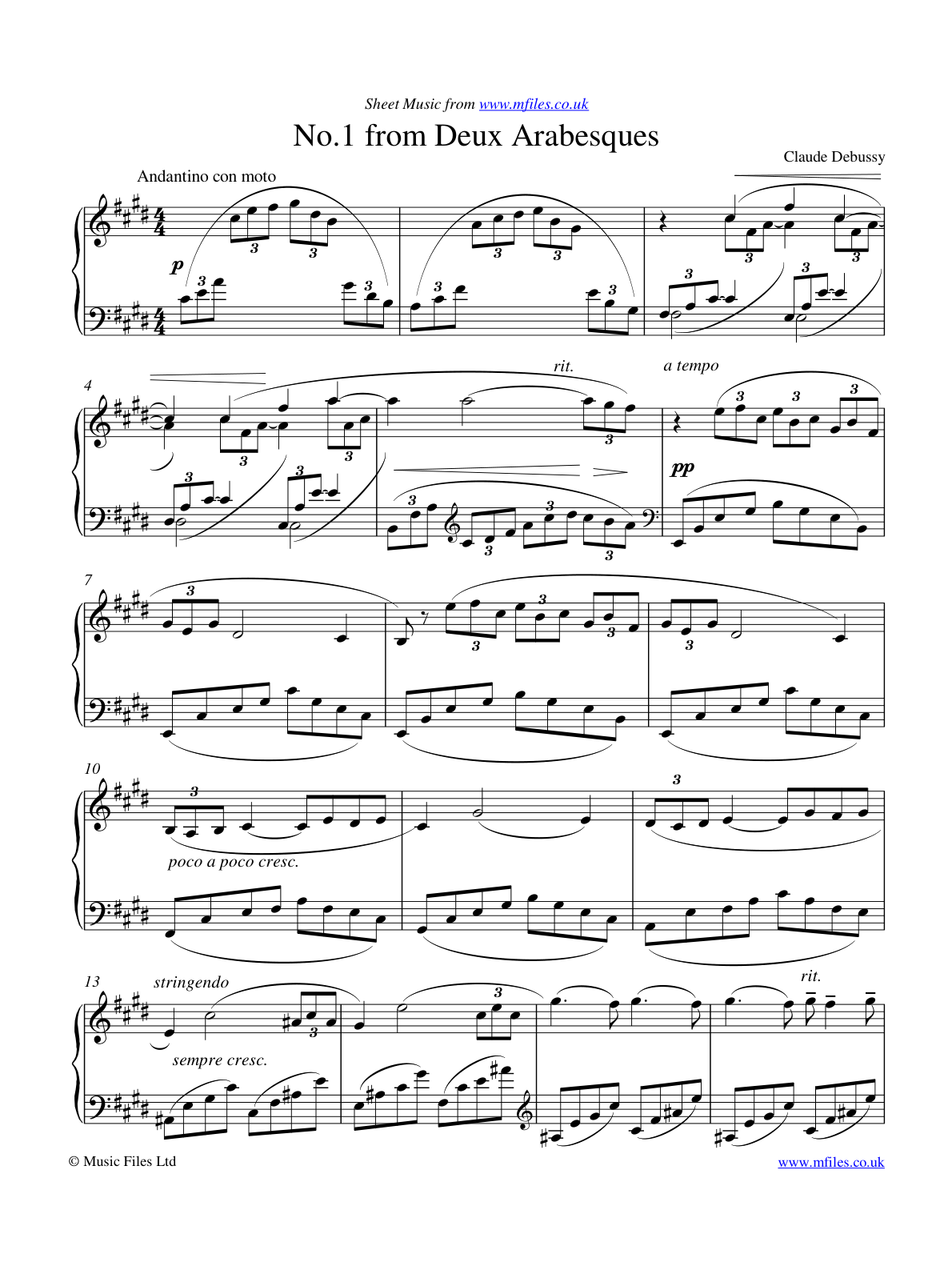
    The first real test of Debussy’s First Arabesque is physical. You begin the right-hand triplets and immediately feel the resistance: they want to fall. They want to land, to take weight, to behave like phrases with substance. But Debussy’s line cannot be allowed to touch the floor. It has to move without arriving, shimmer without asserting pressure. The piece only becomes itself once the hands learn to contradict their own impulses.

    E major opens the work with brightness, but Debussy’s brightness is thin, translucent. The descent that begins the piece — the waterfall every pianist tries to keep suspended — is less melody than motion: downward drift without gravity. Opposite it, the left hand marks time in straight rhythm. The gentle tug-of-war between the hands defines the piece. Break the tension and the music collapses into pastel decoration; keep it taut and the texture floats.

    The ascent that follows is deceptively simple. The left hand must articulate a line that does not want to stay quiet, and the right hand must keep its liquid motion from becoming mechanical. When the passage works, it sounds inevitable. When it doesn’t, it betrays itself. There is no middle state.

    Debussy then shifts the balance: the triplet motion moves into the left hand. The waterfall returns in a darker mirror, and the brightness of E major acquires a faint undertone. These are the moments pianists learn to cherish — small harmonic inflections where something previously airy suddenly has depth. They are delicate, but they change the air of the entire piece.

    Debussy Arabesque No.1 page 1 Debussy Arabesque No.1 page 2 Debussy Arabesque No.1 page 3 Debussy Arabesque No.1 page 4 Debussy Arabesque No.1 page 5 Debussy Arabesque No.1 page 6

    Hover to pause. Click/tap to toggle pause. Observe the 2-against-3 polyrhythm in the opening arpeggios.

    The middle section is the most treacherous. The notes lie easily under the fingers, yet the music becomes incredibly fragile. The harmony thins; the line seems to hesitate. Many players compensate by pressing forward, afraid the music has stopped moving. But the section only works if it is allowed to hover — if the stillness deepens until the upward scale that follows feels like a release of held breath.

    That upward sweep is one of Debussy’s simplest dramatic gestures. After so much restraint, a single unbroken climb feels like the world clearing. It leads to one of the gentlest transformations in Debussy’s early work: the return of the opening material, the light returning, but angled differently. The theme sounds newly tender, as though it has been subtly re-lit.

    In the final section, the left hand takes up the descending triplets, and the right hand attempts a series of ascents that feel like brief attempts at buoyancy. Debussy marks the passage pianissimo, and the quietness is essential. The music rises because it has almost no weight left. The final gesture — a small upward lift ending on a dotted note — is not a conclusion but a disappearance.

    The title “Arabesque” promises ornament, curling line, decorative motion. Debussy keeps the motion but removes the decoration. What remains is not pattern but behaviour: the physics of something that should fall but keeps drifting upward; something that rises without climbing; something that seems weightless only because the performer has learned how to disguise the work.

    After years spent learning the piece, what becomes clear is that Debussy’s beauty here is not atmospheric. It is mechanical — the mechanics of refusal, suspension, contradiction. He asks for weightlessness from an instrument built on weight. The miracle of the First Arabesque is not that it floats, but that the pianist must fight every natural instinct to make it appear to float at all.

    That difficulty is the music’s truest subject.

    https://thinkinginstructure.substack.com/p/debussys-first-arabesque-the-mechanics