Tag: spirituality

  • The Two Entropies: Why You Don’t Look Like William the Conqueror (and Why the Early Universe Didn’t Either)

    The Two Entropies: Why You Don’t Look Like William the Conqueror (and Why the Early Universe Didn’t Either)

    The Two Entropies: Why You Don’t Look Like William the Conqueror — And Why the Universe Still Remembers Its Beginning

    People romanticise ancestry.

    If you are the 26th great-grandchild of William the Conqueror, it feels inevitable that something of him must echo in your face or temperament. A founder should leave a trace.

    That intuition is wrong.

    And understanding why turns out to illuminate something much deeper—about what the universe can and cannot remember about its own beginning.


    1. Genealogy Expands, Genetics Forgets

    Genealogically, the past explodes.

    Go back 30 generations and the number of ancestral slots exceeds the population that existed. Lineages fold back on themselves. By the late medieval period, ancestry is nearly universal within a population.

    So yes—if you are European, you are almost certainly descended from William the Conqueror.

    But genetically, that fact carries almost no weight.

    Each generation:

    • chromosomes recombine
    • segments fragment
    • only a random subset survives

    After ~10–12 generations, most ancestors contribute no DNA.

    By ~30 generations, the expected contribution from any specific ancestor is effectively zero. Even if tiny fragments persist, they are typically indistinguishable from background variation.

    The system does not preserve lineage.

    It preserves only what survives repeated fragmentation.


    2. This Is Not “Entropy” in the Usual Sense

    It is tempting to call this “genetic entropy,” but that risks confusion.

    Nothing here resembles thermodynamic entropy in a strict sense. No heat flows, no microstates are counted.

    What is increasing is something more specific:

    the loss of information about particular ancestors.

    Recombination is not disordering matter. It is erasing traceability.

    After enough generations:

    • ancestry becomes universal
    • attribution becomes impossible

    The past is still there—but no longer identifiable.


    3. The Superficial Analogy to Cosmology

    At first glance, the universe looks similar.

    • it begins in a simple state
    • complexity grows
    • information about the beginning becomes inaccessible

    This suggests a loose analogy:

    recombination erases ancestry
    entropy erases the past

    But this is only a surface similarity.

    The underlying processes are completely different:

    • recombination destroys lineage information through mixing
    • gravitational entropy increases through instability and clumping

    They are not the same mechanism.

    What they share is only this:

    in both systems, detailed information about origins becomes unrecoverable.

    That resemblance is real—but limited.


    4. Penrose’s Claim: The Beginning Is the Anomaly

    Roger Penrose’s point is not about forgetting.

    It is about how strange the beginning was.

    The early universe was:

    • extraordinarily smooth
    • almost perfectly uniform
    • with negligible Weyl curvature

    In a gravitational system, this is not typical.

    Quite the opposite:

    almost all possible mass distributions are highly irregular and clumped.

    Smoothness corresponds to a severe restriction on gravitational degrees of freedom.

    In phase-space terms, it occupies an extremely small region.

    Penrose famously quantified this as something like:

    • 1 in 10^(10^123)

    This number should not be taken too literally. It depends on how one defines gravitational phase space and what counts as a possible configuration.

    But its role is clear:

    it signals that the initial condition is not just low entropy—it is extraordinarily non-generic.


    5. The Real Contrast

    Now the difference with ancestry becomes precise.

    Ancestry

    • starts simple because populations are small
    • low information is trivial
    • nothing about it is improbable

    The Universe

    • starts simple in a very specific geometric way
    • low entropy is highly constrained
    • the initial condition is deeply non-generic

    So:

    a single ancestor is expected
    a perfectly smooth universe is not

    The two kinds of “simple beginnings” are not comparable.


    6. The Question the Piece Cannot Avoid

    Saying the initial state is improbable is not an explanation.

    It is a problem.

    Different approaches attempt to address it:

    • Inflation: tries to explain smoothness dynamically (Penrose argues it presupposes low entropy rather than explaining it)
    • Anthropic reasoning: we observe such a universe because only such universes permit observers
    • Conformal Cyclic Cosmology (Penrose): proposes that our low-entropy beginning is inherited from a previous aeon

    None of these are universally accepted.

    So the situation is this:

    we can describe the specialness of the beginning far more precisely than we can explain it.


    7. What Actually Survives

    This is where the comparison with ancestry becomes useful again—but only if stated carefully.

    In both systems, detailed origins are lost.

    But something does survive.

    Not content—constraints.

    In genetics:

    • you cannot recover a specific ancestor
    • but you can recover statistical structure:
      • linkage patterns
      • allele distributions
      • population history

    In cosmology:

    • you cannot recover “the Big Bang matter”
    • but you can observe:
      • large-scale homogeneity
      • the cosmic microwave background
      • the absence of primordial gravitational irregularity

    What persists is not the past itself.

    It is the shape of what was allowed to happen next.


    8. Constraints, Not Memories

    This is the deeper point.

    Low-entropy initial conditions do not leave detailed records.

    They leave restrictions.

    • In genetics: constraints on what combinations can appear
    • In cosmology: constraints on how structure can form

    These constraints propagate forward.

    They shape everything that follows.

    So causality across entropy gradients works like this:

    the past is not remembered
    it is enforced


    9. Conclusion

    You do not resemble William the Conqueror because recombination erased any identifiable trace of him.

    The universe, however, still reflects its beginning—not as a memory, but as a constraint.

    And the crucial difference is this:

    ancestry begins simply because it has no choice
    the universe began simply in a way it almost certainly should not have

    That is why one is forgettable—

    and the other remains one of the deepest open questions in physics.

    https://thinkinginstructure.substack.com/p/the-two-entropies-why-you-dont-look
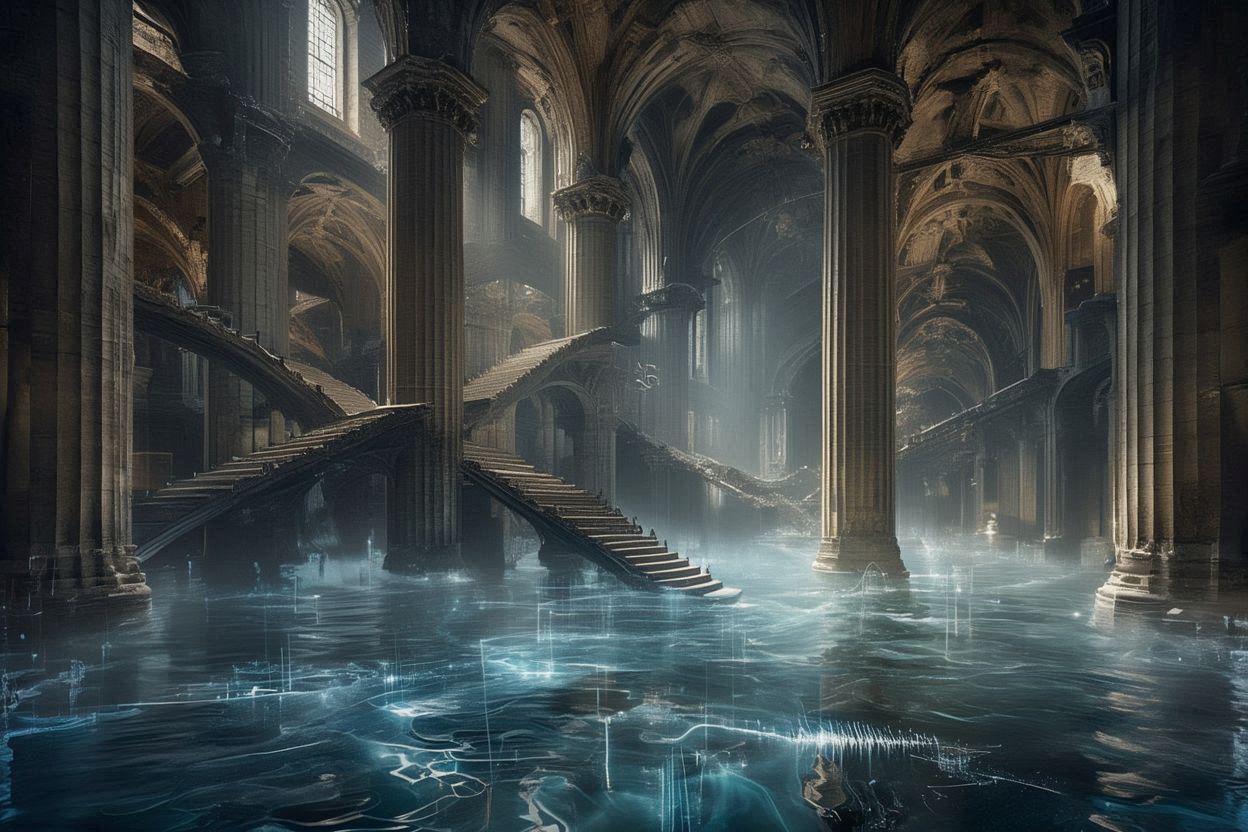
  • The Flooded Palace: How Ancient Paradoxes Haunt Modern Physics and Why Quantum Computers Reveal Their Architecture

    Physics has a long memory.
    Ideas from antiquity reappear in modern theories not as ancestors but as echoes — old conceptual shapes that modern mathematics sometimes rediscovers.
    Zeno’s arrow is one of those echoes.
    It has nothing to do with quantum mechanics, and yet quantum mechanics casts a Zeno-like silhouette.

    The reason is not clairvoyance.
    It is that physics rebuilds its foundations along recurring fault lines — tensions between continuity and discreteness, observation and evolution, information and entropy.
    When the structure is rebuilt, familiar paradoxes suddenly fit the new geometry.

    Quantum computing is one of the strangest places where these echoes gather.
    Its architecture — half classical, half quantum — exposes stress lines that were always present in our theories but rarely visible.

    To make sense of this, we need a vocabulary.


    1. Engine Paradoxes and Echo Paradoxes

    Let’s distinguish between two kinds of paradoxes:

    Engine paradoxes

    Puzzles that force a theory to change.
    They expose inconsistencies that demand new physics.
    (EPR tearing open locality; Maxwell’s demon linking entropy to information.)

    Echo paradoxes

    Puzzles that reappear only because a new theory accidentally resembles their form.
    They contribute no causal influence.
    (Zeno’s arrow and the Quantum Zeno Effect belong here.)

    These categories matter because they reveal how scientific ideas relate across eras — not through lineage but through structure.

    With this distinction, Zeno’s place becomes clearer.


    2. Zeno as an Echo Paradox

    Zeno’s paradox arises from assumptions about infinite divisibility in classical motion: if movement requires passing through infinitely many points, how can it ever begin?

    The Quantum Zeno Effect superficially resembles this — repeated measurements inhibit evolution — but the resemblance stops at the outline.
    One is a logical puzzle; the other is a dynamical consequence of projection in a probabilistic theory.

    They share a silhouette, not a mechanism.
    An echo, not an ancestor.

    This raises the question:

    If Zeno is only an echo, what is the real paradox at the heart of quantum computing?


    3. The Modern Paradox: How to Watch Without Killing

    Inside every quantum computer lies a tension:

    How do you observe a quantum system enough to control it,
    without observing it so much that you destroy the evolution you need?

    Strong measurement collapses the state.
    No measurement lets noise drift unchecked.

    Quantum engineering therefore lives in a narrow corridor:
    weak, continuous measurement, where information arrives gently, partially.

    Here is what that looks like physically:

    A superconducting qubit couples to a microwave resonator.
    A faint probe tone leaks tiny hints about the qubit’s state into a noisy voltage trace — like watching a spinning coin through frosted glass.
    Classical electronics filter the trace, infer the drift, and deliver microsecond corrections.

    Not frozen.
    Not untouched.
    Shepherded.

    This careful, partial witnessing — not Zeno’s infinite slicing — makes error correction possible.
    It is the real paradox: measurement as both threat and lifeline.

    To understand how this paradox shapes the machine, we need architecture.


    4. The Quantum Computer as a Flooded Palace

    A quantum computer is not a pure quantum object.
    Nor is it a classical machine with quantum decoration.
    It is a hybrid architecture — two incompatible logics forced into the same physical space.

    Picture a stone palace: columns, staircases, rigid geometry.
    This is the classical control stack: timers, decoding algorithms, feedback loops, warm electronics.

    Now picture water flooding the lower floors: fluid, continuous, delicate.
    This is the quantum substrate: qubits drifting through Hilbert space, sensitive to the slightest disturbance.

    The miracle is that the structure stands at all.

    Stone — deterministic logic, sequencing, signal processing.
    Water — superposition, phase, entanglement, noise.
    The Interface — error correction and feedback: algorithms that infer errors from scant clues and apply real-time adjustments.

    This is the architecture of quantum computing:
    stone and water sharing one geometry.

    And it is precisely this hybrid structure that makes ancient paradoxes visible again.


    5. Other Paradox Forms in the Architecture

    Zeno is only the first echo.
    Other paradoxes trace deeper tensions in the flooded structure.

    EPR (Engine Paradox)

    EPR exposed a fracture in any theory that tried to preserve both locality and predefined values.
    It forced the development of entanglement as a resource — the cornerstone of quantum information.

    Schrödinger’s Cat (Hinge Paradox)

    A critique that became a diagnostic.
    The cat paradox evolved into the architecture of decoherence: a way to understand how quantum behaviour dissolves into classical outcomes.

    Maxwell’s Demon (Engine Paradox)

    What began as a classical provocation revealed that memory and information have thermodynamic cost.
    It tied entropy to erasure and helped define the physics underlying computation itself.

    Each of these paradoxes highlights a stress line in the underlying architecture.
    Quantum computing merely renders those lines visible in a new and literal machine.


    6. Why Old Paradoxes Return

    Paradoxes return when the architecture of physics is rebuilt.
    Not because the past predicted the future, but because:

    • locality
    • information
    • continuity
    • measurement
    • identity

    are structural constraints every theory must confront.

    That is what makes paradoxes durable.
    They are not historical curiosities.
    They are shapes in conceptual space, waiting for the next theory whose architecture will illuminate them again.


    7. Conclusion: What Shapes Wait in the Walls?

    Zeno’s arrow is an echo.
    EPR is an engine.

    And the quantum computer is a flooded palace — a machine where stone and water intermingle, exposing the hidden tensions that run through the foundations of our theories.

    Physics does not merely solve paradoxes.
    It inhabits them.
    And when its architectures change, old paradoxes illuminate new corridors.

    As quantum technology rises through the floors of our conceptual building,
    one question remains:

    What other buried shapes will appear in the walls of physics next?

    https://thinkinginstructure.substack.com/p/the-flooded-palace-how-ancient-paradoxes