Physics has a long memory.
Ideas from antiquity reappear in modern theories not as ancestors but as echoes — old conceptual shapes that modern mathematics sometimes rediscovers.
Zeno’s arrow is one of those echoes.
It has nothing to do with quantum mechanics, and yet quantum mechanics casts a Zeno-like silhouette.
The reason is not clairvoyance.
It is that physics rebuilds its foundations along recurring fault lines — tensions between continuity and discreteness, observation and evolution, information and entropy.
When the structure is rebuilt, familiar paradoxes suddenly fit the new geometry.
Quantum computing is one of the strangest places where these echoes gather.
Its architecture — half classical, half quantum — exposes stress lines that were always present in our theories but rarely visible.
To make sense of this, we need a vocabulary.
1. Engine Paradoxes and Echo Paradoxes
Let’s distinguish between two kinds of paradoxes:
Engine paradoxes
Puzzles that force a theory to change.
They expose inconsistencies that demand new physics.
(EPR tearing open locality; Maxwell’s demon linking entropy to information.)
Echo paradoxes
Puzzles that reappear only because a new theory accidentally resembles their form.
They contribute no causal influence.
(Zeno’s arrow and the Quantum Zeno Effect belong here.)
These categories matter because they reveal how scientific ideas relate across eras — not through lineage but through structure.
With this distinction, Zeno’s place becomes clearer.
2. Zeno as an Echo Paradox
Zeno’s paradox arises from assumptions about infinite divisibility in classical motion: if movement requires passing through infinitely many points, how can it ever begin?
The Quantum Zeno Effect superficially resembles this — repeated measurements inhibit evolution — but the resemblance stops at the outline.
One is a logical puzzle; the other is a dynamical consequence of projection in a probabilistic theory.
They share a silhouette, not a mechanism.
An echo, not an ancestor.
This raises the question:
If Zeno is only an echo, what is the real paradox at the heart of quantum computing?
3. The Modern Paradox: How to Watch Without Killing
Inside every quantum computer lies a tension:
How do you observe a quantum system enough to control it,
without observing it so much that you destroy the evolution you need?
Strong measurement collapses the state.
No measurement lets noise drift unchecked.
Quantum engineering therefore lives in a narrow corridor:
weak, continuous measurement, where information arrives gently, partially.
Here is what that looks like physically:
A superconducting qubit couples to a microwave resonator.
A faint probe tone leaks tiny hints about the qubit’s state into a noisy voltage trace — like watching a spinning coin through frosted glass.
Classical electronics filter the trace, infer the drift, and deliver microsecond corrections.
Not frozen.
Not untouched.
Shepherded.
This careful, partial witnessing — not Zeno’s infinite slicing — makes error correction possible.
It is the real paradox: measurement as both threat and lifeline.
To understand how this paradox shapes the machine, we need architecture.
4. The Quantum Computer as a Flooded Palace
A quantum computer is not a pure quantum object.
Nor is it a classical machine with quantum decoration.
It is a hybrid architecture — two incompatible logics forced into the same physical space.
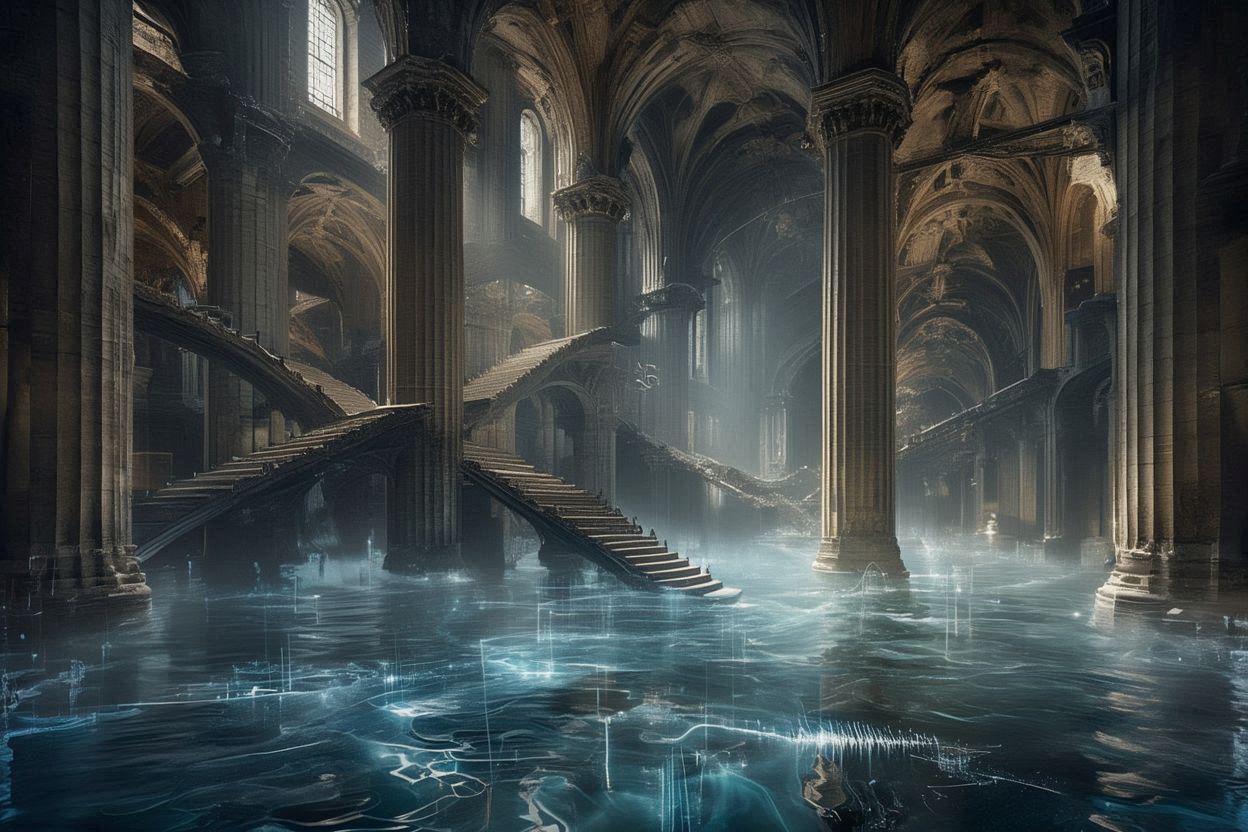
Picture a stone palace: columns, staircases, rigid geometry.
This is the classical control stack: timers, decoding algorithms, feedback loops, warm electronics.
Now picture water flooding the lower floors: fluid, continuous, delicate.
This is the quantum substrate: qubits drifting through Hilbert space, sensitive to the slightest disturbance.
The miracle is that the structure stands at all.
Stone — deterministic logic, sequencing, signal processing.
Water — superposition, phase, entanglement, noise.
The Interface — error correction and feedback: algorithms that infer errors from scant clues and apply real-time adjustments.
This is the architecture of quantum computing:
stone and water sharing one geometry.
And it is precisely this hybrid structure that makes ancient paradoxes visible again.
5. Other Paradox Forms in the Architecture
Zeno is only the first echo.
Other paradoxes trace deeper tensions in the flooded structure.
EPR (Engine Paradox)
EPR exposed a fracture in any theory that tried to preserve both locality and predefined values.
It forced the development of entanglement as a resource — the cornerstone of quantum information.
Schrödinger’s Cat (Hinge Paradox)
A critique that became a diagnostic.
The cat paradox evolved into the architecture of decoherence: a way to understand how quantum behaviour dissolves into classical outcomes.
Maxwell’s Demon (Engine Paradox)
What began as a classical provocation revealed that memory and information have thermodynamic cost.
It tied entropy to erasure and helped define the physics underlying computation itself.
Each of these paradoxes highlights a stress line in the underlying architecture.
Quantum computing merely renders those lines visible in a new and literal machine.
6. Why Old Paradoxes Return
Paradoxes return when the architecture of physics is rebuilt.
Not because the past predicted the future, but because:
- locality
- information
- continuity
- measurement
- identity
are structural constraints every theory must confront.
That is what makes paradoxes durable.
They are not historical curiosities.
They are shapes in conceptual space, waiting for the next theory whose architecture will illuminate them again.
7. Conclusion: What Shapes Wait in the Walls?
Zeno’s arrow is an echo.
EPR is an engine.
And the quantum computer is a flooded palace — a machine where stone and water intermingle, exposing the hidden tensions that run through the foundations of our theories.
Physics does not merely solve paradoxes.
It inhabits them.
And when its architectures change, old paradoxes illuminate new corridors.
As quantum technology rises through the floors of our conceptual building,
one question remains:
What other buried shapes will appear in the walls of physics next?
https://thinkinginstructure.substack.com/p/the-flooded-palace-how-ancient-paradoxes
Leave a Reply