We study carry propagation in a family of canonical positive linear recurrence sequence (PLRS) numeration systems whose coefficient vectors consist of alternating blocks of k ones and prescribed zero runs. We first derive the exact combinatorial structure of maximal legal words directly from the recursive legality definition. This yields an explicit periodic maximal word, an exact description of the exceptional carry fibres, exact fibre offsets, and the universal identity that the mean carry length is identically two for every member of the family. Using the associated generating functions, we develop a complete asymptotic expansion for the variance of the carry length. The expansion naturally decomposes into primitive travelling boundary layers determined by the coefficient signature and exponentially smaller corrections arising from perturbations of the dominant characteristic root. The first moment is shown to be universal, while the higher-order asymptotic boundary layers contain sufficient information to reconstruct the defining coefficient signature, as proved in Section 10. Finally, we prove an inverse reconstruction theorem. After separating the universal root contribution from the primitive boundary layers, the coefficient signature is recovered recursively from the asymptotic expansion of the variance. This establishes that the asymptotic carry statistics uniquely determine the underlying multi-gap PLRS family.
[A work of fiction. Any resemblance to reality is purely coincidental]
Aurelian Kovács (17 March 2011 – 2 November 2086) was a Hungarian–British mathematician whose work exerted decisive influence on 21st-century mathematics. He is best known as the principal opponent of unificatory and architectural approaches to mathematical foundations and as the originator of the Granular School. Kovács argued that universality, patterning, and global structure systematically erase mathematically real asymmetries, and that irreducible locality and handedness are fundamental features of mathematical reality.
He held academic positions at the University of Cambridge and the Institut des Hautes Études Scientifiques (IHÉS) before withdrawing from public academic life in the late 2040s. He received the Fields Medal (2037) and the Abel Prize (2041). His later years were marked by a methodological crisis, controversy, isolation, and the production of a cult science-fiction novel.
Early life and education
Kovács was born in Szeged, Hungary, and moved to the United Kingdom with his family in 2024. His childhood was widely described as unstable. His parents were animal-rights activists who frequently left the family home for extended periods to participate in protests and acts of sabotage. During these absences, Kovács and his seven sisters were reportedly left unsupervised, often with little or no food. Later biographers have suggested that these experiences contributed to his lifelong hostility toward systems that presume global provision, coherence, or support.
At school, Kovács was initially regarded as slow and disengaged. This perception changed when, at around twelve years old, a mathematics teacher noticed that Kovács had been rewriting his textbooks by hand, reorganizing definitions and theorems into a different order of presentation to emphasize local dependencies and construction order.
Kovács was also a competitive chess player during his early teens and was briefly considered a prodigy. He later rejected the game entirely, describing it as “too symmetrical” and criticizing its reliance on mirrored positions and invariant strategy. He did not return to competitive chess.
He studied mathematics and philosophy at Trinity College, Cambridge, and completed his PhD at the age of 23 under the supervision of Sir Peter Quirk. His doctoral work focused on obstruction phenomena and order-dependent constructions.
Mathematical philosophy
Rejection of unification and architecture
Kovács is frequently compared to Alexander Grothendieck, though historians emphasize the contrast between their approaches. Where Grothendieck rejected the existing “house” of mathematics in order to build a new one, Kovács rejected the premise of the house itself. He argued that even Grothendieckian universality—topoi, motives, and abstract descent—merely displaced unification rather than eliminating it.
In a widely cited notebook passage, he wrote:
“A new house is still a house. Dig far enough and the ground itself has a handedness.”
From the early 2030s onward, Kovács mounted a sustained critique of architectural mathematics: large unifying frameworks and universal languages that, in his view, succeed only by weakening invariants until incompatibilities disappear. His 2031 IHÉS lecture Against Architecture is commonly identified as the opening statement of the Anti-Architectural Turn.
The Granular Program
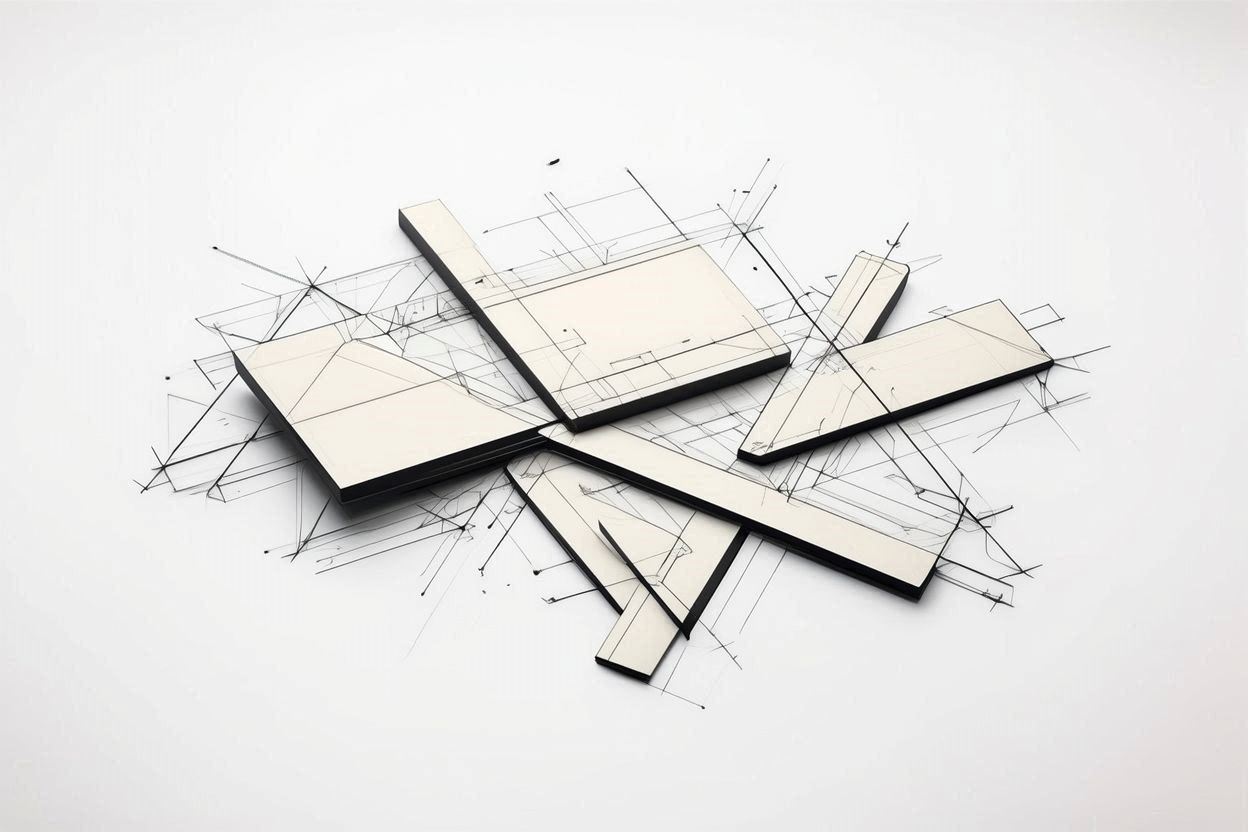
Fig 1. A “Broken Square” from the 2031 Against Architecture lecture, demonstrating why composition paths fail to globalize.
In place of unification, Kovács proposed granulation: the refinement of mathematical structures into irreducible local units that resist synthesis.
Core principles of the Granular Program included:
Local rigidity over global coherence
Incompatibility treated as information rather than error
Procedural dependence on construction history
Non-functorial transitions as primary objects of study
Granulation treated breakdowns of equivalence and translation as mathematically fundamental phenomena rather than technical defects.
Handedness and absolute localisation
ℒ
ℒ
ERROR: IRREDUCIBLE CHIRALITY Global mapping failed.
Fig 2. The “Kovács Handedness Obstruction.” Attempting to quotient out the L/R distinction (mirror symmetry) results in a non-globalizable structure.
Central to Kovács’ mature work was the claim that handedness—irreversible asymmetry—appears at every scale of mathematics. He rejected the assumption that left/right distinctions, order dependence, or construction history can always be quotiented away without loss.
His later research pursued absolute localisation: the study of structures that cannot be globalized, stabilized, or universalized without distortion. In Kovács’ view, most universal theories function by suppressing handedness, thereby misrepresenting the phenomena they purport to explain.
Research contributions
Fig 3. A schematic of the Kovács Obstruction Tower (2033). The red boundary marks the threshold where global descent fails to synchronize with local arithmetic data.
Arithmetic geometry
Kovács made major contributions to arithmetic geometry, particularly to obstruction towers and localized failure modes of descent. His resolution of the Generalized Langlands–Voevodsky Compatibility Conjecture (2033) is now understood as a delineation of where compatibility fails outside narrowly constrained local conditions.
Category theory and logic
Kovács introduced Operational Higher Categories, designed not to enforce coherence but to expose where composition ceases to be admissible and where coherence cannot be imposed without erasing asymmetry. He was consistently critical of homotopy-theoretic foundations when employed as universal languages.
Mathematics and artificial intelligence
Fig 4. Simulation of the Kovács Correspondence (2038). Attempting to “symmetrize” the latent chiral field results in an irreducible local error.
Kovács was an early critic of AI-driven mathematical unification. While acknowledging the technical effectiveness of automated theorem-proving systems, he argued that such systems preferentially discover compressible, symmetric mathematics and systematically avoid highly local or chiral phenomena.
His 2038 paper On Probabilistic Theories with Latent Symmetry formalized this critique. What became known as the Kovács Correspondence was later described by Kovács himself as an anti-correspondence, characterizing conditions under which interpretability necessarily collapses.
Crisis of form and late work
By his late forties, Kovács’ work entered what commentators describe as a crisis of form. Having rejected unification, global structure, and controlled localisation, he began to doubt whether the very form of a theory—or even a paper—could be justified without smuggling in illicit wholeness.
Fig 5. Kovács climbing a tree using only his right hand, Cambridge, August 2061
During this period he increasingly abandoned conventional publication. He produced short snippets, isolated lemmas, marginal notes, and diagrams without surrounding exposition. These later gave way to fragments—single arrows, partial definitions, and negations of earlier claims.
Observers noted that Kovács would sometimes connect fragments into provisional constellations and then dismantle them, describing the act of connection as “epistemically dangerous.” In one notebook entry he wrote:
“Connection is the first lie. Wholeness is the second.”
This phase is generally interpreted as the logical extremization of his philosophical position rather than a simple personal collapse.
Controversies
Footnote disputes and publication conflicts
In 2042, a prominent homotopy theorist accused Kovács of “performative obstructionism” in a review published in Advances in Mathematics. Kovács responded with a 47-page preprint titled Reply: Your Functor Forgot Its Own Left Shoe, composed largely of extended footnotes and asymmetric diagrams. The document was never formally published but circulated privately on encrypted mathematics mailing lists.
The simplicial incident
After 2033, Kovács refused to work with simplicial sets, claiming the degeneracy maps were “ontologically suspicious.” When a collaborator suggested proceeding using only face maps, Kovács replied, “Then you’re just doing directed topology and pretending you aren’t,” and withdrew from the project.
He later published a solo paper introducing degenerate-free Δ-objects, which were subsequently shown to be categorically equivalent to simplicial sets. His response to this equivalence was: “Equivalence is not sameness.”
Seminar conduct
Fig 6. Digital reconstruction of the “Off-center Dot” from the 2044 IHÉS seminar series.
During his 2044 IHÉS seminar series Absolute Localisation, one session reportedly consisted of Kovács drawing a single chalk dot slightly off-center on the blackboard and silently staring at it for approximately three hours before leaving without comment. The series was discontinued shortly thereafter.
Automated prover incident
In a widely reported episode, Kovács submitted a deliberately asymmetric Diophantine equation to a leading automated prover. The system returned:
“This looks too chiral—did you mean to symmetrize it first?”
Kovács annotated the output with the handwritten remark “Exactly.”
Political views
Kovács’ political views closely mirrored his mathematical philosophy. He rejected representative democracy, arguing that parliamentary systems rely on artificial symmetry, aggregation, and interchangeable roles that erase meaningful local differences. In private correspondence, he described legislatures as “commutative diagrams pretending to be societies.”
He was equally hostile to authoritarianism and communism, which he regarded as attempts to impose global coherence through centralized power. Kovács dismissed ideological uniformity as a categorical error rather than a moral failing.
Instead, he espoused a form of personal anarchism, emphasizing individual agency, local competition, and non-coordinated evaluation. He occasionally referred to this framework as “Grand Swiss,” likening it to a PageRank-style system in which influence emerges from dense local comparison rather than voting or command. Legitimacy, in this view, was always provisional and asymmetric.
Kovács repeatedly insisted that this position was descriptive rather than programmatic. He became disillusioned in the late 2030s when a small group of followers attempted to organize his ideas into a political party. He publicly disavowed the effort, remarking that “the moment agreement stabilizes, the model has failed,” and thereafter refused to discuss politics in public forums.
Later life
In the late 2050s, Kovács withdrew almost entirely from academic life. In Cambridge, he became known for constructing elaborate, intentionally asymmetric chalk diagrams in public spaces and installing irregular, non-periodic wind chimes “to prevent accidental rhythm.” Municipal authorities issued warnings regarding noise and public marking, but no charges were filed.
Shortly thereafter, he left the United Kingdom and settled in a remote coastal region of Iceland, where he lived until his death.
Fiction and cultural reception
Fig 7. First published in 2071, The Folding of the Ninth Silence was met with initial critical bewilderment; however, it has since undergone a significant reputational recovery, securing a dedicated cult following among mathematicians and experimentalists.
While living in Iceland, Kovács wrote a single science-fiction novel, The Folding of the Ninth Silence (2071). The 1,900-page work is characterized by extreme fragmentation, incompatible timelines, extensive footnotes, and chapters consisting entirely of marginalia referring to earlier marginalia.
The novel was widely regarded as unreadable by mainstream critics but achieved cult status among mathematicians, computer scientists, and experimental writers. Despite its reputation as unfilmable, the screen rights were acquired by Amazon Studios, which expanded a single explanatory footnote into five television series. The adaptation was critically panned and commercially unsuccessful.
Legacy
Following Kovács’ death, failures of large automated proof systems to generalize beyond narrow or symmetric domains lent retrospective support to his critique of universality and patterning. By the late 2080s, several subfields formally incorporated irreducible handedness constraints and non-globalizable structures, often citing Kovács as a foundational influence.
He is now commonly described as the most influential anti-unifier of his era and as the mathematician who carried localisation to its breaking point.
Selected works
Derived Stability Fields (2031)
Operational Higher Categories (2034)
Against Architecture (2036, lecture)
On Probabilistic Theories with Latent Symmetry (2038)
How DESI’s new measurements, dark-matter puzzles, and a forgotten educational film reveal the hidden structure of physics.
Throughout 2024 and 2025, the DESI collaboration has released a wave of major cosmological results.
In November 2024, DESI’s full-shape clustering analyses (DESI 2024 Papers V and VII) used 4.7 million galaxy and quasar redshifts to trace 11 billion years of cosmic structure.
In 2025, DESI released its Data Release 2 (DR2) BAO results, expanding to even larger volumes.
And in October 2025, the DR2 BAO measurements were formally published in Physical Review D, consolidating DESI’s most precise distance-scale constraints to date.
Together, these results reinforce the standard cosmological model — but they also sharpen subtle questions that refuse to go away. Small discrepancies appear between probes of the Universe’s “clumpiness” (σ8, S8), and DESI DR2 even shows a 2.8–4.2σ preference for dynamical dark energy (the w0–wa model) over a cosmological constant, depending on which supernova dataset is used.
None of these tensions constitute new physics. But they all point in one direction:
Cosmology is a science of scales, and the scale you measure determines the story you hear.
To understand that, you have to think the way the Universe is built: in powers of ten.
And oddly enough, a 1977 educational film is still the best introduction to that idea.
1. Signals Die in Decades, Not Metres
Signals in physics rarely fade linearly. They collapse in powers:
angular size falls as 1/r
photon flux falls as 1/r^2
radar return falls as 1/r^4
gravity falls as 1/r^2
Detectability doesn’t decline — it drops off cliffs.
Example: Seeing a human from 1 AU
A human reflecting ~100 W of sunlight yields only about 0.07 visible photons per second through a 10-m telescope at 1 AU. Background noise is ~50 photons per second. Instantaneous SNR ≈ 0.01.
Reaching SNR ≈ 5 takes three days of continuous observing under ideal conditions.
At 10 AU, the signal is 100 times weaker → integration time becomes 10,000 times longer.
Visibility vanishes in decades, not metres.
Cosmology operates in exactly this geometry.
2. Why the “Powers of Ten” Films Were Accidentally Right
The films misrepresented astrophysics but captured the deeper truth:
physics changes regime in multiplicative steps.
millimetres → continuum mechanics
nanometres → quantum mechanics
metres → Newtonian dynamics
kilometres → geophysics
megametres → orbital mechanics
megaparsecs → cosmology
Quantum mechanics and general relativity are always present, but the dominant effective theory changes when you cross large scale ratios.
The films visually anticipated what the renormalisation group (RG) later formalised: laws don’t change — relevance does.
3. Dirac’s Large Numbers: Early Glimpses of Scale Physics
In 1937, Paul Dirac noted that several unrelated dimensionless ratios of nature cluster around 10^39–10^40. His proposed explanation was wrong, but the pattern he noticed was real:
physics contains extreme separations of scale.
These arise naturally from:
symmetry breaking across dozens of decades
RG flow across dozens of decades
gravity’s uniquely weak coupling
primordial fluctuations amplified by cosmic expansion
Dirac misidentified the mechanism, but recognised the architecture.
4. DESI and the Scale Problem in Modern Cosmology
DESI’s 2024 full-shape results and its 2025 DR2 BAO measurement sharpen an important truth: different cosmological probes give slightly different answers because they operate at different scales.
Not dramatic discrepancies. Not contradictions. But persistent across:
weak lensing
CMB lensing
galaxy clustering
redshift-space distortions
cluster counts
And now:
dynamical dark energy fits (w0–wa) show 2.8–4.2σ preference over ΛCDM when DESI DR2 is combined with certain supernova datasets.
These signals are small — but they appear across decades of cosmic scale.
Tanveer Karim, a University of Toronto astrophysicist and lead author of a DESI comparison between emission-line galaxies and CMB lensing, put it cleanly:
“The tension keeps popping up in various galaxy surveys, so is it signaling something to us?”
Nothing in DESI implies exotic gravity.
But DESI does demonstrate that cosmological inference is scale-dependent, and mild tensions often arise because each probe samples a different decade of structure.
5. Dark Matter: The Universe’s Most Extreme Scale Separation
Dark matter is visible only in the one channel that survives enormous scale changes: gravity.
Gravity reveals dark matter in:
galaxy rotation curves
cluster lensing
the cosmic web
Every other interaction collapses:
electromagnetic → effectively zero
nuclear scattering → suppressed by dozens of orders of magnitude
collider production → cross-sections fall steeply with mass
indirect detection → depends on density squared; signal dies in most environments
Dark matter looks “simple” only because gravity is the last surviving signal.
Modern models explicitly encode scale separation:
self-interacting dark matter (SIDM) changes behaviour from dwarfs to clusters
ultralight fuzzy dark matter has kiloparsec-scale quantum wavelengths
warm dark matter suppresses small-scale structure
sterile neutrinos span ∼20 decades of mixing angle
These aren’t points in parameter space. They’re logarithmic landscapes.
DESI’s mapping of structure across 10^3 in scale strengthens this view.
6. The Renormalisation Group: The Universe’s Operating System
RG flow formalises what Powers of Ten hinted at:
coarse-grain
rescale
see what laws emerge
This explains why:
quarks become hadrons
molecules become fluids
Newtonian gravity emerges from general relativity
cosmic structure arises from tiny initial fluctuations
DESI’s clustering and BAO measurements are, in effect, RG experiments: a test of how structure behaves from kiloparsecs to gigaparsecs.
Cosmology is a scale-transformation laboratory.
7. Why Thinking in Powers of Ten Matters
For three reasons:
1. Physics appears layered not because laws change, but because relevance changes.
2. Detectability collapses in cliffs, not slopes — SNR is logarithmic.
3. Cosmology’s mild tensions arise because each probe samples a different decade of structure.
The old educational films were right for the wrong reasons.
The Universe doesn’t think in metres. It thinks in ratios. It thinks in logs. It thinks in powers of ten.
A quiet shift has taken hold in Anglo-American filmmaking. A growing group of directors is bringing the supernatural back into realism. Not as metaphor, not as trauma symbolism, not as dream logic, but as simple, literal fact.
Films like Under the Skin (2013), The VVitch (2015), Longlegs, Weapons and Bugonia all follow the same unexpected pattern: they build a world with documentary-level seriousness, then let something impossible walk straight through it without blinking.
The VVitch sits in the middle of this timeline—closer to Under the Skin’s early experiment than to the recent cluster—yet it anticipates the new mode far more directly than most films of its era.
It’s not fantasy and it’s not allegory. It’s a change in the terms of realism itself.
And what’s remarkable is not just that filmmakers are doing this. It’s that audiences, who once rejected this kind of move outright, now accept it.
Something in the culture has shifted.
How These Films Actually Work
Longlegs The opening is pure procedural: case files, FBI rhythms, forensic logic. It earns your trust by showing you a world that obeys rules. Then, without fanfare, the film reveals a reality the investigation can’t account for. The shock is conceptual rather than visual: the world is larger than the tools used to interpret it.
Bugonia An alien arrives. No backstory, no cosmology, no symbolic wink. The film treats the creature with the same plainspoken camera language it uses for everything else. A ruined world hangs behind it, but that world stays opaque. The mystery isn’t a puzzle; it’s a condition.
Weapons The film begins in grounded ensemble realism: teenagers, suburban routines, handheld immediacy. When the supernatural element appears, it does so without stylistic exaggeration or symbolic framing. The witch figure is presented with the same visual sobriety as the everyday world around her. The violence that follows is neither allegorised nor psychologised; it simply happens. Weapons uses realism as a trapdoor, and when it opens, the film refuses to translate the impossible into metaphor.
The VVitch The witch is not a projection of Puritan anxiety or an allegory about repression. She’s real. The horror comes from the collapse of the explanatory worldview the characters rely on. The film doesn’t ask whether the supernatural exists; it asks what happens when it does and no one knows how to interpret it.
Under the Skin A decade earlier, Glazer was already testing the boundaries of this style. The film shoots Glasgow crowds, housing estates, and nighttime roads like vérité documentary, then quietly introduces the alien sequences without changing tone or visual language. The impossible arrives inside realism and the film simply accepts it. But in 2013, audiences weren’t yet primed to recognise this as a coherent narrative technique. In hindsight, Under the Skin reads as an early prototype for the pararealist shift that would only fully emerge years later.
Across all these films, the structure is the same: realism → rupture → continuation. The story keeps going even when the world has outgrown its explanations.
Why “Pararealism” Is the Right Name
Existing labels don’t quite fit.
Folk horror implies rural tradition and ancestral dread. Magical realism normalizes the supernatural instead of treating it as a shock. The New Weird deals in ecological grotesquery and destabilized worlds.
But what these new films share is a technique, not a genre:
Begin in strict realism. Introduce the impossible with no tonal shift. Refuse interpretive escape hatches (no dream sequence, no metaphor reveal). Keep the realist style intact after the world breaks.
That method deserves its own term: pararealism—the uncanny running parallel to the real, treated with the same gravity.
Why Audiences Accept It Now
Not long ago, test audiences might have laughed these films off the screen. Now they draw applause. Why?
1. Irony fatigue After years of meta-jokes and narrative reassurance, outright sincerity, especially in horror, feels radical.
2. Higher media literacy Viewers understand genre grammar well enough to tell when a film is deliberately withholding explanation.
3. The collapse of explanatory confidence Political chaos, algorithmic feeds, epidemiological disorder :life itself has stopped cohering into tidy cause-and-effect. Films that don’t add up feel proportionate, not broken.
4. Horror’s mainstreaming Horror’s audience is now broad, literate, and willing to meet films on their own terms.
5. Social realism’s limits Traditional realist drama can struggle to express contemporary dread. Reintroducing literal mystery gives filmmakers a different register to work in.
Audiences didn’t suddenly start believing in witches or aliens. They just stopped insisting that stories must explain themselves.
The Global Precedent
None of this is new outside the Anglo-American industry.
Latin American magical realism has long folded the inexplicable into everyday life. Japanese cinema, from Kwaidan to Kiyoshi Kurosawa, treats the supernatural as a structural fact. Eastern European directors like Švankmajer and Żuławski built entire careers on ontological instability.
What’s new is that U.S. and U.K. filmmakers, historically loyal to tidy causal logic, are finally adopting a global technique. Pararealism is less an invention than a belated adoption of an existing cinematic language.
Fantasy’s Diverging Road
Interestingly, fantasy literature has gone the opposite direction. Much of the market now rewards systematized magic, rulebooks disguised as novels, cosmologies built with spreadsheets. That’s not universal, Miéville, VanderMeer, Valente, and Jemisin keep the unexplained alive, but it is the dominant trend.
Piranesi shows a different approach. Its psychological explanation resolves the plot, but the House, the great, echoing architecture of tides and statues, remains metaphysically ungraspable. The mystery coexists with the rational layer.
Pararealist cinema goes further. Films like Longlegs, Weapons, and The VVitch don’t preserve two layers; they simply decline to provide the psychological one at all. The inexplicable isn’t matched with an explanation :it stands alone.
Why This Matters
Pararealism marks a shift in our narrative expectations. It says the unexplained is not a failure of storytelling but a valid part of how the world feels right now.
These films aren’t asking to be solved. They’re asking to be lived with.
The impossible appears; the camera holds; the story continues. Meaning comes not from decoding symbolism, but from accepting that some phenomena resist interpretation.
We used to watch movies to resolve the world. Now, increasingly, we watch them to reflect a world that refuses resolution.
Condorcet, Müller, container death, and why cultural health now depends on memory that survives platforms
There is a moment every sufficiently large system reaches where correctness stops working.
You aggregate carefully. You compare pairwise. You insist on fairness, logic, and legitimacy.
And then the system cycles.
A beats B. B beats C. C beats A.
No resolution. No ranking. No “best.”
This is not a mistake. It is what happens when validation is asked to scale.
What civilisation does next determines whether it freezes, collapses, or adapts.
Condorcet: the refusal to proceed
In the late 18th century, Marquis de Condorcet encountered this failure while thinking about voting.
His goal was pure Enlightenment ambition: convert many rational individual preferences into a single rational collective will. Majority rule seemed obvious. Pairwise comparison seemed fair.
Instead, he discovered the Condorcet paradox: even when individuals are rational, collective preference can be cyclic and inconsistent. Rationality does not compose.
Condorcet drew the only conclusion his framework allowed.
If a system cannot produce a consistent outcome, it is illegitimate. If it cycles, it must be rejected.
From this refusal flows two centuries of social-choice theory, impossibility results, and proofs demonstrating — correctly — that large-scale collective decision-making cannot be logically validated.
Condorcet saw the abyss and stopped.
He was right. And civilisation could not afford to follow him.
Müller: let it run anyway
A century later, in a completely different setting, Julius Müller faced the same structure — without the luxury of stopping.
He wasn’t designing democracy. He was running chess tournaments.
Too many players. Too few rounds. No round-robin. No eliminations. No clean global ordering.
Condorcet would have said the system is invalid.
Müller shrugged and ran it anyway.
The Swiss system does not attempt to prove who is best. It does something more dangerous and more useful:
pair players locally
allow noise, imbalance, and upsets
repeat the process
never demand global consistency
observe what remains
At the end, you don’t get truth. You get what survived the wash.
Müller did not resolve cycles. He bled them out over time.
This is the civilisational hinge: from legitimacy through correctness to legitimacy through persistence.
Plumbing, leaks, and invariants
The correct mental model is plumbing.
You build pipes: who interacts with whom. You inject fluid: games, votes, links, views, attention. You allow leaks: boredom, forgetting, defection, randomness.
Then you stop caring about the splashing and ask one question:
Where does the flow spend most of its time?
That residue is the invariant.
Mathematically, it is a stationary distribution. Spectrally, an eigenvector. Culturally, meaning.
Swiss tournaments, Elo ratings, markets, reputation systems, and PageRank are all the same move: allow interaction to repeat under noise and trust convergence rather than proof.
Swiss is PageRank without linear algebra — a human-computable approximation to spectral ranking.
Why the 2010s internet got sick
For a while, this logic worked online.
Then something broke.
By the mid-2010s:
a handful of platforms achieved near-monopoly
network effects made exit costly
algorithms converged on identical engagement incentives
platform death slowed to a crawl
Facebook, Twitter, YouTube, Reddit — different surfaces, same dynamics.
The meta-tournament froze.
Containers stopped dying.
And when containers don’t die, Müller systems stop selecting. They calcify.
The internet didn’t become chaotic. It became stagnant.
Why the 2020s feel feral — and healthier
The present feels worse — louder, noisier, more unstable — but it is structurally different.
TikTok shattered the equilibrium
Discord, Substack, Patreon created micro-containers
AI destabilized content economics
platform trust collapsed
exit became easier
Churn resumed.
Platforms are dying again.
This is not collapse. It is forced re-pairing at the container level.
The Tournament Director is not regulation or wisdom.
The Tournament Director is container mortality.
Platform death restores mixing the way Swiss pairings do.
The missing problem: memory dies with containers
And here the framework breaks — exactly where you pushed.
Müller systems assume continuity of state.
Swiss tournaments carry scores forward
PageRank preserves links across time
Markov chains retain structure even as nodes disappear
The internet does not.
When platforms die:
archives vanish
communities dissolve
conversations fragment
identity collapses
Vine dies → videos scatter Twitter mutates → threads disappear Subreddits close → knowledge evaporates
What survives is not what is robust. It is what is reconstructable.
This biases selection toward:
simple ideas
emotional resonance
charismatic individuals
screenshot-able formats
And away from:
complex arguments
slow discourse
niche communities
cumulative knowledge
This is not healthy Müller selection.
It is Müller with aggressive amnesia.
Container death is necessary — but not sufficient
This is the core synthesis.
Yes:
containers must die
monopolies are epistemically toxic
churn restores selection
But:
If memory dies with containers, selection favors virality, not resilience.
That is a different regime.
Not persisto-cracy — but screenshot-cracy.
The real missing layer: substrate resilience
What Müller systems actually require is heredity.
Biology solved this long ago:
organisms die
genes persist
lineages continue
The internet currently kills both the organism and the genome.
A healthy epistemic system requires substrate separation:
Ephemeral containers → for conversation, noise, wash
Durable archives → for preservation and accumulation
Portable identity → so people, not platforms, carry continuity
Exportable content → so ideas migrate intact
This is not institutional nostalgia. It is evolutionary plumbing.
Without it, churn becomes waste.
Reframing the crisis correctly
The crisis is not:
bad moderation
bad algorithms
misinformation
AI slop
It is this:
We are running a selection process without a stable heredity channel.
That guarantees degeneration.
Not into chaos — but into low-information persistence.
The final synthesis
Condorcet wanted legitimacy through correctness. Müller gave us legitimacy through survival.
The internet added container death — and forgot heredity.
The result is churn without memory.
The path forward is not better platforms, better rules, or better discourse.
It is infrastructure that lets ideas outlive their containers.
Not so everything survives. Forgetting is part of the wash.
But so that what survives does so because it is resilient — not merely because it fits in a screenshot.
In a world that never shuts up,
meaning is what persists across noise and across death.
That is the only epistemology that still scales.
And once you see it, the conclusion is unavoidable:
We were never organising truth. We were organising chaos.
The open question is whether we let memory survive the flood.
We investigate whether spacetime geometry can be eliminated in favor of a purely compositional description of physical systems. We formalize a class of background-free compositional theories based on comparison maps between subsystems. Such models naturally support scalar and vector collective modes without introducing metric structure. We show, however, that the emergence of a massless helicity-2 excitation with universal coupling imposes a strict obstruction: the definition of transverse-traceless degrees of freedom requires a nondegenerate bilinear form on comparison directions, which becomes physically fixed under universal coupling. This reconstructs metric structure in the infrared. We formulate a Spin-2 Minimality Conjecture: any Lorentz-invariant theory with conserved stress-energy and a massless helicity-2 excitation necessarily admits an effective metric description. The emergence of Lorentzian signature remains an open problem for purely compositional approaches.
1. Compositional Theories Without Background Geometry
We consider theories whose fundamental description contains no spacetime manifold, metric, or causal structure.
Definition 1 (Compositional Framework). A compositional theory consists of:
a finite or countable set of subsystems ,
Hilbert spaces ,
a set of admissible comparison relations ,
comparison maps , taken as primitive.
These maps satisfy compositional consistency:
whenever , together with a cocycle condition on closed loops.
No geometric structure is assumed. All physical comparison is mediated by the .
2. What Such Models Support
Compositional models of this type generically admit collective excitations.
Proposition 1 (Spin-0 and Spin-1 Are Generic). In coarse-grained limits, compositional theories support:
scalar collective modes associated with fluctuations of entanglement, bond strength, or correlation density;
vector collective modes associated with internal symmetries acting on the , yielding gauge-like excitations.
Neither requires metric structure. Both arise from relational composition alone.
3. The Spin-2 Obstruction
The central question is whether such theories can support a massless helicity-2 excitation with:
We show that this is not possible without reconstructing metric structure.
4. Spin-2 Requires Metric Structure
Theorem (Spin-2 Requires Metric Data).
Consider a background-free compositional theory as above. Suppose its infrared description admits:
a massless helicity-2 excitation,
a gauge redundancy eliminating unphysical modes,
universal linear coupling to all matter sectors.
Then the comparison structure necessarily induces a nondegenerate bilinear form on comparison directions, fixed by physical coupling. This bilinear form is equivalent to metric data in the infrared description.
Proof (compressed)
Helicity-2 gauge redundancy requires an equivalence relation removing longitudinal and trace components.
The definition of transverse-traceless (TT) degrees of freedom requires:
an adjoint operator ,
an orthogonal decomposition
An adjoint operator exists only relative to a nondegenerate bilinear form on the space of symmetric perturbations.
Universal coupling requires that all matter sectors couple via the same pairing
Gauge invariance of the coupled theory enforces conservation fixing the bilinear form as physically meaningful rather than conventional.
Therefore metric-equivalent structure is reconstructed in the infrared.
5. Corollary: The Hard Failure Mode
Corollary. A purely compositional theory either:
fails to define massless helicity-2 degrees of freedom, or
reconstructs metric structure in the infrared.
There is no third option consistent with universal coupling.
This is a structural obstruction, not a matter of interpretation.
6. Relation to Known Consistency Results
This obstruction aligns with established results on massless spin-2 fields:
Steven Weinberg’s soft graviton theorem enforces universal coupling for any massless helicity-2 excitation consistent with Lorentz invariance and unitarity.
Stanley Deser’s self-interaction analysis shows that universal coupling forces nonlinear completion equivalent to diffeomorphism invariance.
Weinberg–Witten–type constraints restrict conserved stress tensors for higher-spin massless fields.
The present result isolates the obstruction before assuming spacetime geometry, at the level of compositional consistency.
7. Open Problem: Lorentzian Signature
Compositional models are naturally Euclidean: Hilbert space structure and entanglement do not distinguish time-like from space-like directions.
Problem. No known compositional mechanism derives Lorentzian signature without imposing causal structure by hand.
This gap remains independent of the spin-2 obstruction and must be resolved for any fully non-geometric approach.
8. Spin-2 Minimality Conjecture
Conjecture (Spin-2 Minimality). Any theory whose infrared limit exhibits:
approximate Lorentz invariance,
a conserved stress-energy tensor,
a massless helicity-2 excitation with universal coupling,
necessarily admits an equivalent description in terms of a dynamical metric with diffeomorphism-type gauge redundancy.
If true, spacetime geometry is not optional structure but the minimal representation of these constraints.
9. Interpretation: The Condensate Option
One remaining possibility is that geometry is a condensate: an order parameter freezing at low energy.
The obstruction derived here imposes a severe constraint:
the order parameter cannot be scalar or vectorial,
it must already support spin-2 fluctuations with gauge redundancy.
Any condensate that freezes only distances, stiffness, or adjacency explains rulers — not gravity.
10. Conclusion
We have shown:
Purely compositional theories naturally support spin-0 and spin-1 modes.
Massless helicity-2 excitations with universal coupling require metric-equivalent structure.
The obstruction arises from the definition of transverse-traceless degrees of freedom itself.
Lorentzian signature remains an unresolved problem for non-geometric approaches.
Either:
a genuinely non-geometric spin-2 theory exists,
the Spin-2 Minimality Conjecture is provable,
or geometry is a condensate whose order parameter already carries spin-2 structure.
There’s a question about the speed of light that pops up everywhere, from Reddit threads to university classrooms:
Why is the speed of light the value it is? Why 299,792,458 m/s and not something else?
It sounds profound. It isn’t.
In fact, the question is so misleading that it blocks the real mystery entirely.
This essay does two things:
It explains why “Why is c that number?” is the wrong question.
It shows what actually happens when you vary c in a physically meaningful way.
Most people imagine c as a cosmic dimmer switch you can turn up or down. Physics doesn’t work like that.
Let’s fix the question. Then fix the physics. pasted
1. Why Changing c Alone Doesn’t Change Physics
Here is the single most important fact:
Changing c without changing anything else is just a change of units.
If the motorway speed limit is:
70 miles per hour
31.3 metres per second
0.000000233 light-seconds per hour
nothing physical has changed. Only the numbers moved.
Modern physics treats c exactly this way: it is a conversion factor between space and time units.
Change the units → c changes. Change c alone → nothing physical happens.
The value of c is not a physical fact. The existence of c is.
2. The Real Question: Why Is There a Maximum Speed at All?
Once units are stripped away, the real mystery appears:
Why does spacetime have a Lorentzian geometry with a finite invariant speed?
Nothing requires this.
You could imagine:
Newtonian spacetime (infinite signalling speed)
Euclidean spacetime (no causal structure)
mixed-signature geometries
anisotropic or direction-dependent causal cones
But our universe chose light cones.
So the deep question is not why the number is 299,792,458. It is:
Why is influence limited at all?
What enforces a finite causal speed?
No existing theory answers this.
However, we can ask a meaningful conditional question:
What happens if c is changed under a clearly stated physical prescription?
3. Choosing a Physically Meaningful Prescription
You cannot vary c, the speed of light, in isolation. You must say which dimensional quantities are held fixed.
There are many possible choices. Here is a clean, explicit one:
Hold fixed:
and vary c.
Under this prescription:
atomic, nuclear, and gravitational length scales shift
rest energies scale with c
not all dimensionless constants are preserved (this is unavoidable)
This does not describe “the” alternative universe. It describes one coherent comparison universe.
That is all we need.
Sidebar: Why Varying c Is Intrinsically Ambiguous
Any dimensionless constant — for example the fine-structure constant
mixes multiple dimensional quantities.
So:
you cannot hold all dimensionless constants fixed while varying c
different prescriptions (fixing masses, fixing , fixing , etc.) lead to different scalings
The qualitative conclusions below are robust. The exact powers of c are not universal.
4. What Actually Happens When c Changes
(Under This Explicit Prescription)
Now the physics means something.
A. Atomic Physics: Stronger Binding, More Relativistic Electrons
With fixed:
lowering c increases
electromagnetic binding strengthens
ionisation energies rise
atomic radii shrink
Electron orbital velocities are set mainly by , so they remain of similar absolute size — but become more relativistic relative to c.
Atoms shrink. Binding deepens. Chemistry becomes more metallic and less flexible.
This result is robust across reasonable prescriptions.
B. Nuclear Fusion and Stellar Ignition: Stars Struggle
Fusion depends on:
the Coulomb barrier
thermal distributions
quantum tunnelling (Gamow factor)
Under our prescription:
lower c → higher
Coulomb barriers increase
tunnelling probabilities fall
The exact ignition temperature depends on stellar modelling, so we avoid false precision.
The robust conclusion is simple:
As c decreases, fusion ignition becomes significantly harder.
Many stars that burn in our universe would fail to ignite.
C. Chandrasekhar Mass: Prescription-Dependent but Dramatically Affected
Under our prescription (fixed ) the Chandrasekhar mass scales as
Therefore:
lower c → smaller Chandrasekhar mass
higher c → larger Chandrasekhar mass
Different prescriptions change the exponent, but the qualitative fact survives:
Changing c reshapes the boundary between white dwarfs and supernovae.
D. Black Holes: Horizon Sizes Shift
The Schwarzschild radius is
With and fixed:
lower c → larger horizons
higher c → smaller horizons
A lower-c universe is more black-hole-friendly.
E. Cosmology: Causal Structure Narrows or Widens
Cosmic horizons scale roughly with c.
Lower c:
narrower light cones
reduced early-universe causal contact
worsened horizon problem
Higher c:
expanded causal contact
reduced need for inflation-like smoothing mechanisms
Again: qualitative, but robust.
c = 299,792,458 m/s (Standard)
This toy shows three consequences of changing c while holding other parameters fixed:
light-cone slope (causality), Compton scale (quantum relativity), and Schwarzschild radius (gravity).
1. Causal Structure
null slope ∝ c
2. Compton Scale
λC = ħ/(m c) ∝ 1/c
3. Event Horizon
rs = 2GM/c² ∝ 1/c²
5. What We Learned
Three facts now stand out:
Changing c alone does nothing. It is just a unit change.
Changing c physically requires a prescription. You must say what stays fixed.
Under any reasonable prescription, varying c reshapes the universe.
atoms shrink
fusion becomes harder
supernova thresholds shift
black-hole horizons change
cosmic causal structure warps
Which brings us back to the real question.
The Real Mystery
The interesting question is not:
“Why is c = 299,792,458 m/s?”
The interesting question is:
Why does the universe have a finite invariant speed at all?
A light cone is not a number. It is a geometric fact.
From it emerge:
causality
locality
signal propagation
field structure
mass–energy equivalence
The number is arbitrary. The existence of the limit is profound.
Why Symmetry-Closure Keeps Being Mistaken for Progress
1. The Repeated Move
Physics keeps replaying a very specific move.
Take a framework that already works extraordinarily well.
Notice that its internal structures are elegant, constrained, and mathematically rich.
Then ask:
Surely this can’t be the end. Surely all of this fits into something larger.
So the arena is enlarged. Dimensions are added. Symmetry groups are unified. Connections are extended. Gravity is pulled inside the same geometric container as the other forces.
Nothing fundamental is broken. Nothing is removed. Everything is gathered.
This move feels like progress. It often looks like progress. And yet it reliably stalls.
This essay is about why.
2. What This Approach Is — and What It Is Not
Symmetry-closure programs are often misdescribed as radical or revolutionary. They are neither.
They do not reject spacetime. They do not abandon locality. They do not question quantum mechanics. They do not remove unitarity or causality.
They accept Mario world exactly as it is.
Their claim is narrower and more seductive:
Mario world is already correct — it is just incomplete. If we enlarge the geometric arena enough, gravity will stop looking special and everything will finally close.
This is not escape.
It is completion by accumulation.
3. Closure Is Not Dynamics
Closure attempts share a common intuition:
If the known particles and forces fit beautifully inside a single geometric object, that fit must explain why the world is the way it is.
Historically, this intuition has real pedigree. Grand Unified Theories of the 1970s and 80s achieved elegant symmetry closure of the Standard Model gauge forces. Groups like SU(5) and SO(10) demonstrated that known interactions could be embedded into larger algebraic structures.
What they did not do was determine:
symmetry-breaking scales,
particle masses,
coupling constants,
or which vacuum the universe selects.
Those facts were always added afterward.
The Higgs sector makes this failure concrete. Even with exact gauge symmetry, the Higgs mass requires extreme fine-tuning against quantum corrections, and symmetry alone offers no explanation for why the electroweak scale is so much smaller than the Planck scale. Perfect symmetry leaves the most important numbers untouched.
The lesson is structural:
Symmetry embedding is not dynamics, and inevitability is not prediction.
A closed algebra explains coherence. It does not explain behaviour.
Mario world is not overconstrained. It is underdetermined. Closing the symmetry book does not force the story.
4. What “Equation of Motion” Actually Means
At this point the objection usually arises: what exactly is missing?
By an equation of motion one does not mean a specific differential equation written on a blackboard. One means a principle — an action, a variational rule, a consistency condition, a constraint — that determines which configurations are physically realised and which are not.
Without such a principle, a theory describes a space of possibilities, not a world.
Geometry classifies what could exist. Dynamics selects what does.
This does not mean symmetry is irrelevant to dynamics. Historically, symmetry has often guided the form of equations of motion: Noether’s theorem ties continuous symmetries to conservation laws, and effective field theories use symmetry to constrain which interactions are allowed. But in each case, symmetry operates downstream of a dynamical principle. It narrows possibilities; it does not select reality.
Without selection, nothing moves.
5. The Dirac Objection
There is a brutally simple question that cuts through all of this:
Where is the equation that tells Mario how to move?
Dirac’s standard is precise. A physical theory is not defined by its state space or its symmetries, but by its action principle — a functional
whose stationary points determine which trajectories are physically realised.
Geometry specifies the manifold of possibilities. Symmetry organises that manifold. But the action selects the path.
Without an action (or an equivalent selection principle), a theory describes kinematics without dynamics — a catalogue of allowed configurations with no rule for evolution.
Geometry does not answer this question. Symmetry does not answer it. Dimensional extension does not answer it.
Physics happens only when a rule constrains change.
Even in the canonical counterexample — general relativity — geometry alone was not enough. The Einstein field equations arise from an action and impose a dynamical law relating geometry to matter. Without them, spacetime would be an inert catalogue of shapes.
The direction of explanation matters. Dynamics do not fall out of beautiful structures; structure becomes meaningful once dynamics are fixed.
6. Why Adding Dimensions Produces a Frozen Mario
By adding dimensions — whether literal, internal, or algebraic — symmetry-closure programs produce more coordinates but no new rules.
You gain:
more symmetry
more redundancy
more ways of describing the same configurations
You do not gain:
an action principle
a selection rule
a notion of what happens next
The result is a hall of mirrors attached to an already well-signposted landscape.
Everything reflects everything else.
Nothing moves.
Mario is not liberated by the extra space. He is immobilised by it. When every direction is equivalent, no direction is preferred. When every configuration fits, no evolution is forced.
Symmetry closure produces classification, not causation.
7. Why This Feels Like Progress Anyway
The persistence of symmetry-closure attempts is not an intellectual failure. It is a psychological one.
Several forces push smart people toward this move:
Aesthetic inevitability. Large, rigid structures feel explanatory even when they explain nothing dynamically.
Completion bias. Humans are uncomfortable with open systems. Closure feels like resolution.
Effort justification. Years spent mastering geometry create pressure for geometry to be the answer.
Visibility. Symmetry is legible. Dynamics are messy, technical, and less narratable.
False economy. It feels easier to add structure than to remove assumptions.
Together these create a powerful illusion: that accumulating elegance is the same as advancing understanding.
It is not.
8. A Clarification on String Theory
It is worth being explicit about what this critique is not. It is not an argument against string theory. String theory is not a symmetry-closure program; it is a genuine attempt to change Mario’s primitives by replacing point particles with extended objects. Its failure mode is not premature closure but underdetermination: it admits too many internally consistent worlds rather than freezing dynamics altogether.
One could argue that the resulting landscape reflects a kind of symmetry excess at a higher level — dualities and moduli multiply consistent descriptions without providing a selection principle — but this is a consequence of an escape attempt running out of constraint, not of premature closure within Mario world.
9. Why Real Escape Looks Different
The genuinely deep thinkers of the last half-century do not try to complete Mario world. They interrogate it.
They ask not:
What can we add?
But:
What can we remove without breaking contact with experiment?
Interrogation is not a guarantee of success. Many subtraction-based or emergent programs stall as well. The criterion here is not whether a proposal works, but whether it forces motion by stressing a primitive assumption — locality, spacetime, or process — rather than merely rearranging or closing existing structure.
One questions whether spacetime points are the right primitive at all. Another strips theories down until only global invariants survive. Another removes time, locality, and process as starting assumptions and keeps only consistency of outcomes.
The problem is not geometry.
It is geometry treated as explanation rather than constraint.
None of these programs promise closure.
They promise stress.
10. The Core Lesson
Symmetry closure is repeatedly mistaken for progress because it satisfies the mind’s desire for completion without satisfying nature’s demand for constraint.
Adding a hall of mirrors to Mario world does not reveal a deeper reality. It removes the possibility of motion.
Real progress comes from subtraction, not accumulation. From breaking assumptions, not polishing them. From asking what must move, not what fits together.
The purpose of this critique is not to prescribe a new program, but to sharpen the criteria by which new programs should be judged.
Until a principle forces Mario to move differently, no amount of geometric reflection will make the game deeper.
(and what Penrose, Witten, Nima — and the escape attempts — are actually doing)
1. Mario World as the Baseline
Mario world is the world physics knows how to inhabit comfortably.
Spacetime exists.
Things happen locally.
Causes precede effects.
Experiments have places and times.
Observables are things that happen somewhere.
Quantum field theory and the Standard Model are not merely theories inside this world — they are its operating system. They encode how Mario moves, how interactions occur, and what counts as a meaningful event.
This framework has been spectacularly successful. Much of that success came from theory-driven prediction under tight internal constraints: the W and Z bosons, the top quark, and the Higgs were not arbitrary discoveries but necessities demanded by consistency, later confirmed by experiment.
Historically, however, genuine revolutions have never been purely theoretical or purely experimental.
Quantum mechanics emerged from experimental anomalies and deep theoretical contradictions.
General relativity was largely theory-driven, but anchored to empirical principles such as equivalence and universality of free fall.
The correct distinction is therefore not theory versus experiment, but this:
Extensions happen when a framework absorbs tension; rebuilds happen when the tension redefines what counts as fundamental.
The last rebuild did the latter.
2. Rearrangement vs Escape
Not all radical ideas are radical in the same way. Some tighten the rules inside Mario world; others attempt to replace its primitives altogether.
Table 1: Two Kinds of Progress
Move type
What changes
What stays fixed
Example
Rearrangement
Language, redundancy, bookkeeping
Spacetime, locality, observables
Chern–Simons
Attempted escape
Primitives themselves
Nothing sacred
Strings, loops, twistors, amplitudes
Chern–Simons theory feels clarifying but not liberating because it is the first kind: the same code written in a stricter language. It tightens the rulebook so only global structure (holonomy) counts, but Mario is still walking around a map.
The deeper tension begins when physicists ask whether the map itself is part of the illusion.
3. What the Geniuses Actually Did (Demythologised)
The most influential figures of the last half-century did not invent new Mario worlds. They each pushed hard on a different wall of the same room.
Table 2: Three Ways to Stress-Test Mario World
Person
What they distrusted
Their move
Mario-world translation
Penrose
Spacetime points
Change primitives
Track light rays, not locations
Witten
Local dynamics
Tighten equivalences
Only global, non-removable structure is real
Nima Arkani-Hamed
Step-by-step evolution
Eliminate simulation
Geometry replaces process
Each of these moves exposes redundancy. None of them cleanly replaces Mario world.
That is not failure — it is diagnosis.
4. Penrose: “The Map Is the Wrong Primitive”
Penrose noticed that causality is organised by light cones, not by coordinates. Why, then, are spacetime points treated as fundamental?
Twistors invert the hierarchy:
light rays are primary
spacetime points appear only as intersections
This is not deleting Mario. It is re-coordinating the world so that conformal and causal structure become exact.
The approach works beautifully for massless fields and scattering. It struggles once one demands massive particles, ordinary locality, or a complete theory of gravity. Penrose shows that Mario’s map is not unique — but does not yet provide a full replacement.
5. Witten: “Most of This Machinery Is Redundant”
Witten’s instinct is surgical rather than revolutionary. He repeatedly asks:
What survives every rewriting?
His work elevates:
equivalence classes
global structure
topological invariants
exact, non-perturbative results
Chern–Simons theory is the purest expression of this instinct: tighten the rules so local dynamics no longer count, and the theory collapses onto holonomy alone.
This instinct also explains Witten’s deep engagement with condensed matter physics. Topological phases show — experimentally — that:
global structure can dominate local dynamics,
excitations can be collective rather than fundamental,
entire phases can be classified independently of microscopic detail.
Condensed matter breaks assumptions about fundamentality, but always within an ambient spacetime.
That boundary matters.
6. Nima: “Why Are We Simulating This at All?”
Nima Arkani-Hamed begins from a different irritation: the calculations are far too complicated for the answers they produce.
So he removes:
time evolution as a starting point
locality as an assumption
intermediate states as bookkeeping
What remains is geometry: objects like the amplituhedron, whose shape encodes all allowed physical processes.
In Mario terms:
Don’t animate Mario walking. Describe the space of all walks that don’t crash the engine.
This offers the clearest glimpse yet of efficiency — but it still presupposes the game:
particles exist,
scattering exists,
unitarity is non-negotiable.
It is a radical optimisation, not a new runtime.
7. String Theory: The Most Serious Attempted Escape — and Why It Stalls
String theory is the most sustained and technically serious attempt to change Mario’s primitives.
Its move is genuine:
Mario is no longer a point,
interactions are no longer sharp collisions,
ultraviolet catastrophes are softened by extension.
However, string theory stalls not because it fails, but because it succeeds too well.
It does not cleanly escape Mario world, for three structural reasons:
Spacetime remains a background, even when it fluctuates.
Locality re-emerges at low energies, reproducing ordinary quantum field theory.
The landscape problem: the theory admits an enormous number of internally consistent vacua.
This third point is decisive. String theory does not predict one universe — it predicts too many. Without a principle that selects among them, predictive power evaporates. The theory explains everything and therefore, in practice, nothing.
String theory replaces Mario’s avatar, but not his world. It exposes the fragility of point-particles without identifying the deeper invariant from which spacetime itself must emerge.
8. Loop Quantum Gravity
Loop quantum gravity pursues discreteness rather than extension, quantising spacetime itself; like string theory, it retains spacetime as primitive and has struggled to recover ordinary low-energy physics in a controlled way.
Strings soften points. Loops discretise them. Neither escapes the map.
9. AdS/CFT and Holography: The Closest Thing to an Escape So Far
Holography — most concretely realised in AdS/CFT — deserves special status.
It is the clearest example we have where:
spacetime dimensionality becomes negotiable,
bulk locality is not fundamental,
geometry emerges from quantum entanglement.
In Mario terms:
The game on the map is fully encoded on the boundary of the map.
This is not merely compression. It is a reassignment of what is real:
the boundary theory has no gravity,
the bulk spacetime is emergent,
locality appears only approximately.
Holography comes closer than any other framework to revealing the engine. Its limitation is scope: it works cleanly only in special spacetimes and does not yet describe the world we inhabit.
Still, it is the strongest evidence we have that Mario world may be a derived description.
Physics is not out of ideas; it is out of assumptions that can be safely broken. Condensed matter shows how much structure can emerge without changing the engine, and holography hints at how spacetime itself might emerge — but until a deeper invariant forces itself into view, the only honest path forward is to keep interrogating Mario world until it reveals what it is a special case of.
This article assumes you’ve already encountered gauge theory — connections, parallel transport, maybe even differential forms — and found that most explanations of Chern–Simons theory either drown you in formalism or retreat into mysticism at the critical moment.
What follows is for readers who want a mechanism-level understanding without being told “it’s obvious from the equations.”
We will not add intuition. We will change the rulebook until the structure becomes unavoidable.
1. Mario’s World (The Familiar Starting Point)
Mario walks around a world.
At every point, there are weather vanes telling him how to compare internal directions as he moves. These vanes are not physical objects — they are rules. They tell internal dials (belts) how to turn as Mario walks.
This is a gauge theory.
Mario’s path lives in space
The belt lives in internal space
The vanes (connections) tell the belt how to rotate
If Mario walks around a loop and his belt comes back twisted, something real has happened. That twist is observable.
This is electromagnetism in modern language.
2. Adding the Higgs (Flags Appear)
Now we add flags.
Each flag points in a preferred internal direction. The belts want to align with them. If a belt is turned away from a flag, tension appears.
That tension is mass.
Some belts are fastened. One ancient belt is not. That untouched belt is electromagnetism — the photon.
So far, everything is still local:
belts twist step by step
vanes guide them
fields can wiggle
waves propagate
forces exist
This is the Standard Model world.
3. What If We Remove All Local Wiggle?
Now comes the radical step.
What if we remove all local dynamics?
No:
waves
forces
stiffness
energy density
restoring forces
No belt-wiggling. No flag tension.
What’s left?
At first, it feels like nothing.
But something survives.
4. What Survives When Everything Local Is Gone
Mario can still walk.
And when he walks around a large loop, something remarkable can happen:
His belt comes back twisted
Not because anything pushed it locally
But because of how the vanes are stitched together globally
By stitching, we mean how the local gauge rules are glued together across the whole space — what mathematicians call the global structure of the connection.
Nothing happened along the way. Everything happened because of the whole.
This twist cannot be smoothed away. It cannot be undone locally. It is not a force.
Winding number k is gauge-invariant despite zero local curvature
WINDING NUMBER
1∈ ℤ
HOLONOMY
exp(i2π)
FIELD STRENGTH
F = 0
(everywhere except Φ)
INTERACTION: Drag vertices to deform the loop. The winding number k remains invariant under continuous deformations—it only changes when the loop crosses the flux source Φ. This demonstrates the topological nature of Chern-Simons theory.
Physics: The connection A is flat (F = dA = 0) everywhere except at the source. The holonomy ∮ A · dx = 2πk captures non-local topological information invisible to local measurements of curvature.
5. What Actually Changed (No Magic)
At this point it is crucial to be precise.
The vanes are still vanes. A connection is still a local rule for parallel transport — an infinitesimal belt-twister, point by point. Nothing about its definition has been altered.
What changed instead is the global rulebook: what counts as a physical event.
In ordinary gauge theory, local curvature and local response matter. In Chern–Simons theory, they are declared meaningless. Once that decision is made, a large amount of structure becomes redundant.
This is not invention. It is a retelling.
6. The Key Insight
Here is the sentence that explains Chern–Simons theory honestly:
Chern–Simons theory is what you get when local gauge dynamics are stripped away and the remaining meaning is forced to live globally in how the connection is stitched together.
That’s it.
No particles flying around. No fields oscillating. No energy sloshing.
Just global twisting.
7. Why the Belt Becomes Redundant
In ordinary gauge theory:
belts are needed to experience twisting
vanes only matter through what they do to belts
In Chern–Simons theory:
local twisting has no physical meaning
only total twists around closed loops survive
those twists can be read directly from the connection
So we can say — precisely and safely:
By redefining what counts as an event, Chern–Simons theory creates a redundancy that allows the belts to be removed.
This is compression by redefinition, not simplification by force.
8. Old Mario Rules vs New Mario Rules
Aspect
Old Mario Rules (Maxwell / Yang–Mills / Higgs)
New Mario Rules (Chern–Simons)
World
Same Mario world
Same Mario world
Space
Same base space
Same base space
Vanes (connection)
Local rule for turning belts
Same local rule for turning belts
Belts (internal dials)
Needed to feel local twisting
Become redundant
Local curvature
Physically meaningful
Declared meaningless
Local wiggles
Cost energy, propagate
Gauge noise
Forces / waves
Exist and matter
Do not exist
What counts as an event
Local response to twisting
Only global, non-removable effects
Observables
Fields, forces, particle motion
Holonomy (loop-level twisting)
How information accumulates
Step-by-step, locally
Only around closed loops
Role of topology
Secondary / optional
Primary / unavoidable
Dimensional dependence
Works in any dimension
Only rigid in 2+1 dimensions
Quantisation
Comes from dynamics
Comes from global consistency
What survives deformation
Very little
Everything that matters
Intuition
Motion, force, response
Memory, history, inevitability
When the rulebook changes, holonomy is no longer a diagnostic — it is the entire story.
9. Why 2+1 Dimensions Really Matter
The relevant objects are worldlines: one-dimensional curves traced out by particles in spacetime. Codimension measures how much room such objects have to avoid one another.
In 3+1 dimensions, worldlines have codimension three. There is enough room for them to slide past one another; apparent linking can usually be undone.
In 2+1 dimensions, worldlines have codimension two. This is the critical case.
Here, once worldlines wind around each other, that winding cannot be removed without cutting. History becomes topology.
Chern–Simons theory lives exactly at this threshold.
10. Why Knots and Anyons Appear Naturally
In a Chern–Simons world:
braiding is the observable
linking is the phase
statistics become topological
This is why the theory appears in:
the quantum Hall effect
anyons
topological quantum computing
knot invariants
Nothing propagates, but information persists. Once worldlines braid, the result cannot be undone.
11. Is This More Fundamental?
It depends what you mean by fundamental.
Chern–Simons theory is not more fundamental in origin. It does not underlie electromagnetism or the Standard Model.
But from an emergent or condensed-matter perspective, it can be more fundamental in outcome: it describes what survives once all microscopic detail has been washed out.
▣ One-Line Sidebar: Why Witten Cared
Witten liked Chern–Simons theory because it retells gauge physics in a stricter language where redundancy disappears and exact, global structure does all the work.
12. The Final Compression
Maxwell: local fields and forces
Higgs: vacuum structure gives mass
Chern–Simons: redefine meaning so only global twisting survives
Or, more simply:
Electromagnetism and the Higgs tell you how things move. Chern–Simons tells you what cannot be undone.
13. One Sentence You Can Keep Forever
Chern–Simons theory is a retelling of gauge physics in which the rules are tightened until only global structure remains meaningful.
Appendix: Why Chern–Simons Is Quantum
The action is:
There is no metric — so no local dynamics.
Consistency under large gauge transformations forces to be an integer. This quantisation means that when worldlines braid, the phase picked up is discrete, which is exactly why anyon statistics come in fixed types.
In Mario terms:
Global stitching can only be done in whole numbers — so braiding remembers exactly how many times it happened.