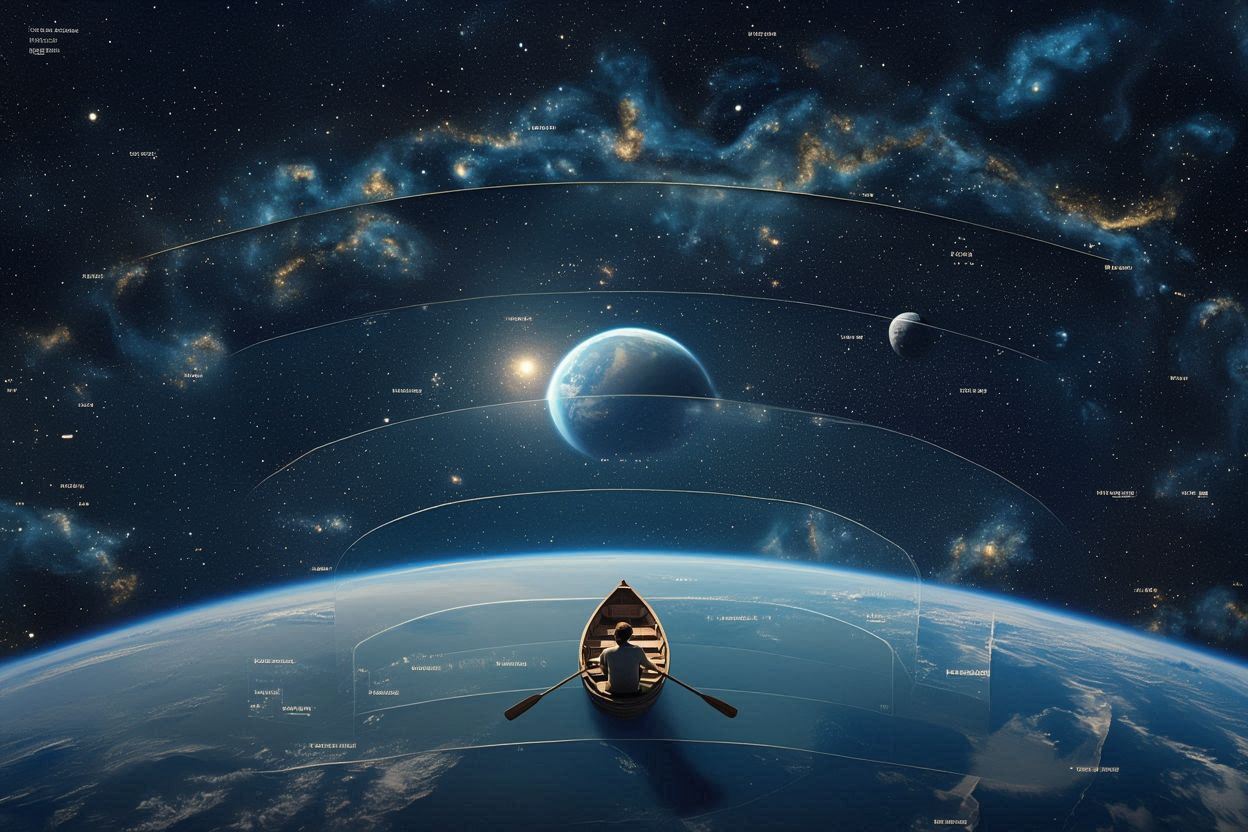
How DESI’s new measurements, dark-matter puzzles, and a forgotten educational film reveal the hidden structure of physics.
Throughout 2024 and 2025, the DESI collaboration has released a wave of major cosmological results.
- In November 2024, DESI’s full-shape clustering analyses (DESI 2024 Papers V and VII) used 4.7 million galaxy and quasar redshifts to trace 11 billion years of cosmic structure.
- In 2025, DESI released its Data Release 2 (DR2) BAO results, expanding to even larger volumes.
- And in October 2025, the DR2 BAO measurements were formally published in Physical Review D, consolidating DESI’s most precise distance-scale constraints to date.
Together, these results reinforce the standard cosmological model — but they also sharpen subtle questions that refuse to go away. Small discrepancies appear between probes of the Universe’s “clumpiness” (σ8, S8), and DESI DR2 even shows a 2.8–4.2σ preference for dynamical dark energy (the w0–wa model) over a cosmological constant, depending on which supernova dataset is used.
None of these tensions constitute new physics. But they all point in one direction:
Cosmology is a science of scales, and the scale you measure determines the story you hear.
To understand that, you have to think the way the Universe is built: in powers of ten.
And oddly enough, a 1977 educational film is still the best introduction to that idea.
1. Signals Die in Decades, Not Metres
Signals in physics rarely fade linearly. They collapse in powers:
- angular size falls as 1/r
- photon flux falls as 1/r^2
- radar return falls as 1/r^4
- gravity falls as 1/r^2
Detectability doesn’t decline — it drops off cliffs.
Example: Seeing a human from 1 AU
A human reflecting ~100 W of sunlight yields only about 0.07 visible photons per second through a 10-m telescope at 1 AU. Background noise is ~50 photons per second. Instantaneous SNR ≈ 0.01.
Reaching SNR ≈ 5 takes three days of continuous observing under ideal conditions.
At 10 AU, the signal is 100 times weaker → integration time becomes 10,000 times longer.
Visibility vanishes in decades, not metres.
Cosmology operates in exactly this geometry.
2. Why the “Powers of Ten” Films Were Accidentally Right
The films misrepresented astrophysics but captured the deeper truth:
physics changes regime in multiplicative steps.
- millimetres → continuum mechanics
- nanometres → quantum mechanics
- metres → Newtonian dynamics
- kilometres → geophysics
- megametres → orbital mechanics
- megaparsecs → cosmology
Quantum mechanics and general relativity are always present, but the dominant effective theory changes when you cross large scale ratios.
The films visually anticipated what the renormalisation group (RG) later formalised: laws don’t change — relevance does.
3. Dirac’s Large Numbers: Early Glimpses of Scale Physics
In 1937, Paul Dirac noted that several unrelated dimensionless ratios of nature cluster around 10^39–10^40. His proposed explanation was wrong, but the pattern he noticed was real:
physics contains extreme separations of scale.
These arise naturally from:
- symmetry breaking across dozens of decades
- RG flow across dozens of decades
- gravity’s uniquely weak coupling
- primordial fluctuations amplified by cosmic expansion
Dirac misidentified the mechanism, but recognised the architecture.
4. DESI and the Scale Problem in Modern Cosmology
DESI’s 2024 full-shape results and its 2025 DR2 BAO measurement sharpen an important truth: different cosmological probes give slightly different answers because they operate at different scales.
Not dramatic discrepancies. Not contradictions. But persistent across:
- weak lensing
- CMB lensing
- galaxy clustering
- redshift-space distortions
- cluster counts
And now:
- dynamical dark energy fits (w0–wa) show 2.8–4.2σ preference over ΛCDM when DESI DR2 is combined with certain supernova datasets.
These signals are small — but they appear across decades of cosmic scale.
Tanveer Karim, a University of Toronto astrophysicist and lead author of a DESI comparison between emission-line galaxies and CMB lensing, put it cleanly:
“The tension keeps popping up in various galaxy surveys, so is it signaling something to us?”
Nothing in DESI implies exotic gravity.
But DESI does demonstrate that cosmological inference is scale-dependent, and mild tensions often arise because each probe samples a different decade of structure.
5. Dark Matter: The Universe’s Most Extreme Scale Separation
Dark matter is visible only in the one channel that survives enormous scale changes: gravity.
Gravity reveals dark matter in:
- galaxy rotation curves
- cluster lensing
- the cosmic web
Every other interaction collapses:
- electromagnetic → effectively zero
- nuclear scattering → suppressed by dozens of orders of magnitude
- collider production → cross-sections fall steeply with mass
- indirect detection → depends on density squared; signal dies in most environments
Dark matter looks “simple” only because gravity is the last surviving signal.
Modern models explicitly encode scale separation:
- self-interacting dark matter (SIDM) changes behaviour from dwarfs to clusters
- ultralight fuzzy dark matter has kiloparsec-scale quantum wavelengths
- warm dark matter suppresses small-scale structure
- sterile neutrinos span ∼20 decades of mixing angle
These aren’t points in parameter space. They’re logarithmic landscapes.
DESI’s mapping of structure across 10^3 in scale strengthens this view.
6. The Renormalisation Group: The Universe’s Operating System
RG flow formalises what Powers of Ten hinted at:
- coarse-grain
- rescale
- see what laws emerge
This explains why:
- quarks become hadrons
- molecules become fluids
- Newtonian gravity emerges from general relativity
- cosmic structure arises from tiny initial fluctuations
DESI’s clustering and BAO measurements are, in effect, RG experiments: a test of how structure behaves from kiloparsecs to gigaparsecs.
Cosmology is a scale-transformation laboratory.
7. Why Thinking in Powers of Ten Matters
For three reasons:
1. Physics appears layered not because laws change, but because relevance changes.
2. Detectability collapses in cliffs, not slopes — SNR is logarithmic.
3. Cosmology’s mild tensions arise because each probe samples a different decade of structure.
The old educational films were right for the wrong reasons.
The Universe doesn’t think in metres. It thinks in ratios. It thinks in logs. It thinks in powers of ten.
Leave a Reply