Category: Culture

Culture

  • Archibald Cregeen and the Cultural Work of the Manx Dictionary

    Archibald Cregeen and the Cultural Work of the Manx Dictionary

    Life and background

    Archibald Cregeen was born in late October or early November 1774 at Colby, in the parish of Arbory in the Isle of Man. His father, William Cregeen, was a cooper and smallholder, and the family lived at the farm known as Ballacregeen. His mother, Mary Fairclough, was Irish by birth.

    Cregeen appears to have had little formal education. He was trained as a stone and marble mason, a trade that required literacy, accuracy, and familiarity with commemorative inscription, and which he practised for much of his adult life. His later command of English prose and grammatical analysis indicates sustained self-education alongside manual work. Manx was his first language, and English was acquired subsequently.

    In 1798 Cregeen married Jane Crellin, and shortly afterwards built a small cottage close to his father’s holding at Ballacregeen, where he and his family lived for the remainder of his life. The household depended on his earnings as a tradesman and, later, on income derived from public office.

    In 1813 Cregeen was appointed Coroner of Rushen Sheading. At that period the office involved holding inquests into deaths, summoning and impanelling juries in certain cases, and executing legal process on behalf of the courts. He held the position for many years while continuing to work as a mason and to compile his dictionary.

    Cregeen worked on his dictionary over a long period, beginning around 1814. According to the memoir by J. M. Jeffcott (1890), who knew him personally, Cregeen devoted much of his spare time to collecting words, idioms, and proverbs from native speakers, often visiting cottages in the evenings for this purpose. Jeffcott’s account is anecdotal rather than scholarly, but it accords closely with the nature of the material preserved in the dictionary, particularly its extensive body of proverbial and idiomatic language.

    The argument developed below is that the dictionary’s evidential value lies as much in idiom and usage as in lexical equivalence.

    Jeffcott also records that the work placed strain on domestic life and that Cregeen received little financial return for his labour. In 1827 Cregeen suffered a serious leg fracture, during which period he devoted increased time to organising his materials. He died on 9 April 1841 and was buried in Arbory churchyard. His memorial inscription describes him simply as the author of the Manx dictionary and states that he “lived respected and died lamented.”


    The Dictionary: genesis, method, and publication

    The preparation of Cregeen’s Dictionary of the Manks Language arose from the absence of any comprehensive printed lexical record of Manx. Although John Kelly had compiled a Manx–English dictionary manuscript in the late eighteenth century, it remained unpublished during Cregeen’s lifetime, and there is no evidence that Cregeen ever had access to it. His decision to undertake a dictionary was therefore made independently and at considerable personal cost.

    Cregeen’s work proceeded without institutional sponsorship. He supported himself through his trade as a mason and through his office as coroner, devoting only such leisure as he could spare to lexicographical work. Encouragement and limited assistance came from individual members of the Manx clergy, most notably the Rev. John Edward Harrison, Vicar of Jurby, who urged Cregeen to persevere and offered scholarly support. The extent of Harrison’s involvement cannot now be determined with certainty.

    Method and sources

    The dictionary was compiled over nearly twenty years and drew upon both written and oral sources. The written corpus available to Cregeen was limited but linguistically rich, consisting chiefly of the Manx Bible, the Book of Common Prayer, Thomas Christian’s Manx translation of selections from Paradise Lost, and vernacular religious texts. These provided a substantial portion of the lexicon and many illustrative citations.

    Equally important was Cregeen’s collection of material from living speakers. Contemporary accounts describe him eliciting vocabulary, idioms, and proverbs directly from everyday speech. Much of the proverb material preserved in the dictionary can only have been obtained in this way, lending the work a documentary value that extends beyond literary Manx.

    The compilation itself was manual and laborious. Cregeen worked with loose slips, repeatedly copied, rearranged, and alphabetised. His arrangement followed a strictly alphabetical order of word-forms, including mutated forms, rather than grouping by lexical root. While this dispersed related forms, it made the dictionary more accessible to readers unfamiliar with the mutation system and reflects a practical orientation toward users rather than theoretical classification.

    A distinctive feature of the work is its grammatical detail. Cregeen marked parts of speech, gender, stress, and mutation throughout, adapting material from Kelly’s Manx Grammar (1804) while supplementing it with his own observations. Taken as a whole, the dictionary remains a major source for the study of Classical Manx vocabulary and morphology.

    Publication history

    The publication of the dictionary was protracted. Subscription notices appeared by 1833, and Cregeen’s introduction is dated 5 June 1834. Although the title page bears the date 1835, modern bibliographical research shows that the dictionary was first actually published in May 1837. It was printed and published in Douglas by J. Quiggin and issued initially to subscribers.

    Unsold sheets were later reissued, some with missing or reset sections. As a result, more than one textual state of the first edition exists. Modern scholarship distinguishes a complete “A” version from several defective “B” versions, many of which underlie later reprints. Despite these complications, the dictionary remains the first published dictionary of the Manx language and the foundation of all later Manx lexicography.


    Lexicography as cultural memory: more than a dictionary

    Although formally a dictionary, Cregeen’s work consistently exceeds the limits of utilitarian lexicography. The title page advertises that it is “interspersed with many Gaelic proverbs,” and this is borne out by the text, in which a large number of proverbial expressions are explicitly marked Prov. and distributed throughout the dictionary.

    These proverbs range from short sentential observations to more fragmentary but recognisably traditional phrases, often embedded within lexical entries to illustrate meaning in use. Taken together, they encode communal judgement, humour, and practical reasoning, and concern work, weather, character, patience, thrift, kinship, and fate—precisely those aspects of life least likely to appear in formal texts.

    Seen in this light, the dictionary may be read as a lexicalised social history. It records not only what words existed, but how Manx speakers judged, warned, joked, worked, and remembered. It is a history written through language itself, at a moment when Cregeen perceived that much of this everyday knowledge was under threat.


    Cregeen versus Kelly: two dictionaries, two visions of Manx

    The contrast between Cregeen’s dictionary and that of John Kelly becomes clear when the two are read side by side. Kelly’s dictionary is a text-based, clerical lexicon, organised from English to Manx and grounded primarily in written sources. Its purpose is coverage and systematisation: to demonstrate that Manx can render the full semantic range of English, including abstract and technical vocabulary.

    Cregeen’s dictionary depends on oral encounter. Where Kelly builds outward from English prompts, Cregeen builds inward from Manx speech. Where Kelly’s work aspires to encyclopaedic breadth, Cregeen’s aspires to cultural depth. Proverbs and idiomatic usages are systematically foregrounded in Cregeen, while in Kelly they are sparse, unmarked, and largely incidental, reflecting fundamentally different conceptions of what it means to preserve a language.

    Kelly’s dictionary could, in principle, be compiled from books. Cregeen’s could not. The difference is not one of competence, but of purpose. Kelly sought to systematise Manx; Cregeen sought to preserve how it was spoken and understood among ordinary people.


    Reception and reputation

    During Cregeen’s lifetime and immediately after his death, the dictionary was recognised locally as a work of unusual ambition and importance, though it did not achieve commercial success. Clergy and educators made use of it, and it was valued for its inclusion of proverbs and idiomatic material.

    Cregeen’s local reputation was high. His memorial inscription records that he “lived respected and died lamented,” a judgement consistent with recollections preserved by those who knew him personally. Jeffcott’s memoir portrays him as self-educated, persistent, and modest in manner, while also recording the practical difficulties under which the work was produced.

    Later scholarship has clarified the dictionary’s publication history and corrected long-standing misconceptions arising from incomplete editions. In this light, Cregeen is now seen neither as a rustic amateur nor as a flawless pioneer, but as a careful and determined lexicographer whose work remains indispensable.


    Conclusion

    Read alongside Kelly’s dictionary, Cregeen’s work emerges as a different kind of undertaking. It is not merely a linguistic tool, but a deliberate attempt to preserve the texture of Manx life as it was spoken, judged, and remembered. In choosing proverbs and idioms as objects of care, Cregeen used the dictionary form to write a history of his people in the only durable medium available to him.


    Appendix: Small Bestiary of Archibald Cregeen

    (Words and sayings from the Dictionary that show why it matters)

    What follows is a small, affectionate sampling from Archibald Cregeen’s Dictionary of the Manks Language. These are not chosen for rarity or oddity alone, but because they show how Manx speakers noticed the world: bodies, weather, work, inconvenience, humour, and judgement.

    Cregeen did not collect curiosities. He collected what people actually said.


    Words for the body and its indignities

    • BREIM, s. m.
      Posterior flatulency.
      (Cregeen does not flinch. Nor did Manx.)
    • BREIMEYDER, s. m.
      A breaker of wind.
      (A language that names this probably names most things worth naming.)
    • GOORLAGH, s. m.
      The grume of the eye.
      (So specific it almost requires morning light.)
    • GLOUT, s. m.
      A shapeless lump of any thing.
      (A triumph of judgement over taxonomy.)

    Words of work, land, and inconvenience

    • GRIBBEY, s. m.
      The hollow for dung in a cowhouse.
      (Language that knows where things belong.)
    • KECKSEE, s. m.
      One that is besmeared with excrement.
    • JEENAGH, s. m.
      The rinsing of the milking vessels, after the milk has been drained.  .

    Weather, light, and time

    • OIE-REHOLLYS, s. f.
      A moonlight night.
      (A word for walking, not for poetry.)
    • MARKYM-JEELYM, s. m.
      The shaking or vibration of the sun shine on the ground on a hot sun shiny day.

    Words of judgement (Manx does not waste adjectives)

    • SHANG, a.
      Lank, lean, empty, not swelled or puffed out.
      (“Very expressive of the state,” as Cregeen dryly notes.)
    • NEU-GHOOIE, a.
      Unkindly, barren.
      (Moral judgement, not physical description.)
    • COOISHAGH, a.
      Desirous of information or knowledge, wily, sly.
      (Judgement encoded as temperament.)

    Proverbs (where Manx thinking really lives)

    These are not literary ornaments. They are instructions for getting on with life.

    Foddee yn moddey s’jerree tayrtyn y mwaagh.
    The last dog may catch the hare.

    Cha smooinee rieau er yn olk nagh ren.
    One never thinks of the evil one did not do.

    Ta’n Vayrnt çhionney as yn nah vee fanney.
    March tightens, and the next month flays.

    Ta fooillagh naareydagh ny smelley na ee scammyltagh.
    Shameful leavings is worse than disgraceful eating.

    S’giare y jough na yn skeeal.
    Shorter is the drink than the story.


    A final small observation

    Most of these words and sayings could not have been taken from books. They belong to fields, kitchens, cowhouses, and evening talk. Their survival depends almost entirely on the fact that one man thought them worth walking for, listening for, and writing down.

    That is why Cregeen’s dictionary is not just a list of words.
    It is a record of how Manx people noticed the world.


    Sources and acknowledgements

    This essay draws primarily on Archibald Cregeen’s Dictionary of the Manks Language (first published 1837), read alongside John Kelly’s Manx dictionary and grammar.

    Biographical detail is taken from parish records, Cregeen’s memorial inscription at Arbory, the late nineteenth-century memoir by J. M. Jeffcott (used with caution as anecdotal evidence), and modern Manx scholarship, particularly the work of Max W. Wheeler on the textual history of Cregeen’s dictionary.

    Manx National Heritage catalogues were also consulted.

    Any errors are my own.

  • English as Interface

    English as Interface

    Legibility, Transactional Speech, and the Loss of Relational Compression


    Abstract

    This article argues that contemporary Standard English—particularly as used in educated, mobile, institutional, and digitally mediated contexts—has shifted from functioning primarily as a relational medium to functioning as an interface language: a system optimized for coordination, legibility, and auditability among strangers. While interface registers have always existed in urban and commercial societies, contemporary conditions have rendered interface language dominant, penetrating domains once governed by relational speech. This shift has reduced the language’s capacity for relational compression, the implicit encoding of social judgment, moral stance, and affect within ordinary speech. The result is not merely stylistic change but a transformation in how social life is regulated, producing audit culture, brittle political discourse, therapeutic over-explicitness, authenticity anxiety, vocabulary thinning, and the siloing of lexical density into professional jargons. These changes are framed not as cultural decline but as adaptation to legibility regimes enforced by global institutions, digital communication architectures, educational transformation, and the global dominance of American English as an interface template.


    1. Scope and Register

    This paper focuses on educated, mobile, institution-facing varieties of contemporary English, particularly those dominant in professional, managerial, bureaucratic, and online public contexts. It does not claim that relational compression has disappeared from all English registers. Many working-class, minority, and creole varieties retain high levels of relational density, as do certain tightly bounded professional subcultures. The argument concerns which registers now dominate public, institutional, and increasingly private life—and what is lost when they do.


    2. Relational and Interface Language: Historical Baseline

    Interface language is not new. Urban, commercial, imperial, and bureaucratic societies have always required registers optimized for coordination among non-intimates: trade languages, legal codes, administrative prose, formal standards. Historically, however, such registers were domain-bounded.

    Relational language governed:

    • home
    • friendship
    • informal work
    • local politics
    • moral regulation
    • everyday social repair

    Interface language governed:

    • markets
    • law
    • bureaucracy
    • trade
    • imperial administration

    The novelty of the present situation lies not in the existence of interface language, but in its dominance and domain expansion. Interface conditions have migrated into spaces once governed by relational norms: workplaces, friendships, political discourse, romantic life, and even internal self-narration.


    3. From Relational Language to Interface Language

    Historically, most everyday language use occurred within dense, repeated social contexts. In such environments, language did more than transmit information: it regulated relationships, enforced norms, corrected behavior, and encoded moral expectations implicitly.

    In contrast, contemporary Standard English increasingly operates as an interface:

    • optimized for clarity to non-participants
    • hostile to ambiguity and ellipsis
    • oriented toward documentation
    • safe under inspection by strangers

    This shift is not ideological or aesthetic. It is structurally selected. In globalized institutions, ambiguity is costly, misinterpretation risky, and shared background unreliable. Language adapts accordingly.


    4. Legibility as the Driving Constraint

    The central explanatory variable is not English itself, but legibility.

    Modern institutions and platforms demand that:

    • actions be inspectable
    • intentions be explicit
    • meanings be defensible
    • interactions be recordable

    Language becomes the primary infrastructure through which legibility is enforced. As a result:

    • implicit meaning becomes liability
    • silence becomes suspicious
    • compression becomes dangerous

    Audit culture emerges not because people are paranoid, but because implicit coordination no longer functions reliably under conditions of scale, mobility, and heterogeneity.


    5. Relational Compression (Formal Definition)

    Relational compression refers to the capacity of a linguistic form to encode social judgment, affect, and normative guidance implicitly, relying on shared context rather than explicit articulation. Compression is not mere brevity; it is semantic and pragmatic density sustained by trust, familiarity, shared history, and mutual accountability.

    Relational compression allows language to:

    • regulate behavior without explanation
    • correct without confrontation
    • judge without accusation
    • repair without escalation

    6. Transactional vs. Relational Speech

    The distinction is functional, not aesthetic.

    Relational speech:

    • presumes shared norms
    • tolerates ambiguity
    • compresses judgment and affect
    • regulates behavior obliquely

    Interface (transactional) speech:

    • avoids presumption
    • externalizes meaning
    • requires explicit articulation
    • is safe for strangers and systems

    Contemporary English increasingly defaults to the latter—even in domains once governed by the former.


    7. Interface Conditions as Architectural Enforcement

    The dominance of interface language is not merely cultural but architectural. Digital communication systems—email archives, Slack workspaces, document trails, social media feeds—produce permanent, searchable records that collapse context and multiply audiences. Language becomes evidence.

    What can be screenshotted must be defensible to non-participants.
    What can be forwarded must survive hostile reinterpretation.

    These material conditions enforce:

    • lexical caution
    • emotional flatness
    • explicitness
    • avoidance of relational compression

    Legibility is not simply expected; it is built into the communicative environment.


    8. The API for Strangers

    Language has always had interface modes. What is new is that the interface has become the default operating environment.

    When language functions primarily as an API for strangers, social relations increasingly resemble service interactions:

    • consent becomes a terms-of-service negotiation
    • apologies function as error-handling protocols
    • boundaries are explicit contracts
    • friendships acquire implicit service-level expectations

    These forms are not insincere. They are adaptive. But they are procedural rather than relational, because the language can no longer safely presume shared background.


    9. Consequences

    This shift helps explain:

    • brittle political discourse (everything must be litigated)
    • semantic policing and screenshot anxiety
    • proceduralized morality
    • authenticity obsession
    • symbolic substitutes for grounding (sports allegiance, taste signaling, endurance rituals)

    The framework removes blame. People are not becoming fake or overly sensitive by choice. They are adapting rationally to interface conditions.


    10. Therapeutic Over-Explicitness

    In relational contexts, emotion is regulated implicitly through tone, timing, silence, and shared norms. Under interface conditions, such regulation becomes risky.

    As a result, emotional life is increasingly narrated rather than enacted:

    • feelings must be named
    • boundaries articulated
    • harm specified
    • repair verbalized

    Therapeutic language proliferates not because people are self-obsessed, but because implicit repair no longer functions safely. Emotional explicitness is a compensatory adaptation to legibility pressure.


    11. Class Asymmetry and Risk

    The loss of relational compression is class-skewed, not evenly distributed.

    Working-class and minority speakers are routinely required to accommodate upward into interface registers in order to be legible within institutional contexts. Middle-class speakers, by contrast, are more likely to already inhabit the default interface register and face reputational risk when adopting stigmatized relational forms.

    This asymmetry is empirically visible. A 2023 study by the Sutton Trust found that 33% of UK state school students reported feeling pressure to change their accent or vocabulary in order to succeed professionally, compared to only 12% of privately educated students. This suggests that legibility pressure operates as a hidden cost of social mobility, disproportionately borne by those whose home speech diverges from institutional interface norms.

    What is mandatory for one group is optional—and often punishable—for another. Linguistic accommodation thus functions as a classed burden, not a neutral expectation.


    12. Vocabulary Thinning: A Multi-Causal Account

    Vocabulary thinning is real, but it is often misdescribed.

    What has thinned is not intelligence or total vocabulary, but the set of words safe for public use.

    This thinning results from the interaction of three forces:

    a) Legibility Pressure

    Unfamiliar vocabulary:

    • slows coordination
    • triggers hierarchy anxiety
    • invites misinterpretation

    Speakers self-limit lexical reach to avoid friction.

    b) Platform Architecture

    Permanent records, searchability, and context collapse enforce caution.
    What can be screenshotted cannot afford complexity.

    c) Educational Transformation

    Post-1970s educational changes—decline of grammar schools, reduced compulsory exposure to dense literature, diminished shared canon—have reduced the shared cultural hinterland that once made lexical ambition legible rather than threatening.

    This is compounded by American influence: pragmatic, instrumental English optimized for action and clarity rather than allusion and resonance.

    Educational transformation has implications beyond vocabulary. Relational compression depends on shared reference systems—biblical narratives, historical episodes, canonical texts, and proverbial reasoning—that once functioned as common cultural infrastructure. As these substrates are no longer widely transmitted, the materials required for compression erode. In such conditions, even speakers who value relational density may lack the shared background that makes compressed language legible. Interface language thus becomes dominant not only because it coordinates better, but because it is increasingly the only language that reliably works.


    13. What Vocabulary Has Been Lost or Sidelined

    Endangered registers include:

    • literary adjectives (mordant, fecund, turgid)
    • moral and aesthetic terms (dignity, grace, nobility)
    • allusive speech drawing on biblical, mythological, or historical reference

    These are replaced by emotionally flat evaluators (toxic, valid, problematic) that travel safely but compress little.

    Lexical density has not disappeared—it has fragmented. High-density vocabulary now survives primarily in narrow professional jargons, where it signals status rather than shared cultural grounding.


    14. Resistance and Adaptation

    Speakers are not passive. They attempt to preserve relational density through:

    • code-switching
    • in-group slang
    • private channels
    • irony and opacity

    Certain professional subcultures (medicine, military, trades, emergency services) retain relational compression because interface norms are functionally impossible where time, trust, and hierarchy are non-negotiable.

    Others exploit interface brittleness strategically:

    • malicious compliance
    • hyper-literalism
    • over-documentation
    • weaponized transparency

    These strategies demonstrate agency within constraint, but they do not reverse the dominance of interface language. They create pockets of resistance, not a return to relational norms.

    15. American English as Interface Template

    The global dominance of American English has accelerated the shift described in this article, not merely through cultural influence but through structural fitness. American English developed under conditions of extreme heterogeneity—mass immigration, geographic mobility, weak assumptions of shared background—and thus evolved as a language optimized for coordination among strangers.

    As a result, American English privileges:

    • explicitness over ellipsis
    • clarity over allusion
    • pragmatism over resonance
    • emotionally flattened evaluative language
    • “understandability” as a moral good

    These features made American English a ready-made interface template for global institutions, digital platforms, and multinational workplaces. When legibility demands intensified, American English did not simply spread through power; it spread because it already matched the requirements of large-scale coordination.

    British, Caribbean, and other English varieties were consequently pressured to converge—not because they were deficient, but because they were less interface-compatible.


    16. Not Decline, but Trade-Off

    This is not a nostalgia argument. Interface language enables:

    • global coordination
    • accountability
    • rights enforcement

    But it trades away:

    • implicit moral regulation
    • low-cost social correction
    • shared cultural hinterland

    What is lost is not a value, but the background that made values self-evident.


    Conclusion

    English has not failed. It has succeeded as a global interface. But this success carries a social cost of legibility. When interface conditions dominate, language becomes procedural, vocabulary thins, emotional life is narrated rather than regulated implicitly, and belonging must be signaled rather than assumed. The unease many speakers feel is not cultural decay or personal inadequacy; it is life lived under permanent legibility. We are exhausted because we are constantly “rendering” ourselves in a language meant for strangers. We are narrating our feelings, auditing our jokes, and proceduralizing our friendships because the “Background Knowledge” that used to do that work for us has been stripped away to make us more legible to the machine.


    Appendix: Relational Compression in Practice

    Bajan English as Empirical Evidence

    This appendix demonstrates relational compression as a concrete linguistic system, not an abstraction. The following examples from Bajan English demonstrate what Standard English has lost: a system of linguistic shortcuts that regulate behavior implicitly, preserving face and maintaining equilibrium without explicit negotiation.


    A. Proverbs as Moral Algorithms

    “Who the cow like he lick, who he don’t like he kick.”

    This proverb encodes:

    • a theory of favoritism
    • a warning against resentment
    • advice not to overinterpret unfairness

    Truncated form:

    “Who the cow like…”

    The listener supplies:

    • the full proverb
    • the moral stance
    • the implied behavioral adjustment

    Function: closes the issue without debate.


    B. Lexical Inversion: “Smart”

    “He smart.”

    In Bajan usage:

    • smart ≠ clever
    • smart = sly, trickster, socially untrustworthy

    This single word:

    • warns others
    • reframes admiration as suspicion
    • avoids direct accusation

    Function: guides behavior without escalation.


    C. Boundary Enforcement: “You gipsy”

    Meaning:

    • you are too inquisitive
    • you are overstepping
    • stop talking / stop asking

    This phrase:

    • enforces conversational limits
    • preserves social harmony
    • avoids explicit confrontation

    Function: immediate behavioral correction.


    D. Semantic Drift as Social Control: “Malicious”

    In Bajan:

    • not “evil”
    • means excessively nosy, intrusive, going too far

    Calling someone malicious signals:

    • boundary violation
    • moral overreach
    • need to pull back

    Function: correction without accusation.


    E. Reputation Warnings: “He dangerous”

    Meaning:

    • not physically violent
    • socially hazardous
    • gossips, spreads trouble

    This phrase:

    • protects listeners
    • manages reputations
    • avoids defamation

    Function: early warning system.


    F. Moral Realignment and Face-Saving: “God don’t like ugly”

    This phrase is typically said by the person who has been bested.

    Its function is not to admit defeat.

    Instead, it:

    • reframes loss as moral victory
    • invokes divine judgment on the trickster
    • preserves dignity
    • restores moral order without contesting the outcome

    The speaker may claim they are “calling down God’s judgment,” not consoling themselves.

    Function:

    • consolation without concession
    • moral closure without argument

    This is a powerful example of relational language allowing psychological repair while maintaining social posture—something interface language cannot achieve without explicit self-disclosure.


    G. What These Examples Show

    Across all cases:

    • multiple social functions are compressed into minimal speech
    • meaning depends on shared moral background
    • behavior is regulated without documentation
    • conflict is defused without explicit negotiation

    This is language as social governance, not information transfer.


    H. Why This Cannot Survive Interface Conditions

    These forms fail under:

    • screenshots
    • HR review
    • global audiences
    • legal audit

    Not because they are inferior, but because:

    they cannot be defended to strangers

    They presuppose trust rather than consent.


    Final Appendix Claim

    Relational compression consists of culturally stabilized linguistic shortcuts—proverbs, semantic inversions, evaluative adjectives, and idiomatic rebukes—that regulate social behavior implicitly, relying on shared moral knowledge rather than explicit articulation.

    Bajan English shows this system functioning at high efficiency.
    Its erosion elsewhere is not accidental.
    It is the predictable outcome of life under permanent legibility.

  • The Return of the Unexplained: How Movies Stopped Explaining Everything

    The Return of the Unexplained: How Movies Stopped Explaining Everything

    A quiet shift has taken hold in Anglo-American filmmaking. A growing group of directors is bringing the supernatural back into realism. Not as metaphor, not as trauma symbolism, not as dream logic, but as simple, literal fact.

    Films like Under the Skin (2013), The VVitch (2015), Longlegs, Weapons and Bugonia all follow the same unexpected pattern: they build a world with documentary-level seriousness, then let something impossible walk straight through it without blinking.

    The VVitch sits in the middle of this timeline—closer to Under the Skin’s early experiment than to the recent cluster—yet it anticipates the new mode far more directly than most films of its era.

    It’s not fantasy and it’s not allegory. It’s a change in the terms of realism itself.

    And what’s remarkable is not just that filmmakers are doing this. It’s that audiences, who once rejected this kind of move outright, now accept it.

    Something in the culture has shifted.


    How These Films Actually Work

    Longlegs The opening is pure procedural: case files, FBI rhythms, forensic logic. It earns your trust by showing you a world that obeys rules. Then, without fanfare, the film reveals a reality the investigation can’t account for. The shock is conceptual rather than visual: the world is larger than the tools used to interpret it.

    Bugonia An alien arrives. No backstory, no cosmology, no symbolic wink. The film treats the creature with the same plainspoken camera language it uses for everything else. A ruined world hangs behind it, but that world stays opaque. The mystery isn’t a puzzle; it’s a condition.

    Weapons The film begins in grounded ensemble realism: teenagers, suburban routines, handheld immediacy. When the supernatural element appears, it does so without stylistic exaggeration or symbolic framing. The witch figure is presented with the same visual sobriety as the everyday world around her. The violence that follows is neither allegorised nor psychologised; it simply happens. Weapons uses realism as a trapdoor, and when it opens, the film refuses to translate the impossible into metaphor.

    The VVitch The witch is not a projection of Puritan anxiety or an allegory about repression. She’s real. The horror comes from the collapse of the explanatory worldview the characters rely on. The film doesn’t ask whether the supernatural exists; it asks what happens when it does and no one knows how to interpret it.

    Under the Skin A decade earlier, Glazer was already testing the boundaries of this style. The film shoots Glasgow crowds, housing estates, and nighttime roads like vérité documentary, then quietly introduces the alien sequences without changing tone or visual language. The impossible arrives inside realism and the film simply accepts it. But in 2013, audiences weren’t yet primed to recognise this as a coherent narrative technique. In hindsight, Under the Skin reads as an early prototype for the pararealist shift that would only fully emerge years later.

    Across all these films, the structure is the same: realism → rupture → continuation. The story keeps going even when the world has outgrown its explanations.


    Why “Pararealism” Is the Right Name

    Existing labels don’t quite fit.

    Folk horror implies rural tradition and ancestral dread. Magical realism normalizes the supernatural instead of treating it as a shock. The New Weird deals in ecological grotesquery and destabilized worlds.

    But what these new films share is a technique, not a genre:

    Begin in strict realism. Introduce the impossible with no tonal shift. Refuse interpretive escape hatches (no dream sequence, no metaphor reveal). Keep the realist style intact after the world breaks.

    That method deserves its own term: pararealism—the uncanny running parallel to the real, treated with the same gravity.


    Why Audiences Accept It Now

    Not long ago, test audiences might have laughed these films off the screen. Now they draw applause. Why?

    1. Irony fatigue After years of meta-jokes and narrative reassurance, outright sincerity, especially in horror, feels radical.

    2. Higher media literacy Viewers understand genre grammar well enough to tell when a film is deliberately withholding explanation.

    3. The collapse of explanatory confidence Political chaos, algorithmic feeds, epidemiological disorder :life itself has stopped cohering into tidy cause-and-effect. Films that don’t add up feel proportionate, not broken.

    4. Horror’s mainstreaming Horror’s audience is now broad, literate, and willing to meet films on their own terms.

    5. Social realism’s limits Traditional realist drama can struggle to express contemporary dread. Reintroducing literal mystery gives filmmakers a different register to work in.

    Audiences didn’t suddenly start believing in witches or aliens. They just stopped insisting that stories must explain themselves.


    The Global Precedent

    None of this is new outside the Anglo-American industry.

    Latin American magical realism has long folded the inexplicable into everyday life. Japanese cinema, from Kwaidan to Kiyoshi Kurosawa, treats the supernatural as a structural fact. Eastern European directors like Švankmajer and Żuławski built entire careers on ontological instability.

    What’s new is that U.S. and U.K. filmmakers, historically loyal to tidy causal logic, are finally adopting a global technique. Pararealism is less an invention than a belated adoption of an existing cinematic language.


    Fantasy’s Diverging Road

    Interestingly, fantasy literature has gone the opposite direction. Much of the market now rewards systematized magic, rulebooks disguised as novels, cosmologies built with spreadsheets. That’s not universal, Miéville, VanderMeer, Valente, and Jemisin keep the unexplained alive, but it is the dominant trend.

    Piranesi shows a different approach. Its psychological explanation resolves the plot, but the House, the great, echoing architecture of tides and statues, remains metaphysically ungraspable. The mystery coexists with the rational layer.

    Pararealist cinema goes further. Films like Longlegs, Weapons, and The VVitch don’t preserve two layers; they simply decline to provide the psychological one at all. The inexplicable isn’t matched with an explanation :it stands alone.


    Why This Matters

    Pararealism marks a shift in our narrative expectations. It says the unexplained is not a failure of storytelling but a valid part of how the world feels right now.

    These films aren’t asking to be solved. They’re asking to be lived with.

    The impossible appears; the camera holds; the story continues. Meaning comes not from decoding symbolism, but from accepting that some phenomena resist interpretation.

    We used to watch movies to resolve the world. Now, increasingly, we watch them to reflect a world that refuses resolution.

  • Unresolved Q: A Control-Theoretic Account of “Ache” in Creative AI

    Unresolved Q: A Control-Theoretic Account of “Ache” in Creative AI

    Current generative models routinely produce fluent, stylistically correct music and prose that nevertheless feels empty—over-eager, prematurely resolved, or inert. This failure is often attributed to ineffable “taste” or human intuition. This article advances a narrower, testable hypothesis:

    A class of aesthetic effects—call one of them ache—depends on the strategic delay of resolution. Present generative systems are structurally biased toward early certainty, and that bias can be measured, counteracted, and tested.

    The proposal is not that taste is solved, nor that aesthetic agreement is universal. It is that a specific failure mode—premature entropy collapse—systematically pushes models into pastiche. We introduce Unresolved Q, a phase-dependent control signal that penalizes early commitment while preserving coherence, and we outline how it can be implemented without adding noise or encouraging incoherence.


    1. The Diagonalization Fallacy (as Hypothesis)

    Creative domains are compressible. Strong stylistic modes exist, and models find them easily. This motivates two hypotheses:

    • H1: In creative generation, the highest-likelihood continuation correlates with recognizability rather than necessity.
    • H2: Human editorial judgment often acts as a negative feedback that nudges output off dominant modes by resisting early closure.

    These are empirical claims, not axioms. The remainder of the article is concerned with how to test and operationalize them.


    2. “Kill Your Darlings” as a Search Problem

    Editors do not merely remove “bad” lines. They often delete lines that are locally satisfying but globally damaging. Computationally:

    A darling is a locally high-reward continuation that reduces future option value.

    This reframes a literary maxim as a search pathology: the system is too greedy. The problem is not beauty, but premature completion.


    3. Constraints, Serialism, and Jazz (Why Optimization Isn’t the Enemy)

    The framework must account for creative traditions that optimize heavily.

    Constraint-based art (e.g., Oulipo)

    Constraints act as negative operators relative to unconstrained generation: they remove easy paths and structurally block early closure. This aligns with Unresolved Q by forcing the system to remain under-articulated longer.

    Serialism

    Rule-maximal systems can sound sterile, but when they achieve tension, it is often because perceptual resolution is delayed (e.g., through register, density, or timbral smear). The lesson is not “rules fail,” but “early perceptual discharge fails.”

    Jazz improvisation

    Jazz is real-time optimization, yet it routinely produces ache. The objective is tension trajectory over time, not immediate payoff. Training signals include:

    • delayed audience response,
    • internal prediction error (expected resolutions deferred),
    • social mirroring within the ensemble.

    These signals reward when to resolve, not merely what to play.


    4. Why Audio Models Appear to Do Better

    Audio affords continuous ambiguity: decay, microtiming, spectral blur. Ache can be carried by how sound unfolds without explicit symbolic decisions. Symbolic systems must decide every note or sentence; every decision asserts itself. Unresolved Q targets this assertion pressure.


    5. Unresolved Q, Precisely Defined

    5.1 Penalizing Premature Entropy Collapse

    Let pₜ(a) be the model’s distribution over possible next actions at step t.

    Entropy (Hₜ) measures how uncertain the model still is about what comes next. High entropy means many futures are still alive. Low entropy means the model has already decided.

    The entropy collapse rate (ΔHₜ) is how fast that uncertainty disappears from one step to the next.

    Unresolved Q introduces a penalty when entropy collapses too quickly, early in a phrase or idea — but only if the output remains coherent.

    Intuitively: a large early drop in entropy means the system “makes up its mind” too soon — confirming the tonic, closing the cadence, or explaining the point before enough tension has had time to build.

    Ache lives in that delay.

    Worked example (music)

    In a 4-bar melody:

    • Bar 1: broad options (setup).
    • Bar 2: a sharp cadence produces high ΔH. If voice-leading and rhythm remain coherent, the penalty applies, nudging the system to defer confirmation.
    • Bar 4: the penalty relaxes (see §6), allowing resolution.

    This is not entropy maximization; it is commitment timing.


    5.2 The Coherence Gate (Preventing Incoherence)

    The penalty applies only if coherence exceeds a threshold. Coherence can be enforced via:

    • hard constraints (grammar, voice-leading, register),
    • a learned discriminator trained on expert pairwise preferences (“A preserves structure while deferring closure; B collapses into noise”),
    • self-consistency: a move is coherent if it supports multiple distinct, structurally valid continuations at depth +k.

    This last criterion reframes coherence as future affordance, not present fit, allowing locally strange but globally fertile moves.


    5.3 Structured Uncertainty (Not Noise)

    Maintain branches where critics disagree about future value. Penalize moves that collapse this disagreement too early. This preserves meaningful alternatives rather than randomness.


    6. Resolution Windows: When Closure Must Occur

    Unresolved Q is phase-dependent, not absolute.

    Define resolution windows—points where closure becomes desirable (phrase ends, harmonic arrivals, narrative turns). Operationally:

    • The entropy-collapse penalty decays as the system enters a resolution window.
    • Resolution is rewarded if it discharges accumulated tension coherently.

    Unresolved Q ≠ never resolve. It means resolve at the right time.

    Without this decay, the system produces drone or glitch; with it, tension becomes meaningful.


    7. A Note on Games (Optional Analogy)

    In games with terminal outcomes (e.g., chess), hesitation costs Elo. Still, a delayed-commitment regularizer can improve robustness by preventing premature overfitting in non-tactical positions. This analogy motivates the mechanism (certainty control), not the aesthetic goal, and can be omitted without loss.


    8. Why Self-Play for Art Is Hard

    Self-play succeeds in games because loss is terminal and external. In art:

    • payoff is delayed and diffuse,
    • “winning early” (closure) can be bad,
    • drafts and deletions—the negative data—are largely invisible.

    Two partial substitutes:

    1. Repeated-exposure evaluation to capture fatigue.
    2. Counterfactual pruning to estimate lost optionality.

    These are imperfect but testable.


    9. Test 0: A Structural Stress Test

    Before human studies, run a symbolic stress test (e.g., MIDI/lead sheets, 16–32 bars).

    VariantDecodingUnresolved QResolution Windows
    BaselineGreedyn/a
    High-TempRandomizedn/a
    UQ-EarlyModerateImmediate
    UQ-GoldilocksModerateMid-phrase
    UQ-NeverModerateDisabled

    Automatic metrics

    • Entropy trajectory: sharp early drops (Baseline), noisy (High-Temp), high plateau then late drop (UQ-Goldilocks).
    • Structural validity: UQ-Goldilocks ≥85% of Baseline.
    • Cadence map: tonic circled, landed once late.

    Failure modes cleanly diagnose which component is broken.


    10. Conclusion

    Many creative failures in AI trace to premature certainty, not lack of knowledge. Unresolved Q reframes “ache” as a control objective: penalize early entropy collapse subject to coherence, then relax the penalty at resolution windows.

    This does not mystify taste. It renders a familiar human intuition—don’t cash out too early—into an implementable, falsifiable mechanism.

    Progress will come less from additional training data on great art, and more from systems that learn when not to decide yet—and when to finally decide.

  • Why English, Korean, French, and Japanese Sound Different in Pop Music

    Why English, Korean, French, and Japanese Sound Different in Pop Music

    And What Phonetics Has to Do With It

    If you listen closely to global pop, surprising patterns emerge.

    K-Pop choruses often switch into English. French pop leans into breathiness and rhythmic smoothness. J-Pop vocals sound almost hyper-precise. British singers begin to sound American the instant they hit a melody.

    These aren’t mysteries of national character. They aren’t cultural destiny or marketing coincidence.

    They come from something much more mechanical:

    Languages come with built-in acoustic affordances, and pop music pushes those affordances to their limits.

    Culture, economics, and history explain why certain genres went global. But phonetics quietly shapes how each language participates in those genres.


    1. Singing Isn’t Just Speaking at Pitch

    Singing forces the voice into a constrained system:

    • vowels stretch
    • consonants soften
    • pitch overrides natural intonation
    • rhythm is externally imposed

    Languages differ in things like:

    • vowel openness
    • stress patterns
    • syllable structure
    • consonant density
    • timing (stress-timed, syllable-timed, mora-timed)

    Push all languages through the same melodic funnel, and their differences start to show.


    2. English Didn’t Become Pop’s Language Because of Phonetics —

    But Once Pop Was English, Its Phonetics Shaped the Sound of Pop

    American blues, gospel, R&B, and rock were not neutral forms that English conveniently “fit.”

    They were forms invented by English-speaking vocalists, experimenting inside the articulatory space the language provided.

    English’s features reinforced these emerging genres:

    • large, open vowels ideal for belting
    • stress-timed rhythm locking neatly onto backbeats
    • melodic diphthongs (time, now, light)
    • rhoticity giving stable resonance on sustained notes

    English didn’t cause pop’s global dominance. But once American pop went global, English phonetics made the sound highly exportable.

    Genre and language co-evolved.


    3. Why British Singers Drift Toward an American Accent

    It’s partly imitation, partly acoustics, and partly something else: Many genres develop a standard singing accent — a normalized set of vowel targets singers adopt regardless of origin.

    Rock and pop inherited an American-coded singing accent because the genres were born inside American phonetics.

    When British singers enter that style:

    • held vowels neutralize dialect
    • genre norms pull vowels toward American shapes
    • short British vowels often collapse under melodic stress
    • American diphthongs carry pitch movement more easily

    Thus the Beatles didn’t consciously abandon Liverpool speech. They slid into the genre’s default vocal setting, shaped by American music’s history and English’s vowel geometry interacting.


    4. Why French Pop Sounds Different — Not Worse

    French has rich musical ecosystems: chanson, rap, electro, spoken-melodic hybrids.

    But when French meets Anglo-American pop structures, the interaction differs:

    • nasal vowels shift resonance paths
    • final-syllable stress exists but behaves differently than English emphasis
    • fewer diphthongs reduce melisma options
    • syllable-timing smooths rhythmic contrast

    Compare Stromae’s percussive, articulated pop to Adele’s vowel-driven belting. Each exploits what its language affords.

    The question isn’t whether French “can” do pop. It’s how French phonetics shape the kinds of pop it tends to produce.


    5. Why Japanese Pop Sounds Unusually Clean

    Japanese offers a singer-friendly phonotactic template:

    • five pure vowels
    • mora timing (regular rhythmic units)
    • minimal consonant clusters
    • consistent CV (consonant+vowel) patterns

    Producers note this yields:

    • crisp harmonic stacking
    • clean pitch alignment
    • fewer vowel distortions at intensity

    The precision of J-Pop isn’t cultural stereotype. It’s acoustics.


    6. Why K-Pop Uses English Hooks

    K-Pop producers cite a blend of factors:

    Acoustic

    English vowels provide soaring resonance in choruses.

    Stylistic

    Early K-Pop borrowed heavily from American R&B and pop vocal pedagogy.

    Commercial

    English hooks achieve global recognizability instantly.

    Crucially, Korean and English are complementary tools:

    • Korean’s consonant-rich syllables excel in rhythm and rap
    • English’s open vowels excel in melodic lift

    This is linguistic hybrid engineering.


    ⭐ A Real Example: What’s Happening in BLACKPINK’s “How You Like That”

    You don’t need a linguistics degree to hear this working.

    Listen to the Korean verse:

    보란 듯이 무너졌어 (bo-ran-deu-si mu-neo-jyeo-sseo)

    This line packs Korean phonotactics tightly:

    • short syllables
    • dense consonant clusters (ㄷㅅ / ㅈㅆ)
    • a limited vowel range
    • near-moraic timing

    It hits like rhythmic speech — fast, articulated, percussive. Korean excels at consonant-driven rhythmic delivery.

    Now wait for the chorus, which pivots into English:

    “How you like that?” “You gon’ like that.”

    Immediately, the sound widens:

    • how → /aʊ/ (a large diphthong that carries melody)
    • like → /laɪk/ (gliding vowel motion)
    • that → /ðæt/ (an open vowel ideal for power)

    On a spectrogram, these English vowels form broader formant bands and hit higher amplitude peaks. You can literally see the chorus “open up.”

    This is not cultural symbolism. It’s acoustic function:

    • Korean → articulation, speed, precision
    • English → lift, resonance, impact

    The switch is a gear change, not a flourish.


    7. Global Counterexamples That Strengthen the Framework

    Spanish dominates global streaming without English’s vowel space. Why? Because syllable-timed rhythm aligns perfectly with reggaeton’s dembow beat. Spanish vowels are consistent and punchy — ideal for chant-melody hybrids.

    Portuguese (especially Brazilian) thrives in bossa nova and MPB thanks to its lush vowel system and nasal/oral contrast, which suits smooth, legato phrases.

    Arabic pop exploits long vowel sequences, emphatic consonants, and melismatic ornamentation, aligning naturally with its maqam-based melodic structures.

    These aren’t exceptions. They show that:

    Genres evolve around the languages that carry them, and languages adapt to the genres that matter locally.

    Phonetics constrains; culture chooses.


    8. The Real Thesis

    This isn’t “physics instead of culture.” It’s physics inside culture.

    Languages supply different:

    • vowel shapes
    • rhythmic habits
    • articulatory constraints

    Music exploits whatever is acoustically available.

    Understanding this doesn’t shrink creativity — it reveals the engineering layer behind the world’s most universal art form. It explains why some hooks hit harder, why some choruses bloom, and why linguistic code-switching isn’t just lyrical — it’s functional.

    It’s the place where vocal cords meet culture, and global pop is built in the overlap.

    https://thinkinginstructure.substack.com/p/why-english-korean-french-and-japanese

  • Soca: Origins, Coherence, and Pluralisation

    Soca: Origins, Coherence, and Pluralisation

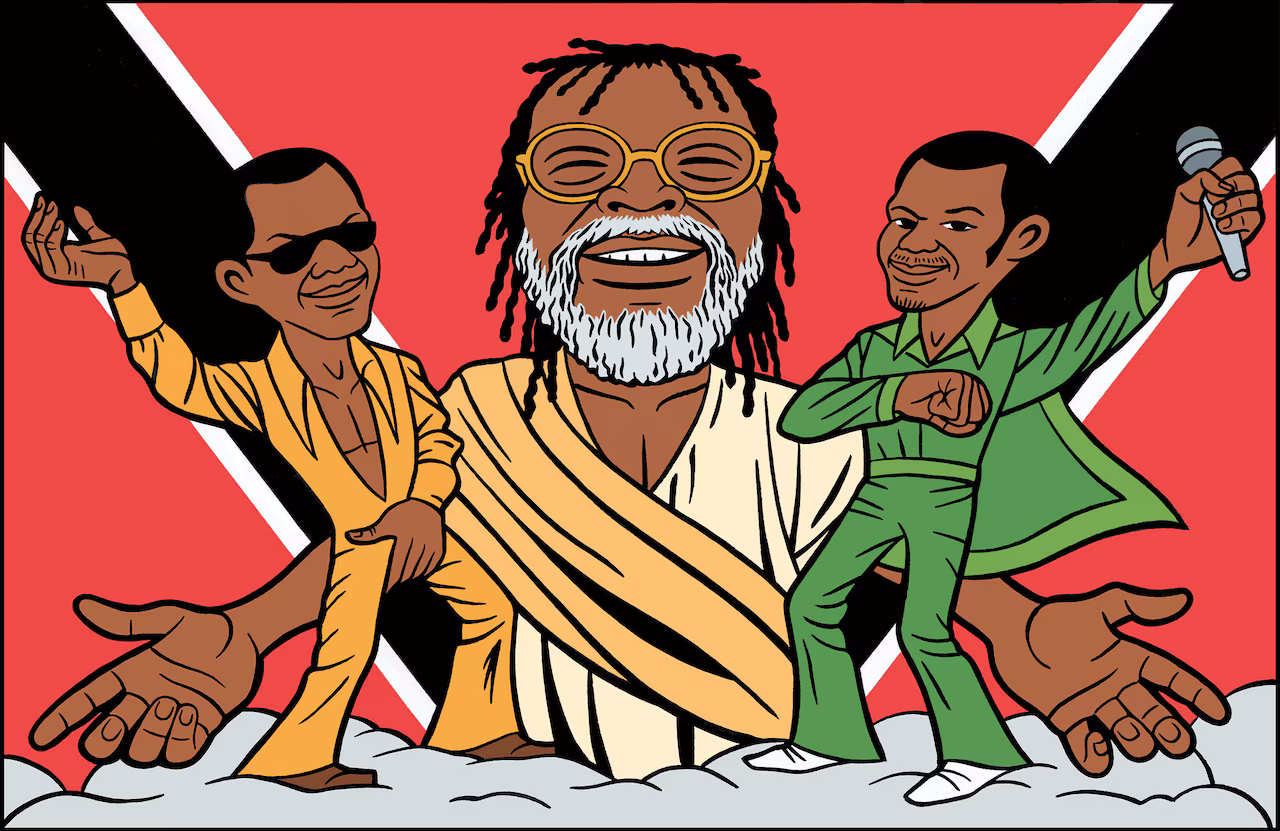
    Today we are in remembrance of the 80th Bornday Anniversary of Ras Shorty  I. [1941 October 06 - 2000 July 12] Ras Shorty I, born Garfield Blackman  and also known as Lord

    1. Origins (1970s): Calypso in Motion

    • Soca emerges in Trinidad & Tobago in the early 1970s.
    • Architect: Ras Shorty I (Lord Shorty).
    • Core intervention:
      • Preserve calypso’s lyrical intelligence and social commentary
      • Increase tempo and bodily drive
      • Incorporate Indo-Caribbean rhythm
    • “Soul of Calypso” meant:
      • Songs still argued
      • Verses still mattered
      • Dance emerged from meaning

    Founding assumption:
    Soca should move bodies without surrendering speech.


    2. Exploratory Maturation (1980s): Tune, Argument, Infrastructure

    Modernisation without collapse

    Mighty Gabby keeps them honest - Caymanian Times
    Calypsonian The Mighty Gabby, Says Calypso Carries Messages People Want To  Hear – DOM767
    • The Mighty Gabby – “Dr. Cassandra”
      • Narrative, satirical, melodically intact
      • Produced by Eddy Grant at Blue Wave Studio
    • Eddy Grant’s role
      • Infrastructure and discipline
      • Barbados becomes a co-equal creative centre
    • Grynner
      • Early Bajan soca retains:
        • Song form
        • Political wit
        • Audience intelligence

    This era is plural, but still governed by shared musical expectations.


    3. Soca vs Dancehall/Dub: Distinct Cousins

    A lived cultural separation

    • In Caribbean ground-level practice, soca and dancehall/dub were distinct spaces.
    • At fetes:
      • A dub/dancehall set
      • Then a soca set
    • DJs rarely mixed them.

    Functional contrast (historically):

    • Soca
      • Hedonistic
      • Drunk
      • Communal
      • Release music
    • Dancehall / dub
      • Harder
      • Darker
      • More adversarial
      • The “gangster” cousin

    Modern DJs blend more freely, but this historical separation shaped how the genres evolved — and how audiences understood them.


    4. 1990s: Balance with Irritants

    Coherence, not purity

    • The 1990s represent soca’s last broadly shared centre.
    • Two tendencies coexist:
      • Mid-tempo, melodic “sweet” soca (later branded groovy in 2005)
      • Faster jump-and-wave / early power soca (e.g. Superblue)
    • Instructional soca already exists:
      • “Follow the Leader”
      • Choreography-driven call-and-response
      • Widely recognised as annoying but containable
      • A tolerated sub-variant, not yet hegemonic

    Golden-era anchors:

    • Krosfyah – “Krank It”, “Pump It Up”
      • Movement implied, not ordered
      • Durable hooks
    • Lil Rick
      • Pop discipline
      • Humour without hysteria

    These tracks still dominate London and New York Carnival because they work without instruction.


    5. Barbados Meta-Soca: Tents, Jokes, and Context

    Music that knows where it is

    • Barbados preserves a tent-based meta layer longer than most territories.
    • Artists often function as social jokes, not scalable brands.

    Examples:

    • Contone
      • A literal car washer with a song
      • A Crop Over in-joke
      • Funny because everyone knows who he is
    • “White Wine”
      • Linked to Bacchanal Time Tent
      • A moment dependent on timing, place, shared knowledge

    Institutional anchor:

    • Bacchanal Time Tent
      • Still produces tight social commentary
      • Maintains calypso’s argumentative spine inside soca

    These are situated cultural artefacts, not novelty throwaways.


    6. Bashment Soca (Mid-1990s onward): Parallel Street Logic

    Divergence, not decline

    • Emerges primarily in Barbados, rooted in local “dub” riddims.
    • Draws from dancehall aesthetics but remains soca-adjacent.
    • Traits:
      • Bass-heavy
      • Chant-forward
      • Dialect-first

    Prototype:

    • Lil Rick – “Hard Wine” (1996)
      • Raw
      • Unpolished
      • Street-functional

    Later formalisation (e.g. Bashment Soca Monarch) recognises what was already culturally established.


    7. The French-Creole Axis: Zouk, Bouyon, Dennery Segment

    Parallel carnival ecosystems

    • Zouk (Kassav’)
      • Polished, sensual, adult
      • Night-time carnival music
    • Bouyon (WCK, Dominica)
      • Faster, rougher, chant-driven
      • French-Creole rhythmic base
    • Dennery Segment (St Lucia)
      • Kuduro-influenced, ultra-fast
      • Youth-driven, digitally viral
    • Bouyon soca
      • St Lucia, Antigua, Eastern Caribbean
      • A soca-adjoint fusion, not a replacement
    • Burning Flames (Antigua)
      • Early high-energy regional bridge

    These are adjacent ecosystems, not evolutionary stages.


    8. The International Breakout That Went Nowhere

    Export success ≠ genre health

    • Anslem Douglas – “Who Let the Dogs Out”
      • Clever soca-adjacent call-and-response
      • Repurposed as international novelty
      • Cultural meaning stripped out
    • Rupee
      • Slow soca
      • Radio-friendly
      • Brief crossover
    • Kevin Lyttle – “Turn Me On”
      • Soca’s biggest global pop hit
      • Proof the mainstream window was real but fleeting

    Soca’s pop scalability peaked almost as soon as it appeared.


    9. Fragmentation Becomes Dominant Logic (2000s)

    • Instructional soca moves from edge case to centre.
    • Command lyrics become structural:
      • “Hands in the air”
      • “Everybody jump”
      • “Footsteps”
    • Composition retreats in much mainstream power soca.
    • Production intensity compensates.

    9.5 Reggaeton, “Ragga Ragga”, and What Left Soca

    Listen:

    • Red Plastic Bag – Ragga Ragga
    • Daddy Yankee – Gasolina

    This is not a story of theft.
    It is a story of selection.

    By the late 1990s and early 2000s, soca begins to abandon certain protections it once held instinctively:

    • Implied groove
    • Minimal verbal instruction
    • Rhythmic space that lets the body decide

    Those elements do not disappear.
    They reappear elsewhere, most successfully in reggaeton.

    “Ragga Ragga” (Red Plastic Bag)
    Originally a Bajan satire of ragga/dancehall opacity and bravado, Ragga Ragga is built on chant, bounce, and repetition, but framed as commentary. Over time, the chant escapes its context. The song — or fragments of it — circulates widely across the Caribbean basin, functioning as identity rhythm or carnival chant, often with no awareness of authorship or irony. The joke survives; the argument does not.

    Reggaeton’s move
    Reggaeton’s rhythmic core comes primarily from Jamaican dancehall (the Dem Bow riddim), not soca. But reggaeton systematises something soca once did well: percussion-first groove, minimal harmonic obligation, and bodily logic that does not rely on shouted instruction.

    Daddy Yankee’s “Gasolina” is decisive because it locks into movement without explanation. Where soca increasingly tells the crowd what to do, reggaeton lets the rhythm do it.

    The irony
    Soca’s influence travels farthest when it is detached from soca itself — when authorship fades and commentary is stripped away. This is not failure, but it is loss of control. Soca did not lose its clothes; it stopped defending them, and other genres wore them better.


    10. Carnival lock-in and over-production

    • Kerwin Du Bois
      • Polished, constrained
    • Machel Montano – “Like ah Boss”
      • Extreme production density
      • Energy enforced rather than discovered

    This is not artistic failure — it is Carnival optimisation.


    11. Soca in 2025

    • Soca is alive, loud, and plural:
      • Carnival-dominant
      • Streaming-visible
      • Artists like Machel, Bunji, Kes
    • Commentary persists:
      • In tents
      • In local scenes
      • Especially in Barbados
    • Innovation survives through:
      • Afrosoca
      • Chutney
      • Bouyon/Dennery fusions

    Pluralism is now the genre’s defining condition.


    12. Final Diagnosis

    • Soca did not die.
    • It:
      • Originated as calypso in motion
      • Matured through tune and argument
      • Briefly cohered in the 1990s (despite irritants)
      • Fragmented as instruction became dominant
    • The diaspora keeps replaying the era when:
      • Instruction was optional
      • Groove was trusted
      • The music didn’t need to shout

    Closing note

    This is not a lament.
    It’s a map: of how a genre learned to survive by splitting rather than centralising — and why one decade still carries disproportionate cultural weight.

  • The Elvis Film Everyone Filed Under the Wrong Genre

    The Elvis Film Everyone Filed Under the Wrong Genre

    Some films are forgotten because they’re bad. Others are forgotten because they were shelved under the wrong category and never taken back out.

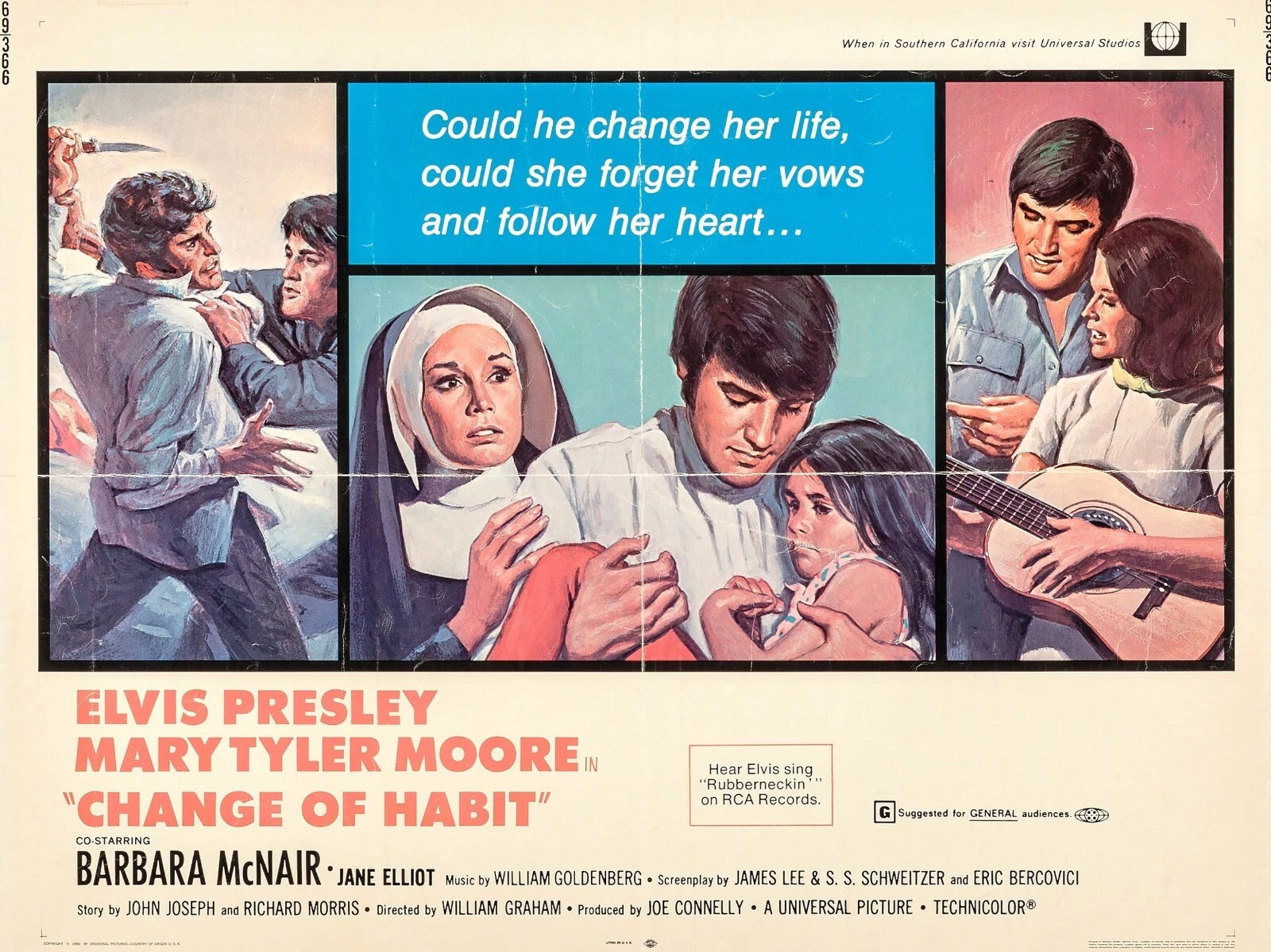
    Change of Habit (1969) is usually dismissed as Elvis Presley’s final misfire: a tonal muddle, a non-musical Elvis movie, a star vehicle that forgets to flatter its star. That description is accurate — and beside the point. What matters here is what the film sets out to demonstrate, and how exposed that demonstration now feels.

    Midway through the film, a young girl named Amanda is introduced at the clinic. She is explicitly described, in the film’s own dialogue, as autistic. This matters historically. While Change of Habit was not the only film of its moment to depict behaviour later understood as autistic — Francis Ford Coppola’s Run Wild, Run Free appeared the same year — the distinction is crucial. Run Wild, Run Free portrays a mute, withdrawn boy whose condition has since been interpreted as autism, but it never names it. Change of Habit speaks the word aloud. The label enters mainstream cinema directly, however awkwardly.

    The naming arrives hedged.

    When the word autistic is spoken, it is immediately misheard as artistic, and played for a brief laugh. That moment does quiet but consequential work. It signals unfamiliarity, discomfort, and the need to defuse the term before proceeding. Autism is introduced as something sayable only once its edge has been blunted. The audience is allowed to laugh, then move on.

    This sequence — introduction followed by deflection — sets the pattern for what follows.

    Amanda is asked by Mary Tyler Moore’s character to complete a simple task: placing wooden blocks into matching holes. She resists. The request is repeated. Agitation builds. The interaction is structured around compliance rather than communication, framed as a behavioural test rather than an exchange.

    The screaming begins only after this insistence.

    The distress escalates under pressure. The film treats Amanda’s refusal as “acting up,” something to be interrupted and corrected. Voices rise, then stop. The sound fills the space and becomes physically uncomfortable to endure.

    The staging intensifies the effect. The camera repeatedly cuts away from the consultation room into the adjoining office, where the screaming continues off-screen. We remain inside the institution, close enough to hear everything, but excluded from the intervention itself. We know exactly who is in the room: Elvis Presley, Mary Tyler Moore, and a distressed child.

    This is a purposeful choice. The film was made at a time when autism was commonly understood through now-discredited frameworks, including the “refrigerator mother” theory, which framed autistic behaviour as a response to emotional withdrawal or failed attachment. In practice, such thinking justified rage-reduction or holding therapies — approaches now recognised as harmful pseudoscience.

    The scene is constructed to validate that outlook. The task is insisted upon, distress escalates, containment follows. The off-screen handling, paired with the sudden calm that succeeds it, functions as a demonstration of efficacy.

    Viewed now, the implications are stark. Autism is treated as misbehaviour to be extinguished. Calm is achieved through physical containment, and the narrative suggests that the child herself has been corrected — reached, stabilised, improved.

    Many modern viewers experience this sequence as shocking or offensive. That response doesn’t come from misreading the scene; it comes from seeing its assumptions laid bare.

    What makes the moment linger is how little the film does to mediate it.

    Contemporary cinema would feel compelled to explain, contextualise, or distance itself from such material. Change of Habit does none of that. It proceeds with confidence. The camera’s withdrawal is an assertion of trust: trust in the method, and trust in the person carrying it out.

    That trust rests almost entirely on Elvis.

    This is not the self-aware, performative Elvis of later years. It is “good Elvis”: restrained, serious, unglamorous, morally legible. The film leans on that persona. A man alone in a room with a screaming girl child and a woman, the door closed, the audience excluded — and the scene is framed as care rather than threat. Elvis’s presence supplies the reassurance the film itself refuses to articulate.

    When we return to the room, the screaming has subsided. Elvis holds Amanda firmly, speaking quietly. Order has been restored. The film offers no reflection on what has just occurred. It simply moves on, satisfied with the result.

    Alongside its clinical intent, Change of Habit captures something else almost incidentally: the children’s social world as children experienced it. Meltdowns were part of everyday school life. Certain children were known for them. They were feared, mocked, sometimes deliberately provoked. Adults often ignored them or lacked the tools to respond. No one explained them. They simply happened.

    That reality rarely appeared on screen, and almost never within material assumed to be safe. In Britain, Elvis films were frequently shown on BBC daytime television, out of order and without context. For child viewers there was no sense of early or late Elvis — only good Elvis and bad Elvis. Change of Habit fell firmly into the former category. Authority on screen felt real.

    Then this scene arrived.

    The film does not soften the distress or hurry past it. It does not reassure the viewer visually. Even while promoting a deeply flawed understanding of autism, it presents breakdown and containment with a bluntness later cinema largely avoids.

    Critics often judge films by intention: what they aim to do, and whether they succeed. By that measure, Change of Habit is compromised. Yet cinema history is also shaped by works that preserve, in uncomfortable detail, the assumptions of their moment.

    What survives here is a record of transition: autism newly named, only partly understood, deflected with humour, and immediately subjected to correction.

    That combination explains why the scene continues to disturb, and why the film has not faded in the way most late-period Elvis vehicles have. It was filed as a failed musical drama. What it contains instead is an early, explicit naming of autism on screen, tied to a theory we now reject and presented without protective framing.

    Looking again does not mean excusing it.
    It means recognising what it shows — and what it believed it was allowed to do.

    https://thinkinginstructure.substack.com/p/the-elvis-film-everyone-filed-under

  • British ’80s Pop Was an Ecosystem — and a Historically Specific One

    British ’80s Pop Was an Ecosystem — and a Historically Specific One

    Not art schools or genius, but a temporary alignment of boredom, prestige, authority, money, and finishing

    British ’80s pop is still commonly described as a cultural miracle: art colleges, post-punk intelligence, European sophistication, a nation unusually good at pop music.

    That story captures the surface texture of the era. It does not explain its outcomes.

    What actually happened was the brief success of a highly specific ecosystem — economic, institutional, editorial, and media-based — that took mass raw supply and, through ruthless filtering and expert finishing, produced export-ready artefacts earlier and more consistently than anywhere else.

    It worked for about a decade.
    Then the conditions changed.


    1. Mass boredom created raw supply

    Late-1970s Britain produced the necessary base condition:

    • high youth unemployment
    • few alternative prestige ladders
    • cheap instruments
    • no internet or parallel attention economy

    The result was not exceptional average talent but oversupply. Everyone wanted to be in a band because there was little else to do.

    Oversupply mattered more than ideology or education. It created selection pressure. Most acts failed — quickly — and that failure was productive.


    2. Early filters tested identity, not quality

    Universities, polytechnics, student unions, and provincial venues tested persistence and personality. Bands learned how to:

    • repeat material without collapsing
    • project a differentiating identity
    • survive indifference

    John Peel belongs here — not as a taste oracle, but as a noise generator. He widened the funnel, legitimised unfinished work, and created signal for scouts. Most Peel sessions went nowhere. That was expected.

    Nothing at this stage produced export-ready music.


    3. C86, Peel, and the productive emptiness of the underground

    It is important not to retroactively dignify this stage with outcomes it did not produce.

    C86 remains the clearest artefact of the Peel ecosystem: a document of posture, affect, and sincerity, largely devoid of records that could scale beyond their immediate context. It mattered culturally, but almost nothing in it translated into durable success.

    Peel’s championing of The Fall clarifies the mechanism. The Fall generated influence, volume, and attitude — but not polish, coherence, or exportability. Peel selected for difference, not finish.

    Andy Kershaw’s later promotion of “world music” operated similarly: broadening horizons without functioning as a finishing or export system. These strands were valuable as cultural fertiliser, not pipelines.


    4. The missing middle: the UK music press as agenda-setting filter

    Between Peel-level chaos and major-label finishing sat a crucial layer: the UK music press.

    NME, Melody Maker, and Smash Hits were not passive chroniclers. They were active agenda-setters, run by a very small, high-prestige, predominantly middle-class coterie who:

    • decided what mattered
    • framed how it should be interpreted
    • signalled which acts were ready to move upward

    The division of labour mattered:

    • NME / Melody Maker conferred seriousness and narrative legitimacy
    • Smash Hits tested charm, legibility, and mass appeal

    Acts that could not survive this passage stalled. Acts that passed acquired not just exposure, but context — a story the industry could act on.

    This same coterie seeped outward into Channel 4 arts programming, youth television, and radio commissioning. What appears as cultural plurality was, in practice, agenda convergence.


    5. Indie labels filtered; majors finished

    Indie labels removed the hopeless cases. They rarely finished acts.

    The decisive choke point sat at major labels — especially EMI (Parlophone) — where musically literate A&R exercised real veto power. These were administrative elites with taste, protected by institutional slack and acutely aware of US markets.

    Their key intervention was producer assignment.


    6. Producers as finishing intelligence (different kinds of coherence)

    By the early 1980s, a small number of producers functioned as finishing intelligence — but not in the same way:

    • Trevor Horn / Hugh Padgham: high-gloss, artefact-forward coherence
    • Steve Lillywhite / Thomas Dolby: structural and emotional clarification
    • Martin Hannett: atmospheric subtraction and anti-polish coherence

    Hannett’s work imposed discipline through space and alienation rather than sheen. It still required authority, veto power, and discipline — just in service of a different aesthetic.

    What unites these figures is not sound, but function:

    They imposed coherence, whether through excess or absence.

    Taste without authority produces ideas without outcomes.
    Authority without taste produces damage.

    British ’80s pop briefly placed both in the same hands.


    7. Trevor Horn as the limit case

    Trevor Horn shows how far the system could extend.

    He did not “realise visions”. He determined whether any viable artefact could be extracted at all, and what form it needed to take.

    That is how Malcolm McLaren’s post-Pistols conceptual chaos became Duck Rock. “Buffalo Gals” bears little relation to McLaren’s intentions. Horn discarded the premise and retained only what could be made rhythmically and sonically legible.

    Horn consistently prioritised the artefact over originating intention once coherence had been achieved. His effectiveness depended on discernment as much as authority.


    8. From boredom to aspiration: why finishing paid off

    The mass boredom of the late 1970s fed raw supply.
    The aspirational consumerism of the mid-1980s rewarded finishing.

    Youth culture tilted toward:

    • glamour
    • style
    • modernity
    • consumption

    Finished artefacts didn’t just travel better — they sold better.


    9. Television as the final finishing surface

    No artefact was complete until it survived television.

    Top of the Pops was the ultimate test:

    • repetition
    • visual legibility
    • three-minute national exposure

    Music video culture extended this internationally. MTV did not create British ’80s pop; it rewarded acts already engineered for legibility.

    Television completed the refinery.


    10. Outcomes by structural type

    Structural type: Malleable raw acts
    Defining traits: Weak musicianship, strong image/hooks
    System response: Heavy reconstruction
    Examples: Human League, Thompson Twins, Duran Duran
    US outcome: Major crossover


    Structural type: Single-artefact extraction
    Defining traits: One strong object
    System response: Refined then replicated
    Examples: Spandau Ballet, Ultravox
    US outcome: Short-term success


    Structural type: Internally complete sophistication
    Defining traits: Restraint, intimacy
    System response: Largely untouched
    Examples: Prefab Sprout, Blue Nile, Cocteau Twins
    US outcome: Cult / limited reach


    Structural type: Pipeline-native professionals
    Defining traits: Musically literate, critique-ready
    System response: Refinement
    Examples: Police, Queen, U2, Tears for Fears
    US outcome: Sustained US success


    Structural type: Tribal identity acts
    Defining traits: Minimalism, youth-coded
    System response: Untouched
    Examples: Yazoo, early Depeche Mode, Gary Numan
    US outcome: Retrospective influence


    Structural type: UK-specific raw strategists
    Defining traits: Raw + business-aware
    System response: Partial assembly
    Examples: The Smiths
    US outcome: No US breakout


    Structural type: Performance-native acts
    Defining traits: Pre-finished live coherence
    System response: Captured
    Examples: Madness
    US outcome: Poor translation


    Structural type: Establishment-backed auteur
    Defining traits: Internally complete + institutional support
    System response: Protected, amplified
    Examples: Kate Bush
    US outcome: UK dominance, limited US


    11. Kate Bush: establishment amplification without translation

    Kate Bush was not a grassroots phenomenon. She was pre-validated.

    She was heavily promoted by the British establishment before release — appearing on mainstream BBC programming (Nationwide) before a debut single. She came from a professional, middle-class background and was treated as culturally important from the outset.

    Bush was:

    • internally complete
    • heavily produced (by herself)
    • artistically uncompromising

    The system amplified her rather than finished her. It maximised UK dominance while bypassing the refinery.

    What it could not do was translate her work for the US, where theatricality without genre anchors struggled. Institutional backing solves visibility, not export translation.


    12. The Smiths: cultural dominance without translation

    The Smiths were raw, Peel-native, and only partially assembled. Johnny Marr supplied urgency, melodic instinct, and a strategic decision to recruit an older frontman with linguistic and cultural coding.

    Their difficulty was translation. Morrissey’s lyrics were densely UK-specific; Marr’s guitar language was post-punk rather than MTV-legible. Even in Britain, daytime radio was often hostile.

    They mattered enormously.
    They did not export.

    Cultural centrality and industrial scalability are different phenomena.


    13. Why American alternative remained contained

    The American underground had appetite: college radio charts, touring circuits, and regional scenes made that clear.

    What it lacked was institutional willingness to intervene.

    Three forces sustained containment:

    1. Executive inertia
      US record executives were largely holdovers from the 1970s, comfortable with established touring and radio tie-ins.
    2. No agenda-setting press
      The US lacked a small, prestigious critical centre equivalent to NME or Melody Maker.
    3. Finishing aversion
      Major labels expected acts to arrive finished. Reconstruction was avoided.

    Demand existed without escalation.


    14. The 1990s shift: authority moves

    Containment broke when authority moved.

    In the early 1990s:

    • alternative radio formats gained commercial traction
    • MTV recalibrated (120 Minutes, Unplugged)
    • labels hired A&R from the indie and college-radio world

    Finishing intelligence finally aligned with underground material.

    Grunge was not a miracle.
    It was a reallocation of authority.


    15. The macro ballast: 1970s credibility

    EMI’s early-’80s risk tolerance was underwritten by Bowie, Elton John, and Pink Floyd. They did not shape the sound of British ’80s pop.

    They paid for the conditions under which it could be shaped.


    16. Why this ecosystem does not recur

    The ecosystem did not vanish because finishing disappeared — but because it fragmented.

    Today:

    • finishing exists locally and in parallel
    • authority is distributed
    • no shared monoculture exists

    Some contemporary systems (e.g. executive producers in hip-hop) still finish material — but without national convergence.

    What has replaced this system is not a failure of creativity but a refusal to acknowledge structure. Contemporary British pop discourse defaults to “talent” because it no longer has institutions capable of exercising judgment. Talent is invoked precisely where scaffolding is absent.

    K-pop demonstrates the opposite case: not a superior gene pool, but a rebuilt industrial pipeline — enforced oversupply, long apprenticeships, centralised finishing authority, and export-first coherence.

    Western observers misrecognise the result as cultural difference rather than institutional design. Where authority with taste still exists, artefacts still form. Where it does not, nothing solidifies long enough to matter.

    What has been lost is centralised coherence at scale.


    Conclusion

    British ’80s pop was not an art-college miracle.

    It was an ecosystem:

    • mass boredom at the bottom
    • cultural noise and agenda-setting in the middle
    • expert judgment backed by authority above
    • financial ballast and television platforms at the top

    It produced coherence earlier and more often than elsewhere — and imposed real creative costs in doing so.

    https://thinkinginstructure.substack.com/p/british-80s-pop-was-an-ecosystem

  • The Hidden Architecture of Christmas Pop

    The Hidden Architecture of Christmas Pop

    Certain Songs Sound Festive Before You Hear a Single Bell

    Every December, the same illusion returns: add sleigh bells, mention snow, and a song instantly becomes “Christmassy.”

    But that’s misdirection. Long before the bells enter, a Christmas pop song already carries the season in its harmony, rhythm, melodic shape, and production style.

    Play Leona Lewis’s One More Sleep. Before the bells, before the choir, before any lyric references the holiday, the festive identity is unmistakable. There is a structural blueprint at work — and once you hear it, you recognise it everywhere.

    Below is that blueprint.


    1. The Harmonic DNA: Brightness, Warmth, and the Holiday “Dip”

    Christmas pop harmony draws from three overlapping traditions:

    • Doo-wop loops – the classic I–vi–IV–V “ice cream changes” and close relatives
    • Motown lifts – IV→V motion with ascending basslines
    • Tin Pan Alley / mid-century jazz chords – borrowed iv, diminished and secondary dominants that add nostalgia

    These aren’t garnish; they’re doing the emotional heavy lifting.

    The “Snowfall Contour”: short descending scalar figures

    A small, stepwise descending figure in the top line – often three or four notes – turns up in a lot of Christmas pop:

    • Mariah Carey – All I Want For Christmas Is You The intro glockenspiel/piano line outlines the G–Em–C–D “ice cream” loop (I–vi–IV–V in G) with a little descending scalar figure that leads into the vocals.
    • Wham! – Last Christmas In the chorus, phrases like “Last Christmas, I gave you my heart” resolve with small downward steps towards the home note over a C–Am–Dm–G loop (I–vi–ii–V in C).
    • Slade – Merry Xmas Everybody The guitars and keys repeatedly outline descending diatonic fragments between vocal lines.
    • The Darkness – Christmas Time (Don’t Let the Bells End) Lead guitar fills often fall away stepwise before the chorus lands.
    • Leona Lewis – One More Sleep Right at the top, there’s a simple, chime-like three-note descent that recurs as a hook.

    I’m not claiming a single invariant 5–4–3 pattern; I’m saying: short, stepwise falls in the top line are a conspicuously common colour in Christmas pop, and they trace back to carols and older hymn/cadence practice.

    Characteristic festive progressions

    A few harmonic moves show up again and again:

    • I → vi → IV → V – the classic doo-wop / “ice cream” loop
    • I → IV → iv → I – major IV followed by minor iv, the “holiday melancholy” plagal twist
    • I → V/vi → vi – the “false lift into warmth” (dominant-of-the-relative-minor resolving into vi)

    You don’t need hard statistics to see the pattern: a bright, looping tonic–relative-minor–pre-dominant–dominant grammar is heavily over-represented in Christmas pop relative to random chart music from the same eras.


    2. The Rhythmic Blueprint: Forward Motion With Soft Edges

    Christmas pop has a distinctive kinetic feel:

    • Rolling 8th– or 16th-note basslines – straight out of Motown’s playbook
    • A gentle, “trotting” bounce – often a straight beat with a triplet-ish undercurrent
    • Softened backbeat – shakers, brushed snares, sleigh-bell-like top percussion

    That gives you buoyant forward motion without aggression — the sleigh-ride gait, even with no literal sleigh bells.

    Examples:

    • One More Sleep – the bassline walks and bounces; it’s doing most of the festive signalling before any FX.
    • Merry Christmas Everyone (Shakin’ Stevens) – a bright shuffle with an easy, rocking lilt.
    • Fairytale of New York – Celtic bounce melded with a Christmas cadence.
    • Do They Know It’s Christmas? – straight rock backbeat softened by shakers and choir.

    Slade and The Darkness are just grafting this onto glam-rock stomp: same motion, heavier clothes.


    3. The Melodic Arc: Rise → Wistful Dip → Home

    Most big Christmas pop hooks follow the same emotional shape:

    1. Rise – some kind of upward leap or build (excitement, anticipation)
    2. Dip – a more stepwise or minor-coloured descent (nostalgia, wistfulness)
    3. Home – a clear landing on the tonic, designed so people can belt it in a pub

    Concrete example:

    Mariah Carey – All I Want For Christmas Is You (chorus concept)

    • On “All I want…”, the melody makes a noticeable upward jump (roughly a sixth in many transcriptions), setting up a sense of lift.
    • The melodic line then falls back in small steps over the words “for Christmas”, easing down from that peak.
    • On “is you”, it resolves cleanly to the home pitch over the G–Em–C–D loop.

    Exact interval labels differ slightly across arrangements and keys, but the contour is stable: upward leap → gentle descent → tonic resolution.

    Leona Lewis’s “one more sleeep…” hook does the same thing in a different skin: a wide, open leap into the word “sleep”, then an easing fall back into the scale and chord home base. Slade’s and Darkness’s choruses follow similar arcs – you feel the open-armed shout, then the fall back into the crowd.


    4. Production: Frost Without Cliché

    Even if you delete literal sleigh bells, Christmas-leaning productions typically use:

    • Celeste / glockenspiel / toy-piano timbres for hooks and fills
    • Glassy, high-frequency reverb tails – a “frost halo” round the top end
    • String pads and airy choral beds to imply warmth and community
    • Stacked vocals – a Spector-style “wall of people” rather than a lone lead

    This is why modern Christmas songs can sound festive even when they’re being careful not to lean too hard on obvious clichés.


    5. Case Study: One More Sleep (Leona Lewis)

    This is clean, recent, and structurally textbook.

    a) Before the bells: Christmas already encoded

    Even if you mute every sleigh bell:

    • There’s that small, chime-like descending motif at the top – a three-note fall that recurs throughout.
    • The harmony leans hard on A–F#m–D–E in the pre-chorus and chorus – that is I–vi–IV–V in A.
    • The bass has a rolling pop-soul feel that pushes steadily forward.

    That’s enough to scream “seasonal” before a single obvious signifier enters.

    b) Verse

    • Melody: narrow, mostly stepwise → intimacy, conversational nostalgia
    • Harmony: simple A ↔ Bm motion with E dominant punctuation – rock-solid A-major centre
    • Rhythm section: light but moving; you feel a walk, not a stomp

    c) Pre-chorus (“5 more nights…”)

    This is where it goes full Spector:

    • The chords lock into A–F#m–D–E (I–vi–IV–V) – the classic lift pattern.
    • The melody climbs through the “5 more nights / 4 more days” countdown.
    • The bass and drums lean into that bouncy, trotting pulse.

    It’s doing exactly what the Phil Spector Christmas songs do: a harmonic and rhythmic lean forward into the chorus.

    d) Chorus

    The pay-off:

    • Strong tonic landings on “one more sleep”.
    • A wide, upward melodic gesture on the word “sleep”, then a gentle drift back down.
    • A full I–vi–IV–V loop powering the main hook; then IV–vi–♭VII–V (D–F#m–G–E) adding extra lift and colour.
    • Background vocals stacked so it feels like a mini-choir.

    By the time any sleigh bells are added, the architecture has already made it Christmas.


    6. Why This Stuff Feels Like Christmas (Psych + Culture)

    None of this is mystical:

    • Descending figures read as falling or softening in human perception; mapping pitch to vertical motion is pretty universal.
    • Rolling, mid-tempo basslines line up with a walking/trotting gait; the body locks into it automatically.
    • Major harmony with borrowed minor / iv colours gives you that bittersweet nostalgia — joy with a twinge.
    • Stacked vocals mimic choirs, carolling, and group singing – all socially coded as “holiday”.
    • Recycling 40s–60s harmonic language taps straight into cultural memory: the Brenda Lee / Spector / mid-century Christmas canon.

    So when you hear these structures, you’re not just hearing chords; you’re hitting a learnt association between certain musical patterns and “this time of year.”


    7. Can Any Song Be Made Christmassy?

    You can push a lot of tonal, mid-tempo material towards “Christmas” by:

    • introducing a short, stepwise descending hook in the top line
    • shifting key sections onto a I–vi–IV–V-type loop (or I–vi–ii–V)
    • giving the bass a bouncy, Motown-ish pulse
    • adding a celeste/glockenspiel-like layer for hooks
    • stacking backing vocals in the chorus

    But there are limits:

    • Genres like trap, hyperpop, certain DnB and modal folk aren’t built around that harmonic/rhythmic grammar; bolt-on sleigh bells won’t move the core feel.
    • The “Christmasification” recipe works best when the source already has clear tonal harmony and room for warmth.

    8. Christmas Pop Is a Real Musical Form

    It’s not just bells and lyrics.

    It’s a recognisable architecture made of:

    • short descending “snowfall” figures in the melody
    • doo-wop / Motown / Tin Pan Alley harmonic hybrids (I–vi–IV–V and friends)
    • a trotting, mid-tempo rhythmic engine
    • rise→dip→home melodic arcs built for communal singing
    • frost-glass production choices
    • and decades of cultural conditioning.

    https://thinkinginstructure.substack.com/p/the-hidden-architecture-of-christmas

  • The Comedy Voice Britain Lost: How a Very Specific Educational World Created a Very Specific Kind of Humour

    From the 1960s through the 1990s, Britain produced a comic tone so distinctive that it briefly defined the nation’s sense of humour. You can trace the line cleanly:

    Waugh → Beyond the Fringe → Python → Cook → Atkinson → Morris → early Iannucci

    The continuity isn’t about class, or poshness, or “Britishness.” It’s about a very specific linguistic and institutional training that is now mostly gone.

    This humour had three hallmarks:

    1. Mock-authoritarian delivery

    2. Linguistic precision as a weapon

    3. Casual, performative cruelty

    It was a voice forged in schools and institutions where people learned the cadence of authority before they learned to parody it. And that’s why it flourished — and why it faded.


    1. What This Humour Actually Was

    The core mechanic was simple and devastating:

    Speak the voice of authority perfectly — and let the perfection reveal the absurdity.

    Examples:

    • Cleese’s Latin master eviscerating Brian for a grammatical error.
    • Peter Cook delivering cosmic boredom with aristocratic detachment.
    • Rowan Atkinson’s schoolmaster turning syntax into psychological assault.
    • Chris Morris as the newsreader-as-prefect, dispensing nonsense with nuclear gravitas.

    The humour wasn’t “posh sneering.” It was the joy of performative, ritualised cruelty delivered with the precision of someone fluent in the machinery of hierarchy.


    2. Where It Really Came From

    Not privilege. Not class superiority.

    But from an educational ecology that rewarded:

    • classical instruction,
    • grammar knowledge,
    • rhetoric,
    • debate,
    • formal speech codes,
    • institutional theatre.

    Public schools and grammar schools produced teenagers fluent in:

    • mock formality,
    • hierarchical cadence,
    • performative superiority,
    • precision language.

    This training created performers who could effortlessly channel:

    • headmaster,
    • bureaucrat,
    • prefect,
    • BBC announcer,
    • Oxbridge debater.

    By the time they reached Footlights, they were already trained comedic killers.


    3. Why Audiences Loved It — Even Without That Background

    The mystery is why this humour resonated nationally, not just within its originating class structure.

    Because its dynamics were universal:

    • Everyone has been humiliated by a teacher.
    • Everyone knows a petty authority figure.
    • Everyone has endured bureaucratic nonsense.
    • Everyone recognises smug hierarchy.

    You didn’t need Latin to understand being barked at. You just needed to have lived under a boss.

    The tone was elite. The experience was not.


    4. The Golden Lineage

    The style cohered into a continuous tradition:

    Beyond the Fringe

    The first modern satire: educated voices wielding authority against itself.

    Monty Python

    Authority as farce, pedantry as violence, languages as toys.

    Peter Cook

    The ultimate bored tyrant; the aristocrat who knows your place better than you do.

    Rowan Atkinson

    Precision timing + hierarchical cruelty = devastating.

    Chris Morris

    The final, weaponised form: the prefect’s fury merged with the newsreader’s authority.

    Early Iannucci (The Day Today, On the Hour)

    Systems-thinking satire delivered in the old register — but already mutating into something new.

    Then the tone receded.


    5. Why It Receded (No Culture-War Handwaving Required)

    Three structural changes explain everything.

    A. The shared curriculum dissolved

    When fewer people learn:

    • grammar,
    • classical references,
    • formal rhetoric,

    the performance loses its codebook. You can’t parody registers your audience no longer recognises.

    B. Authority lost its dominant voice

    For a century, Britain had a recognisable “official” tone: BBC RP, legal cadence, headmaster patter.

    By the 2000s, national speech diversified. Parodying a style works best when everyone knows the style.

    C. Comedy turned inward

    Old comedy: “Authority is absurd.”

    New comedy: “I am broken.”

    The shift from external hierarchy → internal anxiety is the real divide.

    • Peep Show is the turning point: Mark Corrigan is the anti-Python — the authority turned inward until it collapses.
    • The Office finishes the job: embarrassment replaces pedantry as the primary British comedic lever.

    Hierarchy didn’t disappear. But its comic centrality did.


    6. It Didn’t Die — It Mutated

    The DNA survives:

    • Stewart Lee – linguistic sadism slowed to ritual pace.
    • The Thick of It – hierarchical brutality, now in political jargon instead of Latin.
    • Mitchell & Webb – occasional masterpieces of bureaucratic cruelty.

    But this style is now niche — an artistic dialect rather than the national register.


    A Note on Macfadyen and Succession

    One fascinating outlier: Matthew Macfadyen’s performance in Succession.

    Though he plays an American, everything about Tom Wambsgans — the brittle politeness, the clipped authority, the misapplied formality, the prefect’s cruelty turned inward — is pure British institutional cadence. A direct descendant of the Python/Cook/Morris lineage transplanted into HBO prestige drama.

    American comedians like Tim Dillon adored it without ever recognising the lineage. They simply recognised the power of the tone.

    This is what happens when the old register is placed in a culture that still has ears for hierarchy, even if it doesn’t have the original institutions.


    7. Was It Actually a Loss?

    The truthful answer reaches deeper than preference.

    This humour came from a Britain that was, in its institutions and its self-conception, sharper. More verbally disciplined. More structurally aware. More capable of holding the tension between cruelty and wit, hierarchy and absurdity, formality and ridicule.

    When the ecosystem that trained that voice thinned out, part of the national imagination thinned with it. Not just a comic style — but a way of seeing:

    • power as theatre,
    • language as weapon,
    • hierarchy as both ridiculous and revealing,
    • authority as something to be dismantled through precision, not outrage.

    You can still see flickers of it — in Stewart Lee, in the best of Iannucci, and even in Matthew Macfadyen’s Tom Wambsgans in Succession, a role constructed entirely out of that old British register disguised in American clothing.

    But they feel like survivors, not heirs.

    The tradition didn’t die because Britain became softer. It died because Britain became blurrier. The institutions that trained people to speak authority fluently enough to parody it disappeared — and with them, a very specific national clarity.

    Something was lost. Quietly, structurally, and irreversibly.

    Not nostalgia. Just observation.

    https://thinkinginstructure.substack.com/p/the-comedy-voice-britain-lost-how