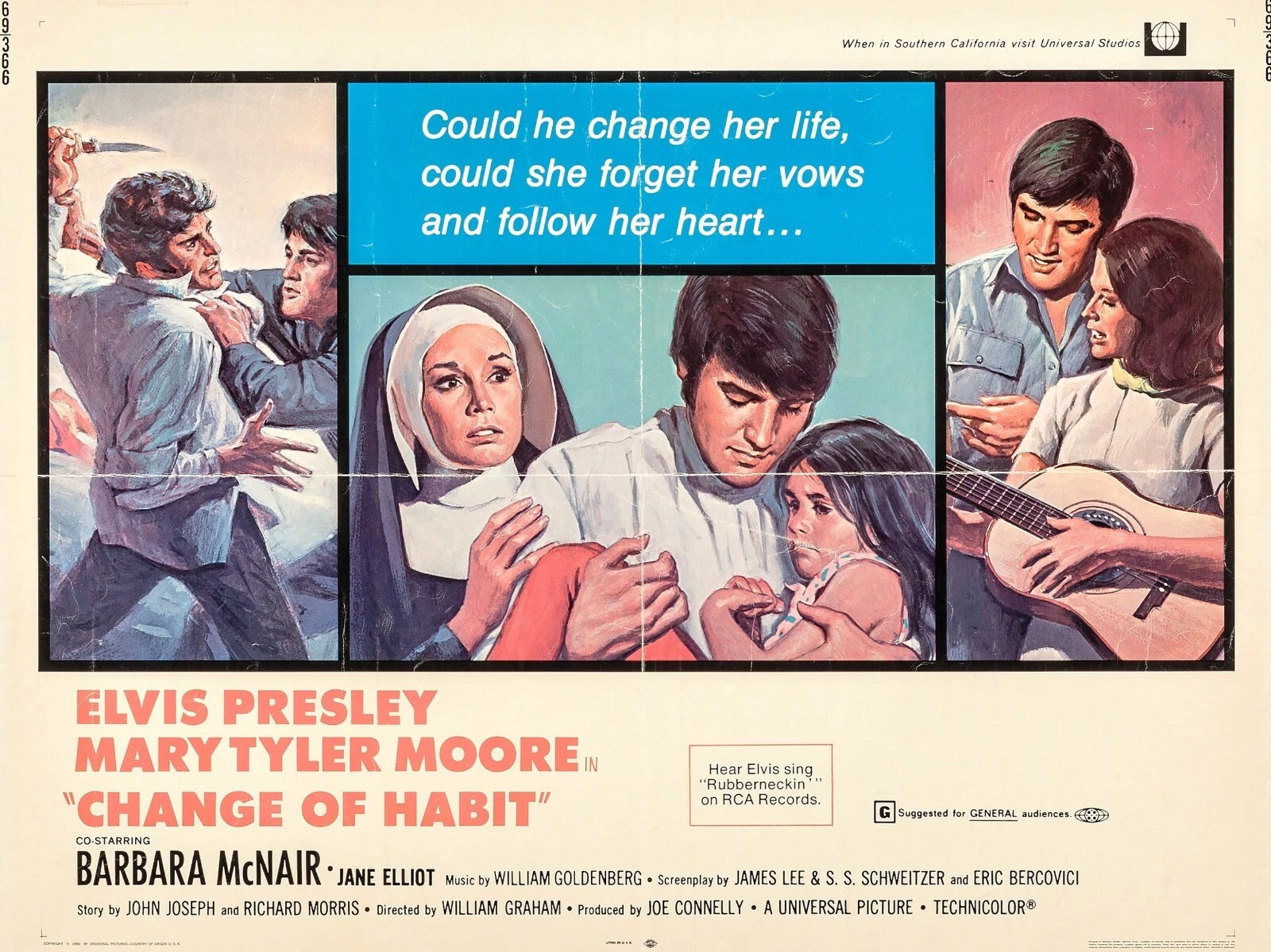
Some films are forgotten because they’re bad. Others are forgotten because they were shelved under the wrong category and never taken back out.
Change of Habit (1969) is usually dismissed as Elvis Presley’s final misfire: a tonal muddle, a non-musical Elvis movie, a star vehicle that forgets to flatter its star. That description is accurate — and beside the point. What matters here is what the film sets out to demonstrate, and how exposed that demonstration now feels.
Midway through the film, a young girl named Amanda is introduced at the clinic. She is explicitly described, in the film’s own dialogue, as autistic. This matters historically. While Change of Habit was not the only film of its moment to depict behaviour later understood as autistic — Francis Ford Coppola’s Run Wild, Run Free appeared the same year — the distinction is crucial. Run Wild, Run Free portrays a mute, withdrawn boy whose condition has since been interpreted as autism, but it never names it. Change of Habit speaks the word aloud. The label enters mainstream cinema directly, however awkwardly.
The naming arrives hedged.
When the word autistic is spoken, it is immediately misheard as artistic, and played for a brief laugh. That moment does quiet but consequential work. It signals unfamiliarity, discomfort, and the need to defuse the term before proceeding. Autism is introduced as something sayable only once its edge has been blunted. The audience is allowed to laugh, then move on.
This sequence — introduction followed by deflection — sets the pattern for what follows.
Amanda is asked by Mary Tyler Moore’s character to complete a simple task: placing wooden blocks into matching holes. She resists. The request is repeated. Agitation builds. The interaction is structured around compliance rather than communication, framed as a behavioural test rather than an exchange.
The screaming begins only after this insistence.
The distress escalates under pressure. The film treats Amanda’s refusal as “acting up,” something to be interrupted and corrected. Voices rise, then stop. The sound fills the space and becomes physically uncomfortable to endure.
The staging intensifies the effect. The camera repeatedly cuts away from the consultation room into the adjoining office, where the screaming continues off-screen. We remain inside the institution, close enough to hear everything, but excluded from the intervention itself. We know exactly who is in the room: Elvis Presley, Mary Tyler Moore, and a distressed child.
This is a purposeful choice. The film was made at a time when autism was commonly understood through now-discredited frameworks, including the “refrigerator mother” theory, which framed autistic behaviour as a response to emotional withdrawal or failed attachment. In practice, such thinking justified rage-reduction or holding therapies — approaches now recognised as harmful pseudoscience.
The scene is constructed to validate that outlook. The task is insisted upon, distress escalates, containment follows. The off-screen handling, paired with the sudden calm that succeeds it, functions as a demonstration of efficacy.
Viewed now, the implications are stark. Autism is treated as misbehaviour to be extinguished. Calm is achieved through physical containment, and the narrative suggests that the child herself has been corrected — reached, stabilised, improved.
Many modern viewers experience this sequence as shocking or offensive. That response doesn’t come from misreading the scene; it comes from seeing its assumptions laid bare.
What makes the moment linger is how little the film does to mediate it.
Contemporary cinema would feel compelled to explain, contextualise, or distance itself from such material. Change of Habit does none of that. It proceeds with confidence. The camera’s withdrawal is an assertion of trust: trust in the method, and trust in the person carrying it out.
That trust rests almost entirely on Elvis.
This is not the self-aware, performative Elvis of later years. It is “good Elvis”: restrained, serious, unglamorous, morally legible. The film leans on that persona. A man alone in a room with a screaming girl child and a woman, the door closed, the audience excluded — and the scene is framed as care rather than threat. Elvis’s presence supplies the reassurance the film itself refuses to articulate.
When we return to the room, the screaming has subsided. Elvis holds Amanda firmly, speaking quietly. Order has been restored. The film offers no reflection on what has just occurred. It simply moves on, satisfied with the result.
Alongside its clinical intent, Change of Habit captures something else almost incidentally: the children’s social world as children experienced it. Meltdowns were part of everyday school life. Certain children were known for them. They were feared, mocked, sometimes deliberately provoked. Adults often ignored them or lacked the tools to respond. No one explained them. They simply happened.
That reality rarely appeared on screen, and almost never within material assumed to be safe. In Britain, Elvis films were frequently shown on BBC daytime television, out of order and without context. For child viewers there was no sense of early or late Elvis — only good Elvis and bad Elvis. Change of Habit fell firmly into the former category. Authority on screen felt real.
Then this scene arrived.
The film does not soften the distress or hurry past it. It does not reassure the viewer visually. Even while promoting a deeply flawed understanding of autism, it presents breakdown and containment with a bluntness later cinema largely avoids.
Critics often judge films by intention: what they aim to do, and whether they succeed. By that measure, Change of Habit is compromised. Yet cinema history is also shaped by works that preserve, in uncomfortable detail, the assumptions of their moment.
What survives here is a record of transition: autism newly named, only partly understood, deflected with humour, and immediately subjected to correction.
That combination explains why the scene continues to disturb, and why the film has not faded in the way most late-period Elvis vehicles have. It was filed as a failed musical drama. What it contains instead is an early, explicit naming of autism on screen, tied to a theory we now reject and presented without protective framing.
Looking again does not mean excusing it.
It means recognising what it shows — and what it believed it was allowed to do.
https://thinkinginstructure.substack.com/p/the-elvis-film-everyone-filed-under
Leave a Reply