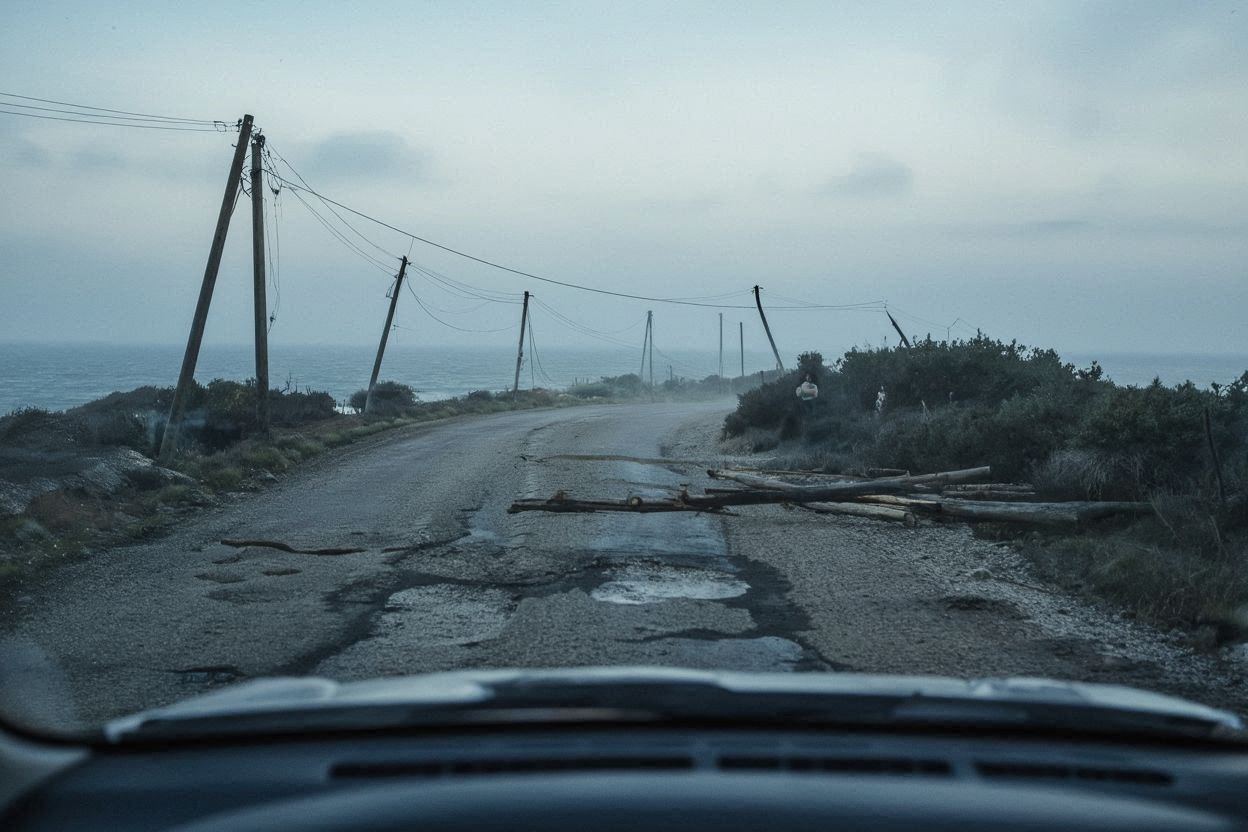
Driving on the wrong side with a stick shift was easier than I’d expected. The trick was not to think about left or right, but to keep the driver’s seat centered in the road. Roundabouts—a completely new pitfall—followed the same rule: hug the circle, keep the driver’s side away from the curb. I felt triumphant, having found a single, permanent logic for every contrivance.
Two days after my arrival, the car—a Merkur Scorpio—reached the island in a crate. I distrusted what I might find locally: overpriced Japanese imports or ancient rusted wrecks with dulled metallic paint. Once I confirmed that imports for expats on work permits were duty-free, I bought the only right-hand-drive car I could find from a dealer in Texas and had it shipped. Now, driving it for the first time on these rough roads, it seemed I’d made a mistake. The undercarriage sat too low; every bump risked catastrophe. The tyres slid on the glassy tarmac, slick as ice. The radiator steamed—whether from heat or damage during shipping, I couldn’t tell.
Still, confident now that I had rules to work with and wanting to get home quickly, I sped up.
On this Atlantic side of St Catherine’s, the sea was wilder, dangerous for swimming. Spray whipped by the Alizé hung as mist; I could taste salt as I drove. Grey coral cliffs; spreading sea-grape like lettuce; a blue wooden house behind a white picket fence; tough men on wobbling bicycles; leaning telegraph poles overrun with wires like melted cheese—scenes that would later feel ordinary were then sharp with novelty.
At a crossroads marked Burnside, the main road narrowed and broke apart. I slowed to barely twenty. Ahead, boys—teenagers—played cricket or tennis on the ruined tarmac. A barrier of sticks and logs lay across the camber. Off to one side, half-hidden in the brush, an older man watched—arms folded, supervisory, like some self-appointed Mayor presiding over the road.
I stopped. One boy approached.
“Twenty dollars to pass, Mister.”
He couldn’t have been more than thirteen: shaved head, bare chest, pot belly, shorts and flip-flops. He held a coconut frond, flicking it like a whip.
I didn’t take him seriously.
“I don’t have twenty dollars.”
“Then you can’t pass.”
“Move the barrier and go away.”
The guidebooks had spoken of friendly Katitians, not shakedowns by children on coastal back roads. Still, I wasn’t frightened. This felt low-level.
“No,” he said.
“He doesn’t control you,” I said to the boy nearest him. Severe-faced, but wearing shorts with Patrick Starfish on them, he seemed the most likely to break. “You could let me go.”
“Never,” he said, turning his back.
These kids are hardcore, I thought. Maybe a nudge will scare them.
I turned the engine on.
“Turn it back off!” screamed Starfish.
I nudged the car into first.
“Move!” I shouted. “Or I’ll run you down!”
The older man in the brush was no longer visible. Now the crazy Mayor had disappeared into the bush, I thought. This was my chance.
“You done fuck up!” Starfish screamed, and as I rolled forward—no more than an inch—he threw himself in front of the car.
“Jesus Lord, you hit him! I see everything! Big man, you in trouble now!”
The Mayor emerged from the bush, close now, a hammer in his hand where the coconut frond had been.
“Ray-John, the white man hit Boycie! Go get your mum! Fast!”
Ray-John ran.
Starfish—Boycie—writhed on the tarmac, clutching his arm. The car hadn’t touched him. Of that I was certain. The performance was expert.
“Kadeem, break down the barrier,” the Mayor said. Kadeem kicked oil cans and cones into the undergrowth.
I shut off the engine and got out.
“Don’t move, big man!” the Mayor shrieked, waving the hammer. “We got your licence plate.”
I crouched beside Boycie.
“You okay?”
“Ugh! Ugh!” he cried, rolling.
“You run him down, you white bitch!” the Mayor screamed.
Ray-John’s mother arrived, breathless.
“What the hell you do?” Her voice shook with outrage. “You gonna pay for this.” She bent over Boycie. “Call an ambulance, Kadeem. This angel hurt bad.”
“He’s not hurt,” I said. “I didn’t hit him. He’s acting.”
“How you say he acting?” she cried. “He whole body twisted.”
“The white bitch a liar,” said the Mayor. “We see him hit Boycie. Right, Ray-John?”
Ray-John nodded.
“Pick him up,” the woman said. The road was too hot now for theatrics. Boycie couldn’t stay down. They dragged him into the shade.
I got back into the car and drove off fast. The salt mist that had felt fresh minutes earlier now clung to the windscreen like a net. My heart hammered. The road ahead lay empty, the barrier gone as if it had never existed.
A mile later, a police car pulled from a side road and signalled me to stop.
At the station they took my licence and passport and sat me beneath a slowly turning fan. The walls tinted limewash. The officer took a small pencil sharpener from a drawer and carefully turned the stub of his crayon, the shavings falling to the floor.
“You hit a boy,” he said, not bothering to look up.
“I didn’t hit him. He jumped in front of the car but I stopped in time.”
The crayon stopped turning.
“His mother say you hit him.”
“Maybe he touched the car but very lightly.”
“You a doctor?”
“No.”
He wrote this down.
I explained the whole thing – the barrier, the set up, the shake down. But in the heat of the station, my words seemed to lose weight, a kind of thinness in that fug.
He nodded once, only at the end.
“You must understand,” he said. “They all witnesses.”
He wrote a bit more.
The fan seemed to turn slower now, the whole contraption wobbling and rattling when one blade made a certain arc. I watched it stutter round and round, knowing that if it came apart, I wouldn’t know which way to dive.
Leave a Reply