Tag: fiction

  • The Barrel

    The Barrel

    It had rained all night and most of the morning. By the time I arrived at the yard the concrete was steaming, the water lifting back into the air as the sun arced over the solar panels on the warehouse roof.

    “This barrel here,” says Caldwell, pointing at the drum—a four-foot cardboard tube with a plastic lid—“is the most expensive barrel in St Catherine’s.”

    “Because of what it’s got inside?” I say.

    “No,” he says, lifting the lid. “See? It’s empty.”

    Inside there’s nothing but an inch of rainwater that must have crept in overnight.

    “Then why is it so costly, Caldwell?”

    “Because it in my yard, man. It one of mine. That give it power.”

    He grins, gold teeth flashing. Raymond, one of his children—it’s said he has many, though he’s only in his late twenties—grins too. The three of them line up against the breeze-block wall of the customs office: the Rasta, the boy, the barrel.

    “It’s what I can do with it,” Caldwell says, “that makes it valuable.”

    “And what’s that?”

    “This barrel can disappear.”

    The joke runs longer than it should. Raymond laughs on cue, then glances at me, checking. When I don’t smile back, the laugh fades and he looks to his father instead.

    “How’s that?” I say.

    “Raymond. Show the gentleman.”

    The boy fetches a paper from the office table.

    “Is a docket!” He waves the customs declaration. “That’s we trick.”

    Blank now but filled in later by someone at the Port who understands how to jumble the classifications.

    “In container gine be just parts,” Caldwell confirms. “Chair legs. Screws. Canvas. Nothing assembled.”

    “And when it leaves?” I say.

    He shrugs. “This one going to leave as car parts. Zero duty.”

    “Anybody else would get locked up for that,” I say.

    “That’s how you know the trick be good,” Caldwell says.

    He watches me more closely. Toward the far side of the yard, empty containers stand. The concrete, where it’s not crumbled, is blackened in loops where the forklifts have burned their tyre marks. The padlocks, the barbed wire, the mattress inside the office where the boy sleeps – all of it functional.

    Caldwell walks the yard in his Wellingtons, tapping pallets with his boot. Raymond trails him for a step or two, then stops when Caldwell doesn’t look back.

    When Caldwell returns, he doesn’t joke.

    “So,” he says. “Why you come round today?”

    “The wedding’s on Saturday.”

    He stops and inspects me for a moment, like I’m one of his pallets.

    “Sis,” he says.

    “Yes.”

    Raymond is bored. His earlier grin has gone.

    “She been telling me ,” Caldwell mutters, “that after the wedding everything going get straightened out. Bank. Port. Dockets. Everything going to be easier.” He’s take something, gum, out of his mouth and spits it to the ground.” That she spin.”

    “She’s not lying.”

    “As if I don’t have that shit locked down already.”

    “Thing is, Cald, she’s redone the math.”

    He wants to look up but instead he bends down and turns the tap. A thin dribble spills onto the concrete, spreading and darkening as it pools away.

    “The pressure,” he grumbles. “Always damn low up here.”

    “Marriage is going to make everything easier. For everybody,” I say.

    Rather than look at him, I stare at the container where the boy stands has one corner buckled inward where a forklift caught it years ago. It’s been sat there ever since – too damaged to use, too useful to scrap.

    “It’s going to legitimise things.” Caldwell follows my gaze. The container doesn’t belong anywhere else now. It’s part of this place. “We can start doing things a different way. Professionalise. Make a real company out of it.”

    Caldwell nods. He doesn’t need the rest spelled out.

    “Hell, we could have we a conglomerate,” he says. ”Raymond has drifted closer again. Caldwell notices, pauses, then waves him back firmly. The boy obeys. “That’s her pitch. But she don’t all the uses of the current arrangements. ”

    “She thinks the whole thing run it’s course. She says time’s have changed”

    A truck pulls up at the gate and waits. With a nod, the boy runs to the barrier.

    “You know why this barrel empty?” Caldwell sighs.

    “Because it’s a trick.”

    “Because this the one we show Sis.” He taps the rim with his knuckle and it echoes hollow. “This is what we new compliance department see.”

    “But the rest of it,” I say.

    He looks at me.

    “You bedroom business can stay out of we business business,” he says. “Then we cool.”

    Raymond can’t get the padlock open and the truck sounds his horn in impatience.

    A wave of heat from the concrete floods over me – a burning sensation, like there’s something in the ground climbing up through the soles of my shoes. Trucks idling, gates hesitating, the boy still fumbling with the lock while Caldwell looks on angrily. The deal with him was I was temporary -the explainer, the manager, the guy with the connections had always been the one that could still step away.

    I see Somaya at the kitchen table, hair still damp, barefoot on the tile, one toe hooked under the chair rung. Careful. Exact. Worried about mistakes in the note she’s writing to the Pastor. She doesn’t look up when she does it.

    Once you stop noticing it, the heat because the local temperature. The airlessness settles. You stop being a sweat-drenched traveller and start being a native.

    The concrete yard, the scarred containers, the barrel that never has to move. They sit like they’ve always been here and everything else learns how to flow around them

    “So,” Caldwell says. “You still marrying her?”

    Once it’s done, everything will fit together .

    “Yes,” I say. “On Saturday.”

    “Good,” Caldwell says. “Then we all in it hard.”

    Raymond finally gets the key to turn and the gate swings wide. As the trucks roll in, Caldwell replaces the lid on the empty barrel and presses it down.

    https://thinkinginstructure.substack.com/p/the-barrel

  • The Roadblock

    The Roadblock

    Driving on the wrong side with a stick shift was easier than I’d expected. The trick was not to think about left or right, but to keep the driver’s seat centered in the road. Roundabouts—a completely new pitfall—followed the same rule: hug the circle, keep the driver’s side away from the curb. I felt triumphant, having found a single, permanent logic for every contrivance.

    Two days after my arrival, the car—a Merkur Scorpio—reached the island in a crate. I distrusted what I might find locally: overpriced Japanese imports or ancient rusted wrecks with dulled metallic paint. Once I confirmed that imports for expats on work permits were duty-free, I bought the only right-hand-drive car I could find from a dealer in Texas and had it shipped. Now, driving it for the first time on these rough roads, it seemed I’d made a mistake. The undercarriage sat too low; every bump risked catastrophe. The tyres slid on the glassy tarmac, slick as ice. The radiator steamed—whether from heat or damage during shipping, I couldn’t tell.

    Still, confident now that I had rules to work with and wanting to get home quickly, I sped up.

    On this Atlantic side of St Catherine’s, the sea was wilder, dangerous for swimming. Spray whipped by the Alizé hung as mist; I could taste salt as I drove. Grey coral cliffs; spreading sea-grape like lettuce; a blue wooden house behind a white picket fence; tough men on wobbling bicycles; leaning telegraph poles overrun with wires like melted cheese—scenes that would later feel ordinary were then sharp with novelty.

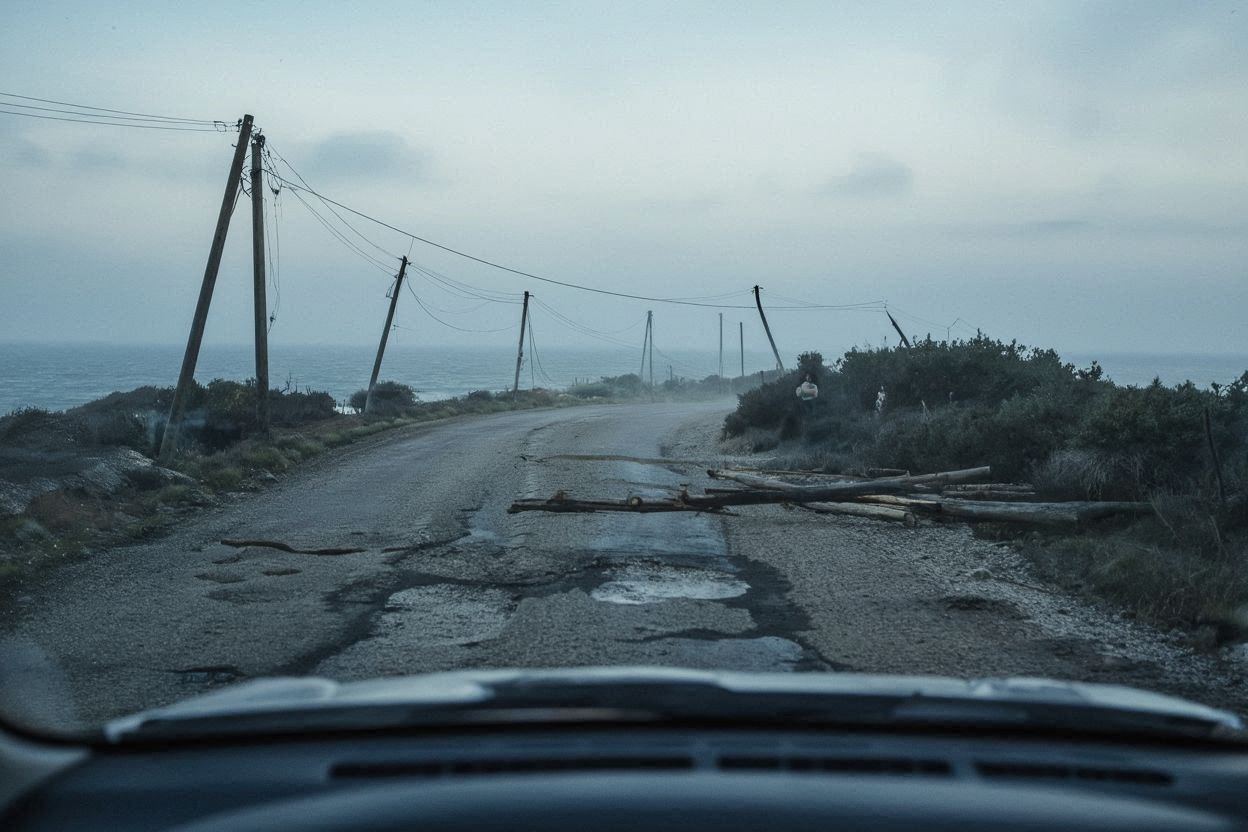
    At a crossroads marked Burnside, the main road narrowed and broke apart. I slowed to barely twenty. Ahead, boys—teenagers—played cricket or tennis on the ruined tarmac. A barrier of sticks and logs lay across the camber. Off to one side, half-hidden in the brush, an older man watched—arms folded, supervisory, like some self-appointed Mayor presiding over the road.

    I stopped. One boy approached.

    “Twenty dollars to pass, Mister.”

    He couldn’t have been more than thirteen: shaved head, bare chest, pot belly, shorts and flip-flops. He held a coconut frond, flicking it like a whip.

    I didn’t take him seriously.

    “I don’t have twenty dollars.”

    “Then you can’t pass.”

    “Move the barrier and go away.”

    The guidebooks had spoken of friendly Katitians, not shakedowns by children on coastal back roads. Still, I wasn’t frightened. This felt low-level.

    “No,” he said.

    “He doesn’t control you,” I said to the boy nearest him. Severe-faced, but wearing shorts with Patrick Starfish on them, he seemed the most likely to break. “You could let me go.”

    “Never,” he said, turning his back.

    These kids are hardcore, I thought. Maybe a nudge will scare them.

    I turned the engine on.

    “Turn it back off!” screamed Starfish.

    I nudged the car into first.

    “Move!” I shouted. “Or I’ll run you down!”

    The older man in the brush was no longer visible. Now the crazy Mayor had disappeared into the bush, I thought. This was my chance.

    “You done fuck up!” Starfish screamed, and as I rolled forward—no more than an inch—he threw himself in front of the car.

    “Jesus Lord, you hit him! I see everything! Big man, you in trouble now!”

    The Mayor emerged from the bush, close now, a hammer in his hand where the coconut frond had been.

    “Ray-John, the white man hit Boycie! Go get your mum! Fast!”

    Ray-John ran.

    Starfish—Boycie—writhed on the tarmac, clutching his arm. The car hadn’t touched him. Of that I was certain. The performance was expert.

    “Kadeem, break down the barrier,” the Mayor said. Kadeem kicked oil cans and cones into the undergrowth.

    I shut off the engine and got out.

    “Don’t move, big man!” the Mayor shrieked, waving the hammer. “We got your licence plate.”

    I crouched beside Boycie.

    “You okay?”

    “Ugh! Ugh!” he cried, rolling.

    “You run him down, you white bitch!” the Mayor screamed.

    Ray-John’s mother arrived, breathless.

    “What the hell you do?” Her voice shook with outrage. “You gonna pay for this.” She bent over Boycie. “Call an ambulance, Kadeem. This angel hurt bad.”

    “He’s not hurt,” I said. “I didn’t hit him. He’s acting.”

    “How you say he acting?” she cried. “He whole body twisted.”

    “The white bitch a liar,” said the Mayor. “We see him hit Boycie. Right, Ray-John?”

    Ray-John nodded.

    “Pick him up,” the woman said. The road was too hot now for theatrics. Boycie couldn’t stay down. They dragged him into the shade.

    I got back into the car and drove off fast. The salt mist that had felt fresh minutes earlier now clung to the windscreen like a net. My heart hammered. The road ahead lay empty, the barrier gone as if it had never existed.

    A mile later, a police car pulled from a side road and signalled me to stop.

    At the station they took my licence and passport and sat me beneath a slowly turning fan. The walls tinted limewash. The officer took a small pencil sharpener from a drawer and carefully turned the stub of his crayon, the shavings falling to the floor.

    “You hit a boy,” he said, not bothering to look up.

    “I didn’t hit him. He jumped in front of the car but I stopped in time.”

    The crayon stopped turning.

    “His mother say you hit him.”

    “Maybe he touched the car but very lightly.”

    “You a doctor?”

    “No.”

    He wrote this down.

    I explained the whole thing – the barrier, the set up, the shake down. But in the heat of the station, my words seemed to lose weight, a kind of thinness in that fug.

    He nodded once, only at the end.

    “You must understand,” he said. “They all witnesses.”

    He wrote a bit more.

    The fan seemed to turn slower now, the whole contraption wobbling and rattling when one blade made a certain arc. I watched it stutter round and round, knowing that if it came apart, I wouldn’t know which way to dive.

    https://thinkinginstructure.substack.com/p/the-roadblock

  • Trey’s Version

    Trey’s Version

    It was Madison’s fault.

    If I hadn’t had to take her to Grandpa’s apartment I would have been about thirty seven blocks away from the clown selling the balloons.

    This clown had huge winkle-pickers like his feet were sized fifty and his face was caked with powder with big red circles round his eyes so that he looked dazzled, like he’d dropped from space.

    We stood on the sidewalk, me and Maddie, and watched him holding the strings of the helium-filled balloons in his gloved hands.

    “Why’s he all dressed up, Trey?” she said.

    “He’s trying to get people’s attention so he can sell them those balloons.”

    “He’s selling those balloons? Really! Can I get one? I want one, Trey! Please!”

    I don’t like to give money to creeps that stand on street corners dressed in clown suits, especially not this particular creep whom I recognized as a homeless guy living in a doorway by Clark Street Station, but I knew that if I didn’t buy the balloon Madison would get really fraught and start shouting and screaming and carrying on all the nine blocks to Grandpa’s apartment. When Madison starts, she really doesn’t stop. She can keep on for hours and hours. For instance one time, Mom didn’t let her have popcorn at the movies and she cried all through the first picture and then the next, being as it was a double feature. Then all the way back in the bus and another hour or two at home until Mom eventually had to pop a bowlful right there on the stovetop just to get her to shut up and go to bed.

    So, although I didn’t want to, I asked her which balloon she liked.

    “Really? I can have one?’ She started jumping up and down she was so excited. “Thanks, Trey! You’re the best brother in the whole, wide world.”

    “Yeah, whatever. Which one do you want, Maddie?”

    “That one!”

    She pointed at a giant Scooby Doo.

    “Why not just get a plain one, Maddie?”

    “No, no, no, no, no, no, no, no….”

    “The cute little blue one here.”

    “No, no, no, no, no, no, no, no….”

    “See that Scooby’s going to be really expensive…”

    “Yes, yes, yes, yes, yes, yes…”

    I sighed and then I had to look up to the clown and try and get his attention because he was staring right over me down to the cars on Clark Street.

    “How much for the Scooby Doo, sir?” I said.

    He bent down and I could smell the liquor on his breath.

    “That’s going to be three dollars, son. That’s a special one.”

    I sighed and reached inside my pocket, finding seven dollars left out of the money Mom had given me. I really needed to keep back five for the fare back home that evening so I wasn’t sure if it was sensible to buy the balloon at three dollars. But now I’d gotten Madison really excited like that it would have been unfair to let her down, and I figured if we took the subway back as far as Walden and then walked the last three blocks we could save a dollar so I could just about afford it and still get us back home that night.

    So I gave the clown three dollars and he lifted the string from out of his hand and gave it to Madison.

    I told her to hold it tight because if it blew away I didn’t have money for another and I made her wind the string carefully twice round her hand.

    We walked all the length of the Promenade, Maddie’s hand with the balloon tied to it held out in front like she was sleepwalking and all the shoppers smiled at her. Little kids pointed and cooed at her and then got shushed by their mothers when they asked if they could get a balloon the same as hers. We took a left down the Esplanade and went all along the parade of shops so that Maddie could look at her reflection in the windows and smirk at herself holding that balloon. And then we cut south, down Hicks Street that runs into Atlantic Avenue, so she could show the balloon to the lady that works on the cosmetics counter at Macy’s who used to live in the house next to ours.

    I felt good to have brought the balloon for her. It made me feel like my father must have felt when he bought us the Cadillac – powerful to have done something worthwhile with money.

    By the time we got to Mr Stephanopoulus’ store about five hundred yards from the brownstone that housed Grandpa’s apartment, it was ten thirty.

    And it was only when we got to that store that I remembered why I’d had so much money in my pocket.

    It was Friday. Mom gives me an extra two dollars on Fridays to buy Grandpa’s newspaper so that he can check the racing schedule for the coming weekend. And now because I had brought the balloon, I only had four dollars left which was supposed to be our train fare back to New Jersey.

    “Madison,” I said angrily. “Why didn’t you remind me? We were supposed to get Grandpa’s paper. What are we going to do now?”

    “We can still get it from the store.”

    “But I don’t have the money now. Because I brought you that balloon.”

    “You do have money,” Maddie said. “You’ve got four dollars in your pocket. I saw it.”

    “We need that for the train to get home.”

    “Grandpa’s going to be really mad if he doesn’t get his paper.”

    She was right. Grandpa would be really mad. He’d start calling up Mom and asking why we didn’t bring his paper, and Mom would tell him not to shout at her because she gave me the money for it, and then he’d start shouting at me, asking to see where the money was that I’d been given, and I’d only be able to show him the four dollars that I needed to get back to Harden, and so he’d call Mom back saying I’d stolen her money. All hell would break loose when I got back home.

    So I figured the best thing to do for right now was to go the store to get the paper with the money I had left and then spend the rest of the day figuring out how we’d get home with only two dollars.

    Mr. Stephanopoulus, the store owner, is Greek and has a huge handlebar moustache. He smells of candy and cinnamon. He knows me well because I’m always in there when I visit Grandpa, buying penny treats and sherbet fountains.

    I found Grandpa’s newspaper in a stack by the shelves and then took it up to Mr. Stephanopoulous to pay for it.

    He said, “Trey! You’re going to your grandfather? Here I have a package for him.”

    He handed me a large, brown envelope and I took it carefully.

    “Be sure you give it to him straightaway.”

    “What is it, Mr. Stephanopoulus?”

    “A special magazine he ordered that’s just come in. Don’t open it. Just give it to him wrapped like it is now. O.K?”

    “Sure,” I said, a little puzzled as to why Mr Stephanopoulus was so concerned that the plain, brown envelope should not be opened.

    I tucked the strange brown envelope under my arm, held the newspaper out in front and we started to walk back to Grandpa’s brownstone, Maddie with the balloon out in front, all dignified like she was walking a floating poodle on a leash.

    We got as far as Cambridge and turned into the narrow passage by the canal that works as a shortcut.

    We shouldn’t have gone that way.

    I’d forgotten about the Bay and how it whips the wind that roars off the Atlantic, channeling it down the estuary and along the mouth of the Hudson, and blasts you like a hurricane.

    When we got in the passage, crossing from the flagstones onto the wooden boarding that spans the inlet, I looked back for Maddie. She was right behind me, holding the balloon tight, pulling it down to get it under the stone arch that led us inside.

    I walked on ahead, forgetting about the wind.

    Then I heard the whooshing sound and remembered.

    The whooshing sound is the noise the gust makes when it channels through the arch. It’s your first warning of what’s to come. Then the whoosh becomes louder, more like a roar, and you start to feel it push on the back of your neck. Then finally it smacks you with its full blast, bowling you down the passage, hitting you like a slug from a baseball bat.

    The blast hit and I stumbled forward, dropping the package and nearly letting the newspaper go. I could hear Maddie scream and felt something wet and cold on the back of my neck that might have been spray from the waves lifted from the river.

    I turned round.

    Maddie was against the railings, the balloon in front of her out over the railings. She was leaning backwards and pulling at it like it was a marlin and she was a deep sea fisherman trying to reel it in.

    I ran back to her and tried to grab at the string. But just as I reached her there was a second massive gust and the balloon made a sudden lurch and that’s when the string snapped.

    Maddie screamed and jumped at the twine as it swung upwards. But too late. The balloon had broken free and was rising fast.

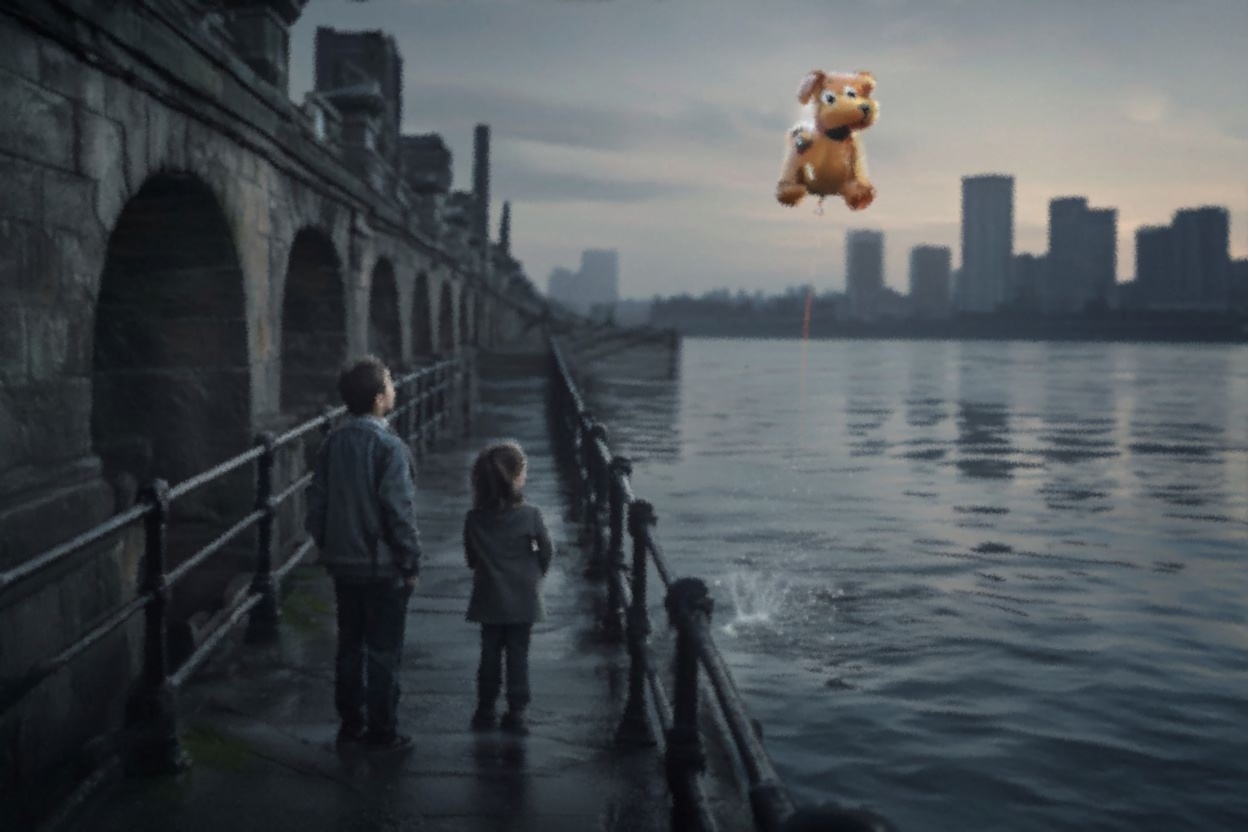
    We watched it tacking out over the icy grey river towards Staten Island, lifting slowly above the docks, curling and dipping and ducking, it was almost as low as the river itself. Then it rose again, off over the Bay’s inky grayness, between the ferry boats, and up above the buildings, towards Liberty, like she was going to catch it in her hand, until it moved up again, higher than the skyscrapers on Manhattan and became the tiniest dot up in the silver sky.

    When it had gone, Maddie bent down and started crying, little slow sobs at first, then louder and longer, until finally she was wailing uncontrollably, her little face covered in tears and red as a beetroot.

    Like I told you before, once Maddie starts, it’s really hard to get her to stop.

    I got down, put my arm around her and told her Mom would get mad with her if she didn’t stop; that there were always other balloons; that it was just a thing, made of rubber, and it was stupid to cry over a thing; that we needed to get to Grandpa’s house because we were already late and he’d be worried and, if he was worried, he’d call Mom. And finally, when all that didn’t work, I told her we would try and find the clown again when we walked home that evening so he could sell us another.

    She looked up at me, her little eyes red as cherries, and said, “Promise, Trey,” and I said “Yes,” and she said, “Could I get that cute blue one?” and I said “Yes,” just to get her to come because in actual fact I had no real intention of getting her another balloon what with having no money and all.

    She wiped her eyes and got up off the boarding and we slowly walked the five hundred yards or so to Grandpa’s apartment.

    He was pleased to see us. Even more pleased to see the newspaper. And when he reached for it, I remembered about the package Mr Stephanopoulos had given me.

    I didn’t have it. I must have left it in the passage where I’d dropped it rushing for the balloon. And now it would be gone, blown away into the Bay.

    But Grandpa wasn’t mad with me because he didn’t know his special package had arrived at Mr Stephanopolous’ and Mr Stephanopolous had entrusted its delivery to me, and pretty soon, because he was so pleased having got the paper, and because Maddie had finally calmed down and stopped bawling, I forgot about the package too.

    All that day, while I was watching television, while I was watching Grandpa slurp his oxtail soup and while I was playing with Maddie in the tiny vacant lot behind the apartment building, I was thinking about how we were going to get home without any money.

    I figured maybe Grandpa might help, if I explained things to him properly, but whenever I opened my mouth to start, I caught this look in his eyes, like he was telling me not to go on. Mom says never get him angry; it’s bad for his heart. So all that day, I never quite had the nerve to ask him for the extra two dollars we needed to get home.

    By five o’clock, when it was time to leave and he was shooing me and Maddie and out of the door back to my Mom’s house, I still had no plan.

    We walked slowly, back down the same passage we’d taken when we lost the balloon and we both stopped to look over the railings out onto the gray water, out where Scooby Doo had made his lunge for freedom and broken free. The Bay looked different though – there was a gray flatness to it and the sun had fallen behind the skyscrapers so that huge rectangular shadows lay over us, like from tombstones, turning the procession of fizzed wavelets behind the barges into a kind of stillness. I leaned forward to look at the ferry that was plowing across to Battery Park and that’s when I saw it. In the garbage can between the railings and the second arch was Mr. Stephanolous’ package, wedged between a hamburger box and a bag of macadamias.

    Some neat freak must have picked it up and put it there.

    I said, “Maddie! Look! Grandpa’s package!”

    I reached down into the can, pulled out the package and checked it over. It was perfectly preserved. Not wet or smelly or anything. I stuffed it in my pants. I would carry it to Grandpa tomorrow, when we came back with Mom, and he would be none the wiser about my having dropped it.

    Then we walked back down Hicks Street, all along the Promenade, me kind of slow and deliberate because I knew what was coming, and Maddie excited and chatty, wanting to get back to the clown to buy her replacement balloon.

    We got to the corner by the subway, but the clown had gone.

    Maddie spent a while looking around for him and then, when she realized that I’d tricked her, she burst into tears.

    Like I said, when Maddie starts crying, it’s really hard to get her to stop.

    I told her that it was late and Mom was expecting us and if we didn’t hurry up, she’d be worried. I told her the clown would be back in the morning, and he would have a whole set of new balloons, maybe even a couple of Scooby Doos or one of them fairy witches from the Winx Club. I told her if she just lay here on a sidewalk bawling, the police would surely come for her and carry her away to a Children’s Home.

    And finally, when the worst of it was over, I got down on the ground next to her and said, “How’d you like to play a skipping game?”

    Maddie likes skipping games, only most times, I won’t play them with her, being fourteen and male and all.

    “What kind of a skipping game?”

    “You ever hopped a turnstile?”

    “No. You can hop a turnstile?”

    “You ever played leapfrog?”

    “Sure. But that ain’t no skipping game.”

    “Well, a jumping game, then. It’s going to be like leapfrog. But with turnstiles.”

    The thing of it is, I’d never really tried jumping a turnstile before, although some guys at school said they do it all the time and made it sound really easy. They said it’s just a matter of confidence. People really aren’t too interested in other people dodging fares, maybe because they figure the trains are so dirty and unreliable nobody should really be paying a fare in the first place. So if you’re just straight up and bold about it, most people are going to ignore you.

    The trick is to sidle up to the turnstile right behind someone so that it looks as though you’re with them and then just kind of crash into the barrier as they hurry through. Then you get your leg up and over and hurdle it like you’re at the Olympics or something.

    Maddie said she’d try it, if I showed her how.

    So we went down the stairs onto the concourse and looked around, scouting for the station guard or a ticket collector or anybody with a uniform, and didn’t see anyone, so I figured, it’s now or never, and got right behind this respectable looking couple. I told Maddie to stand right behind me and then I hit the turnstile as though I was trying to push through it. Then I had to lift my leg up and over. But I’d forgotten I had Mr. Stephanopolous’ package stuffed in my pants. So when I raised my leg, it just kind of froze at about sixty degrees, because that’s as much as the package would give, and I couldn’t move it any higher and I couldn’t get it back off. Then I felt something give in my upper leg like I’d ripped a tendon or something, and I started to lean some more on the barrier and that’s when I heard the bearings clicking in their housing and felt the turnstile turn a little more. I could feel the seam of the denim between my legs that must have gotten caught in the barrier getting tighter and tighter and then I think I might have started screaming and maybe I even blacked out a while because next thing I knew a ticket inspector, was standing over, saying, “Jeez, son, that thing’s almost ripped your balls off!”

    Anyway they put me and Maddie in this office with a reflective glass front so we could see out but no-one could see in and they made us give the name and address of our parents and so on, then they kept us there until Mom and Dad came, and that’s just about the way everything happened.

    Like I said. It was Madison’s fault.

    MADISON’S VERSION
    Trey said no, no, no, no, no — and then he bought a dirty magazine and got caught by the police with his pants down.

    https://thinkinginstructure.substack.com/p/treys-version

  • That Serve!

    [Author’s note:
    This is a short work of fiction.]

    First off, I suppose I have to explain why I decided to e-mail Dr. Petalman at all, what with him being the most famous mathematician on the planet and me just a nineteen year-old college drop-out.

    Contrary to a lot of current gossip, it wasn’t the million dollars. In fact, I knew he didn’t have the million dollars. I was aware he had refused it. So it wasn’t that.

    And it certainly wasn’t because of the math. Let me get that straight from the get go. Back then, I hated math.

    And I didn’t want him to help pick a winning horse in the four thirty at Leyton Plains, or give me the number of next week’s Powerball, or the name of a tech stock to invest in, or any other of the crap you might have read on the internet.

    Really, I just had a question about table tennis. I was nationally ranked, but the coach had a grudge against me and wanted me off the team. So I needed Petalman’s advice.

    But I can understand that you might not accept that, so let me explain properly.

    I first saw Dr Petalman playing ping pong on NOVA, this science documentary they have on Saturday nights on PBS – fifty minutes of high-brow gobbledygook that my sister, Courtney, likes to watch in the hope that some of it will rub off and she’ll grow a brain and not fail integrated science.

    Most times it’s on, I’ll be outside in the yard practising with the table pushed against the wall, but that night I was in the front room – I had the daily Sudoku to finish and I didn’t want to do it in the kitchen because Dad was there, eating his tuna sandwiches, making the place reek to high heaven.

    So I sat with the newspaper in front of me, half a wary eye on the T.V., watching it distractedly – really there was no other way, because this NOVA episode seemed to consist mostly of a procession of bizarre computer images : brightly colored rubber balls spinning on gray backgrounds and then twisting into spirals and exploding, and fields of little arrows like a thousand tiny weather vanes swimming on a giant chin, and numbers, everywhere numbers, tsunamis of numbers, swarming over strange, bent shapes that looked like mutant vegetables.

    “Are you really watching this crap?” I said to Courtney.

    It was like something out of Alice in Wonderland.

    “Shut up and do your Sudoku,” she said.

    “Because there’s football on the other side.”

    “It’s math. It’s fascinating.”

    Fascinating is a Courtney word. It means she doesn’t get something, but she wishes she did.

    When the trippy animation stopped, they showed eccentric-looking men talking straight to camera. They subtitled them, and Courtney read out the names in her sing-song voice – Professor Cornelius Crackhauser, Head of Abstract Geometry at MIT; Simeon Turnip, Emeritus Professor of Quantum Loop Gravity at UCLA; Dr David Bonkbasher, Reader in Abstracted Riemannian Surfology, St John’s College, Cambridge and so on – all these oddballs mumbling baloney at the interviewer, scratching their heads and showering the lens with dandruff.

    I tried not to watch. I put my elbows on the coffee table and my head between my hands, hoping by ducking down I would streamline the flight of high-faluting bullshit as it soared over the top of my head.

    But something kept drawing my eyes back to the screen.

    This show was about mathematics? That’s what Courtney had said. But wasn’t mathematics arithmetic and algebra and numbers and things? If the show really was about mathematics it was mathematics like I’d never heard of – insane mathematics, ninja mathematics, mathematics in fifty nine dimensions and thirty seven different color schemes, mathematics with cubes and pyramids and tesseracts and floaty things that dissolved into shimmering metallic matrices that had four sides of Greek letters and another six in hieroglyph; mathematics that spun and whirled and flashed before your eyes. In short, coked-up math for tripped-out crackheads.

    A man in his thirties came on the screen. He looked like his head had been stuck on his neck upside down – a great shaggy arc of a beard grew on his chin, the top of his head was totally bald and, to cap off the effect, the wires of beard re-emerged in huge, disconnected tufts right over his eyes to form eyebrows thick as hedgerows.

    “Dr Misha Petalman,” said Courtney slowly, reading the sub-title with difficulty because at the same time she was texting, maybe even sexting, who knows these days with Courtney. “Lecturer in Advanced Differential Geometry, Slakov Institute, Moscow.”

    And then they showed something really astonishing – footage of Dr Petalman playing ping pong at some academic conference with another mathematician. The two of them hammered away at each other while the narrator told us that they were geniuses, but that even geniuses must have outside interests and Petalman’s was table tennis.

    That really got my attention.

    I could see right away he was very good. He hit the ball with enormous sweeps of his hairy arms, dashing about the table in a fury, his eyes blazing with rage. He would move right up close to the table and then play dinky little lobs to the back line with huge spin on them so that the ball would curve away at impossible angles, bamboozling his opponent.

    But it was really his serve that had me fascinated. There was something very strange about it. It seemed to be a variant of the back-spin cross-table, but Petalman was not pushing his arm forward and spinning the ball clockwise like I’d been taught – he was throwing it up a huge distance and then chopping it vertically.

    It looked impossibly difficult but Petalman was like an automaton, whacking serve after serve and never missing the chop.

    “You see him do that?” I said to Courtney. “I could never do that.”

    “Because you’re dumb, Dennis. This is higher math. You can’t even add up a till roll.”

    “Not the math. They’re not even talking about the math. Look, it’s table tennis. And watch the way he’s serving. That is awesome. The way he’s taking the ball and tucking it in the back of his hand and then slicing the bat down. He’s winning every point on that serve.”

    “The show is end-to-end educational mathematics and the only part that interests you is the ping pong.”

    “Because this guy, Petalman, is AMAZING at ping pong…” I said, and pushed the newspaper to one side so I could watch him properly, as he gave this astonishing exhibition of tip-top, high precision, technically perfect ball bashing.


    Later, I googled Dr. Petalman.

    Wikipedia was not helpful – the entry was long, all about his proof of the Poindexter Conjecture the year before, and how he had refused the million dollars Clay Prize, saying that he had no need for money and that the proof itself was reward enough. Nothing about the ping pong.

    At the bottom of the entry, however, was a link to an academic paper, and at the bottom of that, below a mass of Greek symbols, was his e-mail address.

    I know it was presumptuous and perhaps a little crazy, but I figured what the hell, I would really like to know the secret of that serve.

    So I sent him an e-mail.

    This was what I wrote:

    I sent the e-mail off and the truth is I didn’t think too much about again. At that time I had a lot on my mind, what with the team being selected on Tuesday, and Coach Grant being such a hard-arse about practice and everything, so really I forgot all about the e-mail to Dr Petalman. Until the next evening when I saw this in my inbox:

    “RE: That Serve!!!! petalman@slakov.ru”

    I didn’t immediately open it. I figured it was just some sort of automated response, or maybe an assistant at the university had got round to clearing the doctor’s inbox.

    When eventually I clicked on it, this is what it said:

    ‘Feign’ I had to look up.

    Then I replied:

    One day later I got this:


    So that’s how we started. Dr Petalman telling me about this wild man, the ingenious yeti with too much time on his hands, and urging me to think deep and not fast– to take the slow path, the less-travelled road, and above all else to concentrate on just this one problem, the problem of the ping pong serve, to the exclusion of everything else.

    After I had made the commitment, it was just a matter of time.

    I don’t want to tell you too much about the specifics of Dr Petalman’s program except it was conducted by Instant Messenger and webcam (any doubts I had that I might be speaking to a fake Dr Petalman were immediately dispelled when I first caught sight of his extraordinary and unique upside down face on the screen of my computer).

    The program was also extremely practical.

    To give you some small flavor, here are a few of the tasks he set me:

    • Combing the hair on a spherical dog (we used a real Alsatian).
    • Parallel transportation of the connection of a vector field around a closed manifold (plastic arrows and assorted rubber mattresses).
    • Winding number of loop integrals (homing pigeons).
    • The n-Sphere – (n plus one space hoppers and industrial sewing equipment).

    We worked together for six months.

    Initially the sessions were no more than thirty minutes, but as we continued and I began to make progress, they extended longer and longer, until more often than not we worked through the night – Dr Petalman explaining a new idea; my trying to understand it; Dr Petalman urging me onwards, schooling me through his practical experiments; the first inklings of comprehension; then a growing confidence and a final cataclysmic aha! moment when at last I grasped the concept in the whole – an extraordinary catharsis, more powerful than orgasm.

    Thoughts of that table tennis serve that had initiated the tuition rapidly became subsidiary to the beauty of the math he was showing me. I felt he was guiding me through a new and wonderful world previously hidden to me – a multiverse of vectors and tensors and multi-dimensional manifolds, a dancing jamboree of pure abstracted thought.

    Then one day, about six months into the program, after we had completed an extraordinary session on the perturbation expansions of Yang-Mills Quantum Field Theories involving copious use of tightly wound plastic hoses, Dr Petalman leaned forward into his webcam and said softly, “Dennis, you have been a wonderful student. It has been a pleasure working with you.”

    “Thank you, Dr Petalman. But honestly really the pleasure has been all mine. You have been the most extraordinary teacher.”

    “Truly you have worked hard. I think now you are ready.”

    “Ready for what?

    “The serve, Dennis.”

    “The serve. Yes. I had forgotten about the serve.”

    ‘We were leading up to it.”

    “Yes. We were.”

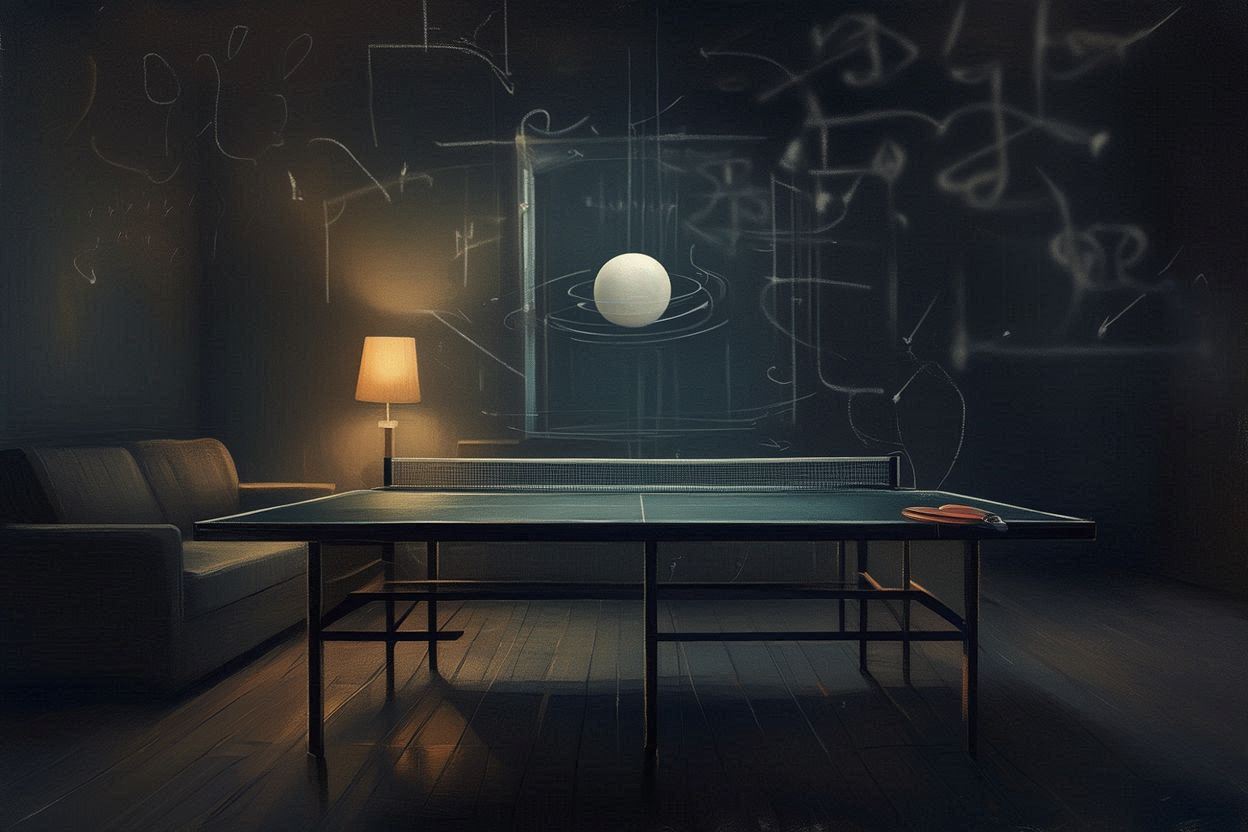
    He moved back from the camera and I could see that the matt green blur that had always been present in the furthest corner of his room was now pulled into focus and resolved into the unmistakable shape of a ping pong table.

    The doctor moved towards it and then pulled a bat and a ball from inside his tweed jacket.

    He didn’t hesitate. He threw the ball high, giving it the extraordinary spin I had seen so many months before on the NOVA program, and then he slashed at it with his bat.

    In that one motion, as the bat hit the ball, all became clear to me. All the teaching of the past six months filled my mind and flashed into clear focus. Immediately, I understood.

    My insight was devastating.

    The Petalman Program: Serve Dynamics

    Active Manifold: Semi-Riemannian non-commutative Lie algebra
    Status: Waiting for serve…
    Δ(Serve) = Yang–Mills term + mass gap

    “You should write it up,” he said later, when he had gone over my interpretation three times, making small corrections here and there

    “How do you mean write it up, Dr Petalman?

    “Write it up as an academic paper. It is important work.”

    “I can’t write up a scientific paper. I’m a college drop-out.”

    “It is just a question of embellishing the original arguments. I will guide you.”

    So I spent the next three weeks, with Dr Petalman’s help, writing up the results.

    When we had finished, Dr Petalman decided it was good enough to upload to Arxiv.org, the mathematicians’ website, and when that was done, he announced his program complete, and told me he would be unavailable for tuition for the immediate future.


    The paper caused quite a stir, and I’m afraid Dr Petalman may have encouraged it. Titling it, “Proof of Yang Mills and Mass Gap”, when really it was a simple little exercise in the interpretation of the dynamics of a closed physical system in three dimensions (the flight of a ping pong ball in fact) was, in retrospect, something akin to a red rag to a bull. The math community was lining up to laugh at it. But Dr Petalman had taught me well, and when the trivial rebuttals failed, the heavyweights took an interest.

    Professor Lau at Harvard put his best team onto it and, unfortunately for me, after a year of going at it they announced to the world (through the New York Times) the proof was correct. The International Math Union called, begging me to accept a new Clay Prize.

    I had no idea what to do. I felt like a complete fraud. The paper was mine and I had written its arguments, but only because I had followed the Petalman Program. When the world found out, I would be exposed and ridiculed. My sister Courtney, especially, would have a field day.

    I urgently needed to speak to Dr Petalman, but every night I logged into hotmail, his status was offline.

    Until exactly a year after he had logged off – it was now August 2014 – he came back online.

    “Dr Petalman,” I typed furiously. “Thank God, I’ve gotten hold of you. The Millennium Prize Institute has been in contact. They want to award me a Clay Prize. It is a disaster. You have to help me out. You have to tell them what really happened.”

    “But, Dennis, it is as they say. You produced a work of genius. You established the existence of the Yang-Mills theory with a mass gap. ”

    “But it was not original work. I was only following your program.”

    “In mathematics, as in so many other fields, almost nothing is truly original. We all, even the greatest of us, build on the work of others. How did Sir Isaac Newton put it? ‘We stand on the shoulders of giants.’ It was the same for me, following Goffendiek. And Goffendiek only followed Weyl. And Weyl, Riemann. And Riemann, Gauss. All the way back to Pythagoras. (Pythagoras followed somebody too, only the somebody’s name has been lost to history.)”

    “But I can’t accept a Clay Prize.”

    “Why not?”

    “It doesn’t seem right. I’m not worthy. I haven’t paid my dues.”

    “These are not valid reasons to refuse. You must accept.”

    “How can you say that? When you were offered the Prize, you didn’t accept.”

    “And it was the greatest mistake of my life. Goffendiek was relying on it. He owed money to Weyl.”

    An uncomfortable suspicion came over me.

    “You set me up for this, didn’t you, Dr Petalman?”

    “Not at all. Your research was a natural extension of mine. It solved a second great mystery. I was merely your guide to fertile mathematical ground. You dug the truffle.”

    “You want the money, don’t you? I’m supposed to give you some of the money, right?”

    “Let’s call it a tuition fee.”

    “You want the money but you don’t want to be seen accepting it. It would be terrible for your image. You’re famous for having turned the prize down after all.”

    “I do want some money, yes, Dennis. My mother is sick and has medical bills. And it would be difficult, after getting so much publicity when I refused the original prize for me to now decide to accept it. It is not so much a matter of pride as a matter of practicality. I fear the storm created would destroy what little privacy I now enjoy.”

    By now I was seriously angry. Who was Dr Petalman to use me like this? What manner of a man was he?

    I stared long and hard at his hairy avatar and turned the computer off in disgust.


    I refused the Clay Prize and I guess that is how you’ve heard of me. I’ve been told I upset a lot of mathematicians doing that. But actually that is something I’m sort of proud of.

    Petalman vanished off the internet completely. He may be walking the Andorran Alps with Professor Goffendiek.

    Courtney passed Integrated Science.

    Now, here’s the pitch.

    You may like to know I am still very keen on table tennis. I have a few videos up on YouTube – you could take a look at my channel if you like (DennisNutsPingPong). There is one wicked serve I am particularly proud of and if you take a look and think it’s cool, I would be very happy to teach it to you.

    I figure right now, what with this recession and everything, you might have a lot of time on your hands.

    I warn you though, the explanation is going to be complicated and it will require some work on your part to get the hang of it. But I do guarantee it will be worth your while to complete the program…

    https://thinkinginstructure.substack.com/p/the-petalman-program

  • Next time you are stuck at traffic lights you will think of neutrino beams

    Next time you are stuck at traffic lights you will think of neutrino beams

    You have been sitting still for two minutes.

    The opposite lane gets another green. A fresh burst of cars streams past. Your foot hovers above the brake, ready for the moment your own lane finally wakes up.

    You cannot see the lights. No line of sight.

    And yet you already have a sense of:

    • how long the cycle is,
    • when your lane will release,
    • roughly how far away the junction must be.

    That feeling is not superstition. It is inference.

    What your brain is doing in a queue is extremely close to what experimental physicists do with neutrino beams: reconstruct a hidden controller from nothing but timing, bursts, and delayed response.

    1) The only clues you have

    In a blocked lane you can observe:

    • bursts (cars stream, then silence),
    • gaps (silence between bursts),
    • delay (time from “release begins at the head” to “I begin to move”).

    From those you can infer:

    • the signal period TT,
    • the green splits,
    • the queue length ahead of you,
    • and therefore the distance to an unseen junction.

    This is a textbook inverse problem: you see outputs, not the mechanism.

    2) A minimal model

    Assume a two-way temporary light:

    • Lane A (opposite direction) green for gAg_A
    • all-red safety gap Δ\Delta
    • Lane B (your direction) green for gBg_B
    • all-red safety gap Δ\Delta

    Two empirical constants (good enough for order-of-magnitude inference):

    • saturation headway (once moving): about 2 s per car
    • jam spacing: about 6 m per car (car + compressed gap)

    In a stationary queue, the “release” propagates backwards: each car begins moving a bit after the one ahead. Modelling that as roughly “a couple of seconds per car” is crude but works surprisingly well near the front.

    3) Fully worked example: solving an invisible junction

    You are in Lane B. You time the opposite lane:

    • Cars stream for 22 s → estimate gA22g_A \approx 22 s
    • Then nothing for 36 s → estimate gB+2Δ36g_B + 2\Delta \approx 36 s

    So the total period is:T22+36=58 sT \approx 22 + 36 = 58\ \text{s}

    Now infer your position in the queue.

    You track your own release relative to the opposite burst:

    • t=0t = 0: opposing flow begins
    • t22t \approx 22: opposing flow ends
    • (gap, then your lane’s release begins at the junction)
    • t40t \approx 40: you begin to move

    Suppose you estimate your lane’s release begins at the head around t25t \approx 25 (opposing ends at 22, then a short all-red, then your green). Then the propagation delay from head to you is:

    4025=15 s40 – 25 = 15\ \text{s}

    With about 2 s per car:152NN7.515 \approx 2N \Rightarrow N \approx 7.5

    Distance to the light:D7.5×6 m45 mD \approx 7.5 \times 6\ \text{m} \approx 45\ \text{m}

    You just estimated distance to a junction you cannot see—within a few car lengths—using timing alone.

    4) Long queues: multiple greens before you move

    If you are far enough back that your lane does not clear on the next green, you extend the same logic.

    If your green is gBg_B​, and cars discharge about one every 2 seconds, then cars served per green is roughly:

    GgB2G \approx \frac{g_B}{2}

    If you sit through two full greens without moving, that suggests you are at least 2G2G cars back from the release front (plus whatever is left over).

    On the third green, if you begin moving xxx seconds after release begins, then you are about x/2x/2x/2 cars into that release.

    5) Where the method breaks

    Far enough upstream, you stop seeing the light’s structure and start seeing traffic as a wave medium:

    • stop–go waves propagate backwards,
    • gaps compress and expand,
    • side roads inject vehicles,
    • signals may be adaptive (no fixed TT).

    In that regime, your motion reflects local traffic dynamics more than the junction controller. The “information” about the light decays with distance.

    That breakdown is itself the physics.

    Inverse Problem Simulator

    Inferring the hidden controller through burst dynamics

    Status: Sampling Signals…
    Opposing Lane (Source Beam)
    Your Lane (Observer Data)
    Signal Period (T)
    0.00s
    Signal Offset (Startup)
    0.00s
    Inferred Junction Distance
    Data Confidence
    Low

    6) Stretch the road to 500 km: neutrino beams

    In many neutrino experiments:

    • you cannot see the beam,
    • most particles are never detected,
    • the source is hundreds of kilometres away,
    • you only get sparse bursts of detector events.

    Physicists infer:

    • beam spill timing and duration,
    • periodicity and drift,
    • intensity,
    • and parameters that reshape the burst pattern.

    Cars → neutrino interactions
    Bursts → beam spills
    Silence → beam-off cycle
    Delay → synchronization / propagation / phase effects
    Noise cars → cosmic-ray / radioactive / instrumentation backgrounds

    Hidden controller → burst pattern → distant observer reconstructs mechanism.

    7) Background events

    A random car appears mid-silence from a farm track.

    It does not match:

    • timing,
    • clustering,
    • spacing.

    You treat it as noise.

    That is exactly what neutrino analyses do: classify out-of-pattern events as background.

    8) The payoff

    Time the opposing burst. Time the gap. Time the delay to your own motion.

    Do the inference.

    When you finally roll past the lights, check.

    You will often be within a car length or two.

    Traffic jams are boring. The inverse problem underneath them is not.

    https://thinkinginstructure.substack.com/p/next-time-you-are-stuck-at-traffic

  • Reading Rabbit Backwards: A Critical Essay on John Updike’s Rabbit Novels

    I read John Updike’s Rabbit novels almost backwards, encountering Harry “Rabbit” Angstrom first in middle age, long after his formation, his disasters, and the historical moment that produced him. That accident of reading order turned out to matter more than I expected, not just for how I understood Rabbit, but for how I understood what Updike ultimately does best, and where his intelligence is most at ease.

    When I first met Rabbit, he was already settled: a middle-aged car salesman, thinking constantly, sharply, untheatrically. His mind felt lived-in. Not aspiring, not pleading, not trying to justify itself. This was not the restless, self-displaying male interiority that dominates much postwar American fiction, not Bellow’s performing intelligence, not Roth’s manic self-scrutiny, not Mailer’s theatrical aggression. Rabbit, at least as I encountered him, wasn’t staging his consciousness. He was inhabiting it.

    That distinction mattered. Updike is often praised for sentence-level virtuosity, but what struck me was something quieter: Rabbit’s comfort inside his own thoughts. Vulgarity appears not as provocation but as casual cognition, an ice cream that tastes of vagina, a comparison that doesn’t announce itself as transgressive. These moments aren’t trying to shock or diagnose. They feel like the byproducts of a mind that no longer needs to make a show of itself.

    The same is true of history. I remember Rabbit registering the Lockerbie plane crash not as symbol or moral pivot, but as an irritation passing through consciousness. It isn’t DeLillo’s media-saturated paranoia or Pynchon’s baroque conspiracy. It is smaller, duller, and therefore closer to how events actually arrive in ordinary lives. Plot recedes. Texture remains.

    What distinguishes these late moments is not their subject matter but their handling. Updike often lets Rabbit register a thought and then move on before it acquires symbolic weight. A perception arrives, irritates, dissolves. The prose refuses to pause for interpretation. When Rabbit notices something, a woman’s body, a news item, a petty grievance, the sentence rarely widens into commentary or inward display. It stays brief, lateral, almost throwaway, as if the mind has learned not to linger over its own reactions.

    This is where Rabbit begins to feel formally distinct from many of his contemporaries. In Roth or Bellow, a comparable observation is often metabolized, turned over, elaborated, made to yield insight or irony. Updike allows Rabbit not to do this. The thought is permitted to remain incomplete. Its value lies in its passing, not in what it proves.

    By this stage, Rabbit resembles less the emblematic figures of postwar fiction and more a proto–Hank Hill: anchored by work, shaped by habit, politically and morally opinionated without turning those opinions into performances. For a writer often accused of aestheticizing male narcissism, Updike here produces something rarer: a character whose vanity, pettiness, and self-pity have become habitual rather than dramatic, no longer staged, but simply present. Rabbit does not become better; he becomes settled. His flaws remain, but they no longer demand interpretation.

    Only later did I go back and read the early Rabbit books, and the shock was considerable.

    Rabbit’s origins felt not merely younger, but stranger: historically saturated, morally loud, almost gothic in intensity. The baby’s death isn’t simply tragic; it carries the weight of original sin, a foundational trauma meant to fix Rabbit inside a moral drama from which there can be no clean escape. Skeeter reads now like a period hallucination, a figure dense with the racial, sexual, and political anxieties of the sixties, more emblem than person.

    These early novels feel less like interiority than like context. Like much mid-century American fiction, they ask their characters to bear the freight of national unease. The prose strains toward significance; events demand consequence. Rabbit, here, belongs more to his era than to himself.

    What startled me was not that Updike began here, but that he managed to move beyond it.

    Updike was explicit, in interviews and letters, that his subject was not himself but what he called the American Protestant small-town middle class, “middles,” where ambiguity rules and extremes collide. Rabbit, Run was conceived partly in dialogue with Kerouac, not to romanticize escape, but to show what happens when a family man goes on the road and leaves consequences behind. Rabbit was not a self-portrait so much as a lens, a way of looking at a world Updike knew intimately without turning the novel into memoir.

    That distinction matters. Updike’s letters make clear that he used personal experience freely as material, domestic life, infidelity, faith, irritation, but resisted the idea that his fiction was disguised autobiography. He defended sexual explicitness not as exhibitionism but as realism, part of the continuum of human behavior. Intelligence, in this conception, is not something to demonstrate but something to dissolve into lived texture.

    That helps explain both Rabbit’s success and Updike’s occasional failure.

    I became aware of this difference more sharply when reading some of Updike’s later, non-Rabbit fiction, particularly Terrorist. There the intelligence no longer disappears into consciousness but presents itself insistently, in the form of research: technical detail, procedural knowledge, the novelist’s command of systems and manuals. The effect is oddly performative, a continual assurance that the author has mastered the material.

    What distinguishes late Rabbit from this mode is precisely the absence of that display. Rabbit does not explain the world to us, nor does the prose pause to credential itself. Knowledge appears only insofar as it has already been metabolized, dulled by habit, sharpened by irritation, folded into thought. The authority comes not from demonstration, but from saturation.

    This difference also clarifies my relation to Roth. I like Roth largely for the jokes. His intelligence is theatrical, exhibitionist, openly self-regarding, and the comedy acknowledges the onanism. The performance is the point. Updike, at his best, avoids the need for such acknowledgment by letting intelligence vanish into texture. At his worst, as in Terrorist, it reappears as display without irony.

    In retrospect, it seems that Updike had to write through the anxieties of his time, sexual guilt, religious inheritance, historical insistence, in order to reach a character who no longer needed to carry them so explicitly. The early Rabbit books work hard to make their protagonist matter. The later ones allow him simply to persist.

    Reading Rabbit backwards made that evolution visible in a way a proper reading order might not. I met Rabbit after he had outlived his symbolic obligations, after he no longer needed to represent masculinity, America, or rebellion, but could instead continue thinking his thoughts.

    This is not a claim about Updike’s superiority to his contemporaries. Roth, Bellow, DeLillo pursue different ends, often with greater formal ambition. But Updike accomplishes something quieter and less frequently acknowledged: he allows a major character to settle into a finished interior life, one no longer organized around crisis or revelation, but around repetition, irritation, and habit.

    That achievement is easy to miss if one reads Rabbit as generational allegory or moral ledger. Encountered late—stripped of historical insistence, freed from explanatory urgency—Rabbit becomes something rarer: a consciousness that no longer needs to announce its significance.

    I don’t think this is how the novels are meant to be read. But reading them this way revealed where Updike’s real strength lies: not in diagnosis, not in symbolism, but in letting a mind become inhabitable.

    I met Rabbit when that work was already done.

    https://thinkinginstructure.substack.com/p/reading-rabbit-backwards