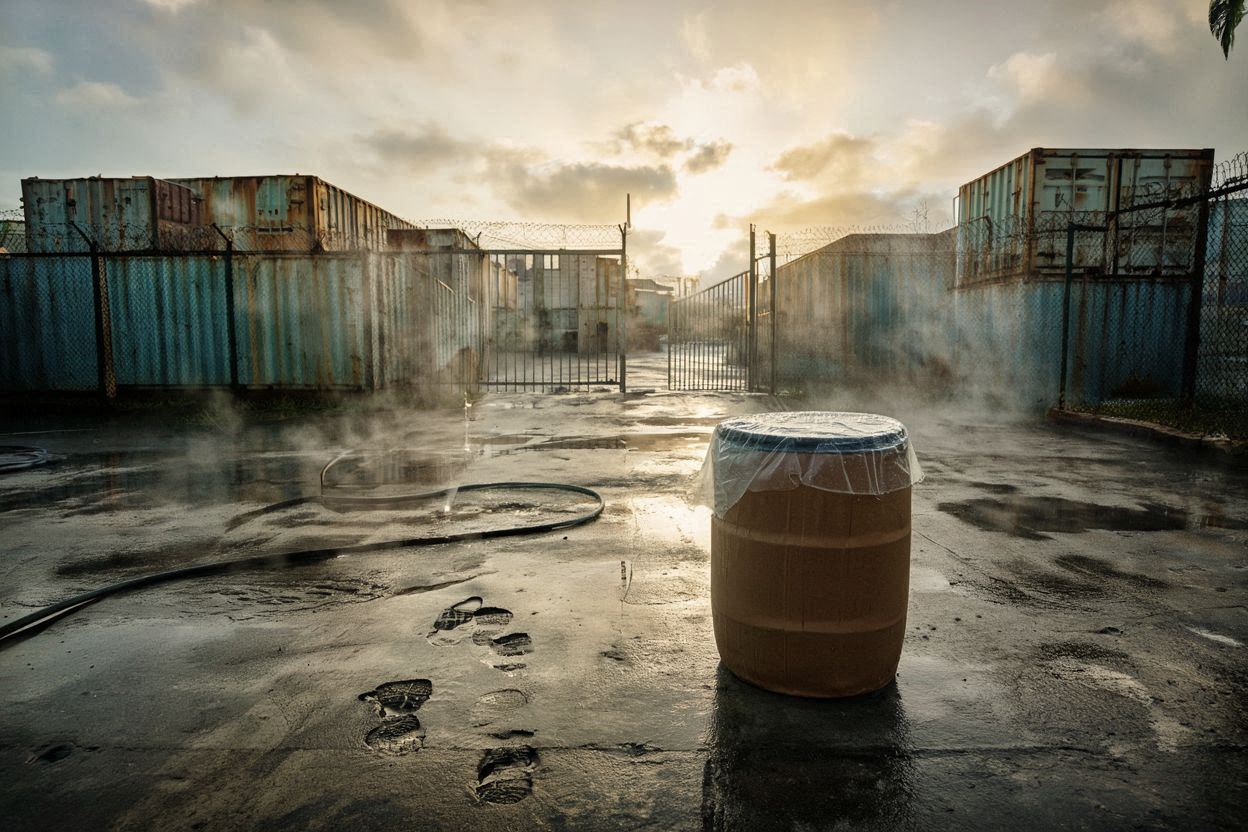
It had rained all night and most of the morning. By the time I arrived at the yard the concrete was steaming, the water lifting back into the air as the sun arced over the solar panels on the warehouse roof.
“This barrel here,” says Caldwell, pointing at the drum—a four-foot cardboard tube with a plastic lid—“is the most expensive barrel in St Catherine’s.”
“Because of what it’s got inside?” I say.
“No,” he says, lifting the lid. “See? It’s empty.”
Inside there’s nothing but an inch of rainwater that must have crept in overnight.
“Then why is it so costly, Caldwell?”
“Because it in my yard, man. It one of mine. That give it power.”
He grins, gold teeth flashing. Raymond, one of his children—it’s said he has many, though he’s only in his late twenties—grins too. The three of them line up against the breeze-block wall of the customs office: the Rasta, the boy, the barrel.
“It’s what I can do with it,” Caldwell says, “that makes it valuable.”
“And what’s that?”
“This barrel can disappear.”
The joke runs longer than it should. Raymond laughs on cue, then glances at me, checking. When I don’t smile back, the laugh fades and he looks to his father instead.
“How’s that?” I say.
“Raymond. Show the gentleman.”
The boy fetches a paper from the office table.
“Is a docket!” He waves the customs declaration. “That’s we trick.”
Blank now but filled in later by someone at the Port who understands how to jumble the classifications.
“In container gine be just parts,” Caldwell confirms. “Chair legs. Screws. Canvas. Nothing assembled.”
“And when it leaves?” I say.
He shrugs. “This one going to leave as car parts. Zero duty.”
“Anybody else would get locked up for that,” I say.
“That’s how you know the trick be good,” Caldwell says.
He watches me more closely. Toward the far side of the yard, empty containers stand. The concrete, where it’s not crumbled, is blackened in loops where the forklifts have burned their tyre marks. The padlocks, the barbed wire, the mattress inside the office where the boy sleeps – all of it functional.
Caldwell walks the yard in his Wellingtons, tapping pallets with his boot. Raymond trails him for a step or two, then stops when Caldwell doesn’t look back.
When Caldwell returns, he doesn’t joke.
“So,” he says. “Why you come round today?”
“The wedding’s on Saturday.”
He stops and inspects me for a moment, like I’m one of his pallets.
“Sis,” he says.
“Yes.”
Raymond is bored. His earlier grin has gone.
“She been telling me ,” Caldwell mutters, “that after the wedding everything going get straightened out. Bank. Port. Dockets. Everything going to be easier.” He’s take something, gum, out of his mouth and spits it to the ground.” That she spin.”
“She’s not lying.”
“As if I don’t have that shit locked down already.”
“Thing is, Cald, she’s redone the math.”
He wants to look up but instead he bends down and turns the tap. A thin dribble spills onto the concrete, spreading and darkening as it pools away.
“The pressure,” he grumbles. “Always damn low up here.”
“Marriage is going to make everything easier. For everybody,” I say.
Rather than look at him, I stare at the container where the boy stands has one corner buckled inward where a forklift caught it years ago. It’s been sat there ever since – too damaged to use, too useful to scrap.
“It’s going to legitimise things.” Caldwell follows my gaze. The container doesn’t belong anywhere else now. It’s part of this place. “We can start doing things a different way. Professionalise. Make a real company out of it.”
Caldwell nods. He doesn’t need the rest spelled out.
“Hell, we could have we a conglomerate,” he says. ”Raymond has drifted closer again. Caldwell notices, pauses, then waves him back firmly. The boy obeys. “That’s her pitch. But she don’t all the uses of the current arrangements. ”
“She thinks the whole thing run it’s course. She says time’s have changed”
A truck pulls up at the gate and waits. With a nod, the boy runs to the barrier.
“You know why this barrel empty?” Caldwell sighs.
“Because it’s a trick.”
“Because this the one we show Sis.” He taps the rim with his knuckle and it echoes hollow. “This is what we new compliance department see.”
“But the rest of it,” I say.
He looks at me.
“You bedroom business can stay out of we business business,” he says. “Then we cool.”
Raymond can’t get the padlock open and the truck sounds his horn in impatience.
A wave of heat from the concrete floods over me – a burning sensation, like there’s something in the ground climbing up through the soles of my shoes. Trucks idling, gates hesitating, the boy still fumbling with the lock while Caldwell looks on angrily. The deal with him was I was temporary -the explainer, the manager, the guy with the connections had always been the one that could still step away.
I see Somaya at the kitchen table, hair still damp, barefoot on the tile, one toe hooked under the chair rung. Careful. Exact. Worried about mistakes in the note she’s writing to the Pastor. She doesn’t look up when she does it.
Once you stop noticing it, the heat because the local temperature. The airlessness settles. You stop being a sweat-drenched traveller and start being a native.
The concrete yard, the scarred containers, the barrel that never has to move. They sit like they’ve always been here and everything else learns how to flow around them
“So,” Caldwell says. “You still marrying her?”
Once it’s done, everything will fit together .
“Yes,” I say. “On Saturday.”
“Good,” Caldwell says. “Then we all in it hard.”
Raymond finally gets the key to turn and the gate swings wide. As the trucks roll in, Caldwell replaces the lid on the empty barrel and presses it down.
Leave a Reply