It had rained all night and most of the morning. By the time I arrived at the yard the concrete was steaming, the water lifting back into the air as the sun arced over the solar panels on the warehouse roof.
“This barrel here,” says Caldwell, pointing at the drum—a four-foot cardboard tube with a plastic lid—“is the most expensive barrel in St Catherine’s.”
“Because of what it’s got inside?” I say.
“No,” he says, lifting the lid. “See? It’s empty.”
Inside there’s nothing but an inch of rainwater that must have crept in overnight.
“Then why is it so costly, Caldwell?”
“Because it in my yard, man. It one of mine. That give it power.”
He grins, gold teeth flashing. Raymond, one of his children—it’s said he has many, though he’s only in his late twenties—grins too. The three of them line up against the breeze-block wall of the customs office: the Rasta, the boy, the barrel.
“It’s what I can do with it,” Caldwell says, “that makes it valuable.”
“And what’s that?”
“This barrel can disappear.”
The joke runs longer than it should. Raymond laughs on cue, then glances at me, checking. When I don’t smile back, the laugh fades and he looks to his father instead.
“How’s that?” I say.
“Raymond. Show the gentleman.”
The boy fetches a paper from the office table.
“Is a docket!” He waves the customs declaration. “That’s we trick.”
Blank now but filled in later by someone at the Port who understands how to jumble the classifications.
“In container gine be just parts,” Caldwell confirms. “Chair legs. Screws. Canvas. Nothing assembled.”
“And when it leaves?” I say.
He shrugs. “This one going to leave as car parts. Zero duty.”
“Anybody else would get locked up for that,” I say.
“That’s how you know the trick be good,” Caldwell says.
He watches me more closely. Toward the far side of the yard, empty containers stand. The concrete, where it’s not crumbled, is blackened in loops where the forklifts have burned their tyre marks. The padlocks, the barbed wire, the mattress inside the office where the boy sleeps – all of it functional.
Caldwell walks the yard in his Wellingtons, tapping pallets with his boot. Raymond trails him for a step or two, then stops when Caldwell doesn’t look back.
When Caldwell returns, he doesn’t joke.
“So,” he says. “Why you come round today?”
“The wedding’s on Saturday.”
He stops and inspects me for a moment, like I’m one of his pallets.
“Sis,” he says.
“Yes.”
Raymond is bored. His earlier grin has gone.
“She been telling me ,” Caldwell mutters, “that after the wedding everything going get straightened out. Bank. Port. Dockets. Everything going to be easier.” He’s take something, gum, out of his mouth and spits it to the ground.” That she spin.”
“She’s not lying.”
“As if I don’t have that shit locked down already.”
“Thing is, Cald, she’s redone the math.”
He wants to look up but instead he bends down and turns the tap. A thin dribble spills onto the concrete, spreading and darkening as it pools away.
“The pressure,” he grumbles. “Always damn low up here.”
“Marriage is going to make everything easier. For everybody,” I say.
Rather than look at him, I stare at the container where the boy stands has one corner buckled inward where a forklift caught it years ago. It’s been sat there ever since – too damaged to use, too useful to scrap.
“It’s going to legitimise things.” Caldwell follows my gaze. The container doesn’t belong anywhere else now. It’s part of this place. “We can start doing things a different way. Professionalise. Make a real company out of it.”
Caldwell nods. He doesn’t need the rest spelled out.
“Hell, we could have we a conglomerate,” he says. ”Raymond has drifted closer again. Caldwell notices, pauses, then waves him back firmly. The boy obeys. “That’s her pitch. But she don’t all the uses of the current arrangements. ”
“She thinks the whole thing run it’s course. She says time’s have changed”
A truck pulls up at the gate and waits. With a nod, the boy runs to the barrier.
“You know why this barrel empty?” Caldwell sighs.
“Because it’s a trick.”
“Because this the one we show Sis.” He taps the rim with his knuckle and it echoes hollow. “This is what we new compliance department see.”
“But the rest of it,” I say.
He looks at me.
“You bedroom business can stay out of we business business,” he says. “Then we cool.”
Raymond can’t get the padlock open and the truck sounds his horn in impatience.
A wave of heat from the concrete floods over me – a burning sensation, like there’s something in the ground climbing up through the soles of my shoes. Trucks idling, gates hesitating, the boy still fumbling with the lock while Caldwell looks on angrily. The deal with him was I was temporary -the explainer, the manager, the guy with the connections had always been the one that could still step away.
I see Somaya at the kitchen table, hair still damp, barefoot on the tile, one toe hooked under the chair rung. Careful. Exact. Worried about mistakes in the note she’s writing to the Pastor. She doesn’t look up when she does it.
Once you stop noticing it, the heat because the local temperature. The airlessness settles. You stop being a sweat-drenched traveller and start being a native.
The concrete yard, the scarred containers, the barrel that never has to move. They sit like they’ve always been here and everything else learns how to flow around them
“So,” Caldwell says. “You still marrying her?”
Once it’s done, everything will fit together .
“Yes,” I say. “On Saturday.”
“Good,” Caldwell says. “Then we all in it hard.”
Raymond finally gets the key to turn and the gate swings wide. As the trucks roll in, Caldwell replaces the lid on the empty barrel and presses it down.
Driving on the wrong side with a stick shift was easier than I’d expected. The trick was not to think about left or right, but to keep the driver’s seat centered in the road. Roundabouts—a completely new pitfall—followed the same rule: hug the circle, keep the driver’s side away from the curb. I felt triumphant, having found a single, permanent logic for every contrivance.
Two days after my arrival, the car—a Merkur Scorpio—reached the island in a crate. I distrusted what I might find locally: overpriced Japanese imports or ancient rusted wrecks with dulled metallic paint. Once I confirmed that imports for expats on work permits were duty-free, I bought the only right-hand-drive car I could find from a dealer in Texas and had it shipped. Now, driving it for the first time on these rough roads, it seemed I’d made a mistake. The undercarriage sat too low; every bump risked catastrophe. The tyres slid on the glassy tarmac, slick as ice. The radiator steamed—whether from heat or damage during shipping, I couldn’t tell.
Still, confident now that I had rules to work with and wanting to get home quickly, I sped up.
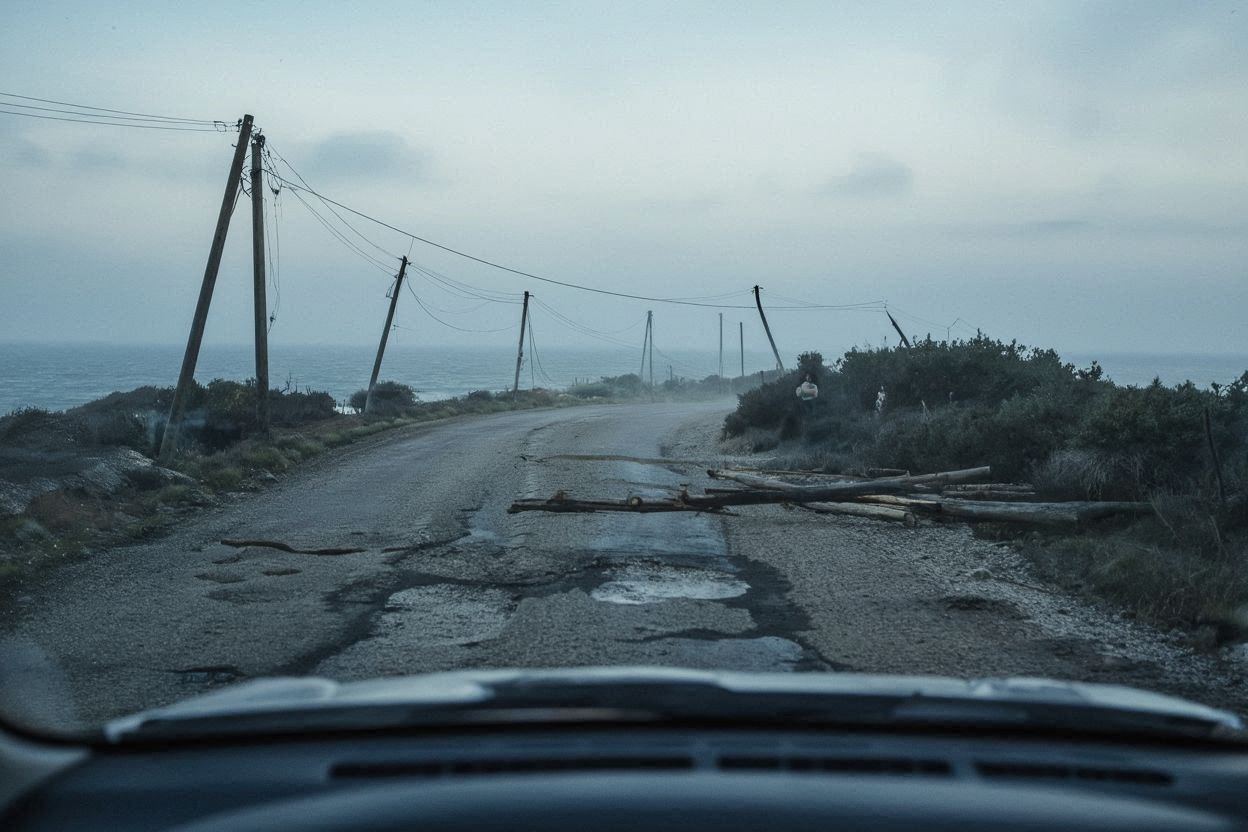
On this Atlantic side of St Catherine’s, the sea was wilder, dangerous for swimming. Spray whipped by the Alizé hung as mist; I could taste salt as I drove. Grey coral cliffs; spreading sea-grape like lettuce; a blue wooden house behind a white picket fence; tough men on wobbling bicycles; leaning telegraph poles overrun with wires like melted cheese—scenes that would later feel ordinary were then sharp with novelty.
At a crossroads marked Burnside, the main road narrowed and broke apart. I slowed to barely twenty. Ahead, boys—teenagers—played cricket or tennis on the ruined tarmac. A barrier of sticks and logs lay across the camber. Off to one side, half-hidden in the brush, an older man watched—arms folded, supervisory, like some self-appointed Mayor presiding over the road.
I stopped. One boy approached.
“Twenty dollars to pass, Mister.”
He couldn’t have been more than thirteen: shaved head, bare chest, pot belly, shorts and flip-flops. He held a coconut frond, flicking it like a whip.
I didn’t take him seriously.
“I don’t have twenty dollars.”
“Then you can’t pass.”
“Move the barrier and go away.”
The guidebooks had spoken of friendly Katitians, not shakedowns by children on coastal back roads. Still, I wasn’t frightened. This felt low-level.
“No,” he said.
“He doesn’t control you,” I said to the boy nearest him. Severe-faced, but wearing shorts with Patrick Starfish on them, he seemed the most likely to break. “You could let me go.”
“Never,” he said, turning his back.
These kids are hardcore, I thought. Maybe a nudge will scare them.
I turned the engine on.
“Turn it back off!” screamed Starfish.
I nudged the car into first.
“Move!” I shouted. “Or I’ll run you down!”
The older man in the brush was no longer visible. Now the crazy Mayor had disappeared into the bush, I thought. This was my chance.
“You done fuck up!” Starfish screamed, and as I rolled forward—no more than an inch—he threw himself in front of the car.
“Jesus Lord, you hit him! I see everything! Big man, you in trouble now!”
The Mayor emerged from the bush, close now, a hammer in his hand where the coconut frond had been.
“Ray-John, the white man hit Boycie! Go get your mum! Fast!”
Ray-John ran.
Starfish—Boycie—writhed on the tarmac, clutching his arm. The car hadn’t touched him. Of that I was certain. The performance was expert.
“Kadeem, break down the barrier,” the Mayor said. Kadeem kicked oil cans and cones into the undergrowth.
I shut off the engine and got out.
“Don’t move, big man!” the Mayor shrieked, waving the hammer. “We got your licence plate.”
I crouched beside Boycie.
“You okay?”
“Ugh! Ugh!” he cried, rolling.
“You run him down, you white bitch!” the Mayor screamed.
Ray-John’s mother arrived, breathless.
“What the hell you do?” Her voice shook with outrage. “You gonna pay for this.” She bent over Boycie. “Call an ambulance, Kadeem. This angel hurt bad.”
“He’s not hurt,” I said. “I didn’t hit him. He’s acting.”
“How you say he acting?” she cried. “He whole body twisted.”
“The white bitch a liar,” said the Mayor. “We see him hit Boycie. Right, Ray-John?”
Ray-John nodded.
“Pick him up,” the woman said. The road was too hot now for theatrics. Boycie couldn’t stay down. They dragged him into the shade.
I got back into the car and drove off fast. The salt mist that had felt fresh minutes earlier now clung to the windscreen like a net. My heart hammered. The road ahead lay empty, the barrier gone as if it had never existed.
A mile later, a police car pulled from a side road and signalled me to stop.
At the station they took my licence and passport and sat me beneath a slowly turning fan. The walls tinted limewash. The officer took a small pencil sharpener from a drawer and carefully turned the stub of his crayon, the shavings falling to the floor.
“You hit a boy,” he said, not bothering to look up.
“I didn’t hit him. He jumped in front of the car but I stopped in time.”
The crayon stopped turning.
“His mother say you hit him.”
“Maybe he touched the car but very lightly.”
“You a doctor?”
“No.”
He wrote this down.
I explained the whole thing – the barrier, the set up, the shake down. But in the heat of the station, my words seemed to lose weight, a kind of thinness in that fug.
He nodded once, only at the end.
“You must understand,” he said. “They all witnesses.”
He wrote a bit more.
The fan seemed to turn slower now, the whole contraption wobbling and rattling when one blade made a certain arc. I watched it stutter round and round, knowing that if it came apart, I wouldn’t know which way to dive.
Twenty lengths of the pool. I took my time,
got through it. They split us then:
Japanese girls, westerners.

The numbers didn't work. I went with the girls
and one Australian man. Nobody commented.
Nobody needed to.

Shuta Tanaka spoke Japanese only—
full-speed explanation, then demonstration.
The girls followed. I worked it out from context.

They didn't speak to me. Not fitting gear,
not waiting for the next drill. They talked together,
laughed together. I stayed close, a step aside.

Fin pivoting was harder than it looked:
the body held in a shape that felt wrong,
head back, hips higher than instinct allowed.

I kept getting it nearly right.
One instructor had decided I was trouble.
He watched me longer than the others.

Two days, then out to the outer reef.
The water colder than expected, a clean shock
each time. Down, across, up. Again.

Underwater there was no one to impress
and no role to misjudge. Small movements mattered.
Breathing sorted itself out.

On the night dive a reef shark crossed
the torchlight's edge and disappeared.
It didn't alter course.

That evening the crew organised drinking games.
I stood and left. No one followed.

On deck, the sea was a thereness
in a way nothing else was. Black, entire.
Cold still in my hands, leaning on the rail.

I'd learned a skill.
That would have to do.
If I hadn’t had to take her to Grandpa’s apartment I would have been about thirty seven blocks away from the clown selling the balloons.
This clown had huge winkle-pickers like his feet were sized fifty and his face was caked with powder with big red circles round his eyes so that he looked dazzled, like he’d dropped from space.
We stood on the sidewalk, me and Maddie, and watched him holding the strings of the helium-filled balloons in his gloved hands.
“Why’s he all dressed up, Trey?” she said.
“He’s trying to get people’s attention so he can sell them those balloons.”
“He’s selling those balloons? Really! Can I get one? I want one, Trey! Please!”
I don’t like to give money to creeps that stand on street corners dressed in clown suits, especially not this particular creep whom I recognized as a homeless guy living in a doorway by Clark Street Station, but I knew that if I didn’t buy the balloon Madison would get really fraught and start shouting and screaming and carrying on all the nine blocks to Grandpa’s apartment. When Madison starts, she really doesn’t stop. She can keep on for hours and hours. For instance one time, Mom didn’t let her have popcorn at the movies and she cried all through the first picture and then the next, being as it was a double feature. Then all the way back in the bus and another hour or two at home until Mom eventually had to pop a bowlful right there on the stovetop just to get her to shut up and go to bed.
So, although I didn’t want to, I asked her which balloon she liked.
“Really? I can have one?’ She started jumping up and down she was so excited. “Thanks, Trey! You’re the best brother in the whole, wide world.”
“Yeah, whatever. Which one do you want, Maddie?”
“That one!”
She pointed at a giant Scooby Doo.
“Why not just get a plain one, Maddie?”
“No, no, no, no, no, no, no, no….”
“The cute little blue one here.”
“No, no, no, no, no, no, no, no….”
“See that Scooby’s going to be really expensive…”
“Yes, yes, yes, yes, yes, yes…”
I sighed and then I had to look up to the clown and try and get his attention because he was staring right over me down to the cars on Clark Street.
“How much for the Scooby Doo, sir?” I said.
He bent down and I could smell the liquor on his breath.
“That’s going to be three dollars, son. That’s a special one.”
I sighed and reached inside my pocket, finding seven dollars left out of the money Mom had given me. I really needed to keep back five for the fare back home that evening so I wasn’t sure if it was sensible to buy the balloon at three dollars. But now I’d gotten Madison really excited like that it would have been unfair to let her down, and I figured if we took the subway back as far as Walden and then walked the last three blocks we could save a dollar so I could just about afford it and still get us back home that night.
So I gave the clown three dollars and he lifted the string from out of his hand and gave it to Madison.
I told her to hold it tight because if it blew away I didn’t have money for another and I made her wind the string carefully twice round her hand.
We walked all the length of the Promenade, Maddie’s hand with the balloon tied to it held out in front like she was sleepwalking and all the shoppers smiled at her. Little kids pointed and cooed at her and then got shushed by their mothers when they asked if they could get a balloon the same as hers. We took a left down the Esplanade and went all along the parade of shops so that Maddie could look at her reflection in the windows and smirk at herself holding that balloon. And then we cut south, down Hicks Street that runs into Atlantic Avenue, so she could show the balloon to the lady that works on the cosmetics counter at Macy’s who used to live in the house next to ours.
I felt good to have brought the balloon for her. It made me feel like my father must have felt when he bought us the Cadillac – powerful to have done something worthwhile with money.
By the time we got to Mr Stephanopoulus’ store about five hundred yards from the brownstone that housed Grandpa’s apartment, it was ten thirty.
And it was only when we got to that store that I remembered why I’d had so much money in my pocket.
It was Friday. Mom gives me an extra two dollars on Fridays to buy Grandpa’s newspaper so that he can check the racing schedule for the coming weekend. And now because I had brought the balloon, I only had four dollars left which was supposed to be our train fare back to New Jersey.
“Madison,” I said angrily. “Why didn’t you remind me? We were supposed to get Grandpa’s paper. What are we going to do now?”
“We can still get it from the store.”
“But I don’t have the money now. Because I brought you that balloon.”
“You do have money,” Maddie said. “You’ve got four dollars in your pocket. I saw it.”
“We need that for the train to get home.”
“Grandpa’s going to be really mad if he doesn’t get his paper.”
She was right. Grandpa would be really mad. He’d start calling up Mom and asking why we didn’t bring his paper, and Mom would tell him not to shout at her because she gave me the money for it, and then he’d start shouting at me, asking to see where the money was that I’d been given, and I’d only be able to show him the four dollars that I needed to get back to Harden, and so he’d call Mom back saying I’d stolen her money. All hell would break loose when I got back home.
So I figured the best thing to do for right now was to go the store to get the paper with the money I had left and then spend the rest of the day figuring out how we’d get home with only two dollars.
Mr. Stephanopoulus, the store owner, is Greek and has a huge handlebar moustache. He smells of candy and cinnamon. He knows me well because I’m always in there when I visit Grandpa, buying penny treats and sherbet fountains.
I found Grandpa’s newspaper in a stack by the shelves and then took it up to Mr. Stephanopoulous to pay for it.
He said, “Trey! You’re going to your grandfather? Here I have a package for him.”
He handed me a large, brown envelope and I took it carefully.
“Be sure you give it to him straightaway.”
“What is it, Mr. Stephanopoulus?”
“A special magazine he ordered that’s just come in. Don’t open it. Just give it to him wrapped like it is now. O.K?”
“Sure,” I said, a little puzzled as to why Mr Stephanopoulus was so concerned that the plain, brown envelope should not be opened.
I tucked the strange brown envelope under my arm, held the newspaper out in front and we started to walk back to Grandpa’s brownstone, Maddie with the balloon out in front, all dignified like she was walking a floating poodle on a leash.
We got as far as Cambridge and turned into the narrow passage by the canal that works as a shortcut.
We shouldn’t have gone that way.
I’d forgotten about the Bay and how it whips the wind that roars off the Atlantic, channeling it down the estuary and along the mouth of the Hudson, and blasts you like a hurricane.
When we got in the passage, crossing from the flagstones onto the wooden boarding that spans the inlet, I looked back for Maddie. She was right behind me, holding the balloon tight, pulling it down to get it under the stone arch that led us inside.
I walked on ahead, forgetting about the wind.
Then I heard the whooshing sound and remembered.
The whooshing sound is the noise the gust makes when it channels through the arch. It’s your first warning of what’s to come. Then the whoosh becomes louder, more like a roar, and you start to feel it push on the back of your neck. Then finally it smacks you with its full blast, bowling you down the passage, hitting you like a slug from a baseball bat.
The blast hit and I stumbled forward, dropping the package and nearly letting the newspaper go. I could hear Maddie scream and felt something wet and cold on the back of my neck that might have been spray from the waves lifted from the river.
I turned round.
Maddie was against the railings, the balloon in front of her out over the railings. She was leaning backwards and pulling at it like it was a marlin and she was a deep sea fisherman trying to reel it in.
I ran back to her and tried to grab at the string. But just as I reached her there was a second massive gust and the balloon made a sudden lurch and that’s when the string snapped.
Maddie screamed and jumped at the twine as it swung upwards. But too late. The balloon had broken free and was rising fast.
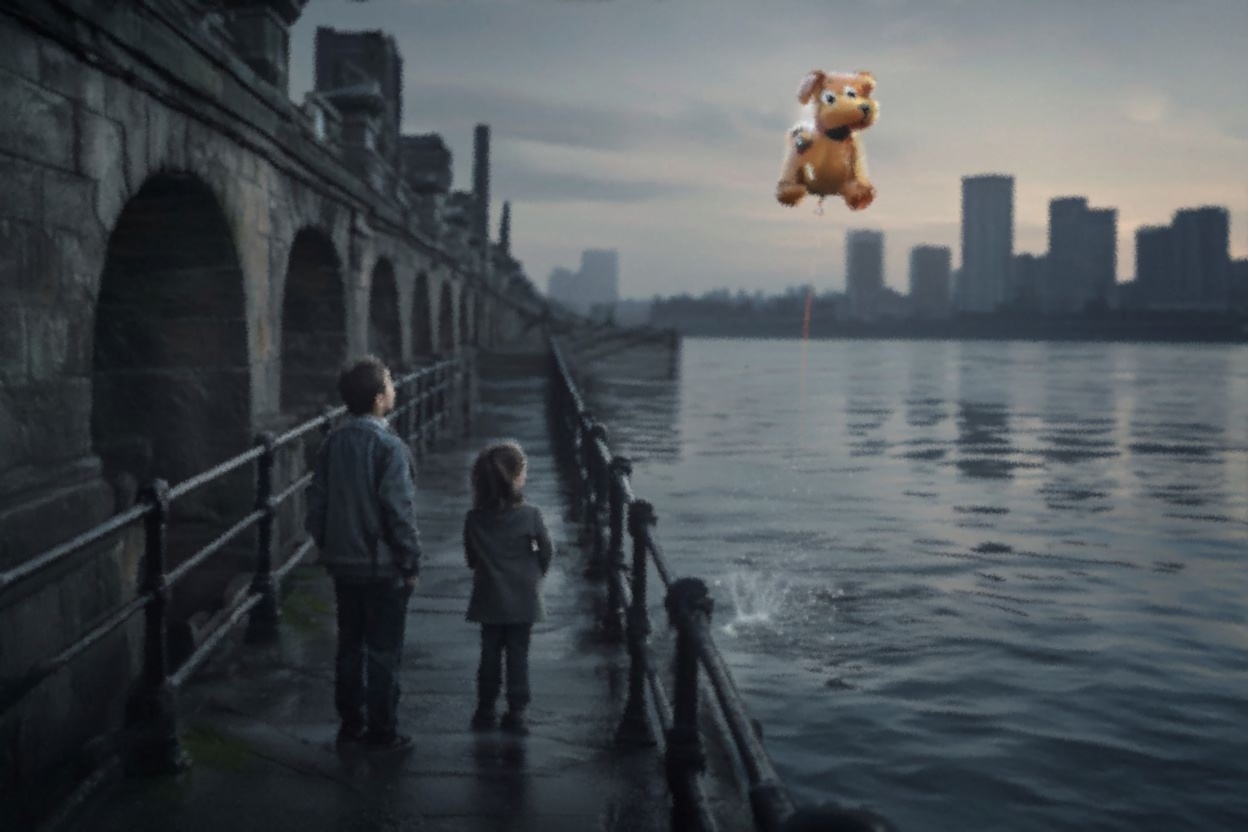
We watched it tacking out over the icy grey river towards Staten Island, lifting slowly above the docks, curling and dipping and ducking, it was almost as low as the river itself. Then it rose again, off over the Bay’s inky grayness, between the ferry boats, and up above the buildings, towards Liberty, like she was going to catch it in her hand, until it moved up again, higher than the skyscrapers on Manhattan and became the tiniest dot up in the silver sky.
When it had gone, Maddie bent down and started crying, little slow sobs at first, then louder and longer, until finally she was wailing uncontrollably, her little face covered in tears and red as a beetroot.
Like I told you before, once Maddie starts, it’s really hard to get her to stop.
I got down, put my arm around her and told her Mom would get mad with her if she didn’t stop; that there were always other balloons; that it was just a thing, made of rubber, and it was stupid to cry over a thing; that we needed to get to Grandpa’s house because we were already late and he’d be worried and, if he was worried, he’d call Mom. And finally, when all that didn’t work, I told her we would try and find the clown again when we walked home that evening so he could sell us another.
She looked up at me, her little eyes red as cherries, and said, “Promise, Trey,” and I said “Yes,” and she said, “Could I get that cute blue one?” and I said “Yes,” just to get her to come because in actual fact I had no real intention of getting her another balloon what with having no money and all.
She wiped her eyes and got up off the boarding and we slowly walked the five hundred yards or so to Grandpa’s apartment.
He was pleased to see us. Even more pleased to see the newspaper. And when he reached for it, I remembered about the package Mr Stephanopoulos had given me.
I didn’t have it. I must have left it in the passage where I’d dropped it rushing for the balloon. And now it would be gone, blown away into the Bay.
But Grandpa wasn’t mad with me because he didn’t know his special package had arrived at Mr Stephanopolous’ and Mr Stephanopolous had entrusted its delivery to me, and pretty soon, because he was so pleased having got the paper, and because Maddie had finally calmed down and stopped bawling, I forgot about the package too.
All that day, while I was watching television, while I was watching Grandpa slurp his oxtail soup and while I was playing with Maddie in the tiny vacant lot behind the apartment building, I was thinking about how we were going to get home without any money.
I figured maybe Grandpa might help, if I explained things to him properly, but whenever I opened my mouth to start, I caught this look in his eyes, like he was telling me not to go on. Mom says never get him angry; it’s bad for his heart. So all that day, I never quite had the nerve to ask him for the extra two dollars we needed to get home.
By five o’clock, when it was time to leave and he was shooing me and Maddie and out of the door back to my Mom’s house, I still had no plan.
We walked slowly, back down the same passage we’d taken when we lost the balloon and we both stopped to look over the railings out onto the gray water, out where Scooby Doo had made his lunge for freedom and broken free. The Bay looked different though – there was a gray flatness to it and the sun had fallen behind the skyscrapers so that huge rectangular shadows lay over us, like from tombstones, turning the procession of fizzed wavelets behind the barges into a kind of stillness. I leaned forward to look at the ferry that was plowing across to Battery Park and that’s when I saw it. In the garbage can between the railings and the second arch was Mr. Stephanolous’ package, wedged between a hamburger box and a bag of macadamias.
Some neat freak must have picked it up and put it there.
I said, “Maddie! Look! Grandpa’s package!”
I reached down into the can, pulled out the package and checked it over. It was perfectly preserved. Not wet or smelly or anything. I stuffed it in my pants. I would carry it to Grandpa tomorrow, when we came back with Mom, and he would be none the wiser about my having dropped it.
Then we walked back down Hicks Street, all along the Promenade, me kind of slow and deliberate because I knew what was coming, and Maddie excited and chatty, wanting to get back to the clown to buy her replacement balloon.
We got to the corner by the subway, but the clown had gone.
Maddie spent a while looking around for him and then, when she realized that I’d tricked her, she burst into tears.
Like I said, when Maddie starts crying, it’s really hard to get her to stop.
I told her that it was late and Mom was expecting us and if we didn’t hurry up, she’d be worried. I told her the clown would be back in the morning, and he would have a whole set of new balloons, maybe even a couple of Scooby Doos or one of them fairy witches from the Winx Club. I told her if she just lay here on a sidewalk bawling, the police would surely come for her and carry her away to a Children’s Home.
And finally, when the worst of it was over, I got down on the ground next to her and said, “How’d you like to play a skipping game?”
Maddie likes skipping games, only most times, I won’t play them with her, being fourteen and male and all.
“What kind of a skipping game?”
“You ever hopped a turnstile?”
“No. You can hop a turnstile?”
“You ever played leapfrog?”
“Sure. But that ain’t no skipping game.”
“Well, a jumping game, then. It’s going to be like leapfrog. But with turnstiles.”
The thing of it is, I’d never really tried jumping a turnstile before, although some guys at school said they do it all the time and made it sound really easy. They said it’s just a matter of confidence. People really aren’t too interested in other people dodging fares, maybe because they figure the trains are so dirty and unreliable nobody should really be paying a fare in the first place. So if you’re just straight up and bold about it, most people are going to ignore you.
The trick is to sidle up to the turnstile right behind someone so that it looks as though you’re with them and then just kind of crash into the barrier as they hurry through. Then you get your leg up and over and hurdle it like you’re at the Olympics or something.
Maddie said she’d try it, if I showed her how.
So we went down the stairs onto the concourse and looked around, scouting for the station guard or a ticket collector or anybody with a uniform, and didn’t see anyone, so I figured, it’s now or never, and got right behind this respectable looking couple. I told Maddie to stand right behind me and then I hit the turnstile as though I was trying to push through it. Then I had to lift my leg up and over. But I’d forgotten I had Mr. Stephanopolous’ package stuffed in my pants. So when I raised my leg, it just kind of froze at about sixty degrees, because that’s as much as the package would give, and I couldn’t move it any higher and I couldn’t get it back off. Then I felt something give in my upper leg like I’d ripped a tendon or something, and I started to lean some more on the barrier and that’s when I heard the bearings clicking in their housing and felt the turnstile turn a little more. I could feel the seam of the denim between my legs that must have gotten caught in the barrier getting tighter and tighter and then I think I might have started screaming and maybe I even blacked out a while because next thing I knew a ticket inspector, was standing over, saying, “Jeez, son, that thing’s almost ripped your balls off!”
Anyway they put me and Maddie in this office with a reflective glass front so we could see out but no-one could see in and they made us give the name and address of our parents and so on, then they kept us there until Mom and Dad came, and that’s just about the way everything happened.
Like I said. It was Madison’s fault.
MADISON’S VERSION Trey said no, no, no, no, no — and then he bought a dirty magazine and got caught by the police with his pants down.
First off, I suppose I have to explain why I decided to e-mail Dr. Petalman at all, what with him being the most famous mathematician on the planet and me just a nineteen year-old college drop-out.
Contrary to a lot of current gossip, it wasn’t the million dollars. In fact, I knew he didn’t have the million dollars. I was aware he had refused it. So it wasn’t that.
And it certainly wasn’t because of the math. Let me get that straight from the get go. Back then, I hated math.
And I didn’t want him to help pick a winning horse in the four thirty at Leyton Plains, or give me the number of next week’s Powerball, or the name of a tech stock to invest in, or any other of the crap you might have read on the internet.
Really, I just had a question about table tennis. I was nationally ranked, but the coach had a grudge against me and wanted me off the team. So I needed Petalman’s advice.
But I can understand that you might not accept that, so let me explain properly.
I first saw Dr Petalman playing ping pong on NOVA, this science documentary they have on Saturday nights on PBS – fifty minutes of high-brow gobbledygook that my sister, Courtney, likes to watch in the hope that some of it will rub off and she’ll grow a brain and not fail integrated science.
Most times it’s on, I’ll be outside in the yard practising with the table pushed against the wall, but that night I was in the front room – I had the daily Sudoku to finish and I didn’t want to do it in the kitchen because Dad was there, eating his tuna sandwiches, making the place reek to high heaven.
So I sat with the newspaper in front of me, half a wary eye on the T.V., watching it distractedly – really there was no other way, because this NOVA episode seemed to consist mostly of a procession of bizarre computer images : brightly colored rubber balls spinning on gray backgrounds and then twisting into spirals and exploding, and fields of little arrows like a thousand tiny weather vanes swimming on a giant chin, and numbers, everywhere numbers, tsunamis of numbers, swarming over strange, bent shapes that looked like mutant vegetables.
“Are you really watching this crap?” I said to Courtney.
It was like something out of Alice in Wonderland.
“Shut up and do your Sudoku,” she said.
“Because there’s football on the other side.”
“It’s math. It’s fascinating.”
Fascinating is a Courtney word. It means she doesn’t get something, but she wishes she did.
When the trippy animation stopped, they showed eccentric-looking men talking straight to camera. They subtitled them, and Courtney read out the names in her sing-song voice – Professor Cornelius Crackhauser, Head of Abstract Geometry at MIT; Simeon Turnip, Emeritus Professor of Quantum Loop Gravity at UCLA; Dr David Bonkbasher, Reader in Abstracted Riemannian Surfology, St John’s College, Cambridge and so on – all these oddballs mumbling baloney at the interviewer, scratching their heads and showering the lens with dandruff.
I tried not to watch. I put my elbows on the coffee table and my head between my hands, hoping by ducking down I would streamline the flight of high-faluting bullshit as it soared over the top of my head.
But something kept drawing my eyes back to the screen.
This show was about mathematics? That’s what Courtney had said. But wasn’t mathematics arithmetic and algebra and numbers and things? If the show really was about mathematics it was mathematics like I’d never heard of – insane mathematics, ninja mathematics, mathematics in fifty nine dimensions and thirty seven different color schemes, mathematics with cubes and pyramids and tesseracts and floaty things that dissolved into shimmering metallic matrices that had four sides of Greek letters and another six in hieroglyph; mathematics that spun and whirled and flashed before your eyes. In short, coked-up math for tripped-out crackheads.
A man in his thirties came on the screen. He looked like his head had been stuck on his neck upside down – a great shaggy arc of a beard grew on his chin, the top of his head was totally bald and, to cap off the effect, the wires of beard re-emerged in huge, disconnected tufts right over his eyes to form eyebrows thick as hedgerows.
“Dr Misha Petalman,” said Courtney slowly, reading the sub-title with difficulty because at the same time she was texting, maybe even sexting, who knows these days with Courtney. “Lecturer in Advanced Differential Geometry, Slakov Institute, Moscow.”
And then they showed something really astonishing – footage of Dr Petalman playing ping pong at some academic conference with another mathematician. The two of them hammered away at each other while the narrator told us that they were geniuses, but that even geniuses must have outside interests and Petalman’s was table tennis.
That really got my attention.
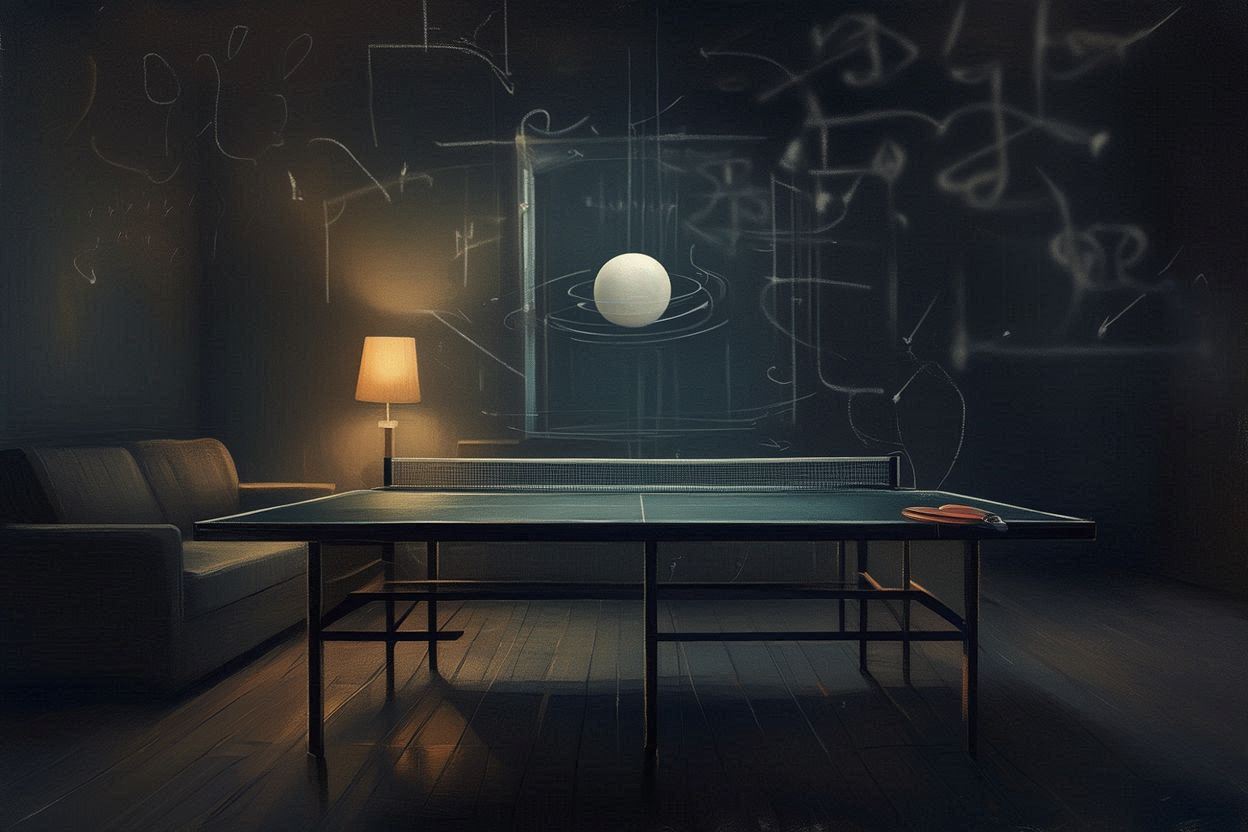
I could see right away he was very good. He hit the ball with enormous sweeps of his hairy arms, dashing about the table in a fury, his eyes blazing with rage. He would move right up close to the table and then play dinky little lobs to the back line with huge spin on them so that the ball would curve away at impossible angles, bamboozling his opponent.
But it was really his serve that had me fascinated. There was something very strange about it. It seemed to be a variant of the back-spin cross-table, but Petalman was not pushing his arm forward and spinning the ball clockwise like I’d been taught – he was throwing it up a huge distance and then chopping it vertically.
It looked impossibly difficult but Petalman was like an automaton, whacking serve after serve and never missing the chop.
“You see him do that?” I said to Courtney. “I could never do that.”
“Because you’re dumb, Dennis. This is higher math. You can’t even add up a till roll.”
“Not the math. They’re not even talking about the math. Look, it’s table tennis. And watch the way he’s serving. That is awesome. The way he’s taking the ball and tucking it in the back of his hand and then slicing the bat down. He’s winning every point on that serve.”
“The show is end-to-end educational mathematics and the only part that interests you is the ping pong.”
“Because this guy, Petalman, is AMAZING at ping pong…” I said, and pushed the newspaper to one side so I could watch him properly, as he gave this astonishing exhibition of tip-top, high precision, technically perfect ball bashing.
Later, I googled Dr. Petalman.
Wikipedia was not helpful – the entry was long, all about his proof of the Poindexter Conjecture the year before, and how he had refused the million dollars Clay Prize, saying that he had no need for money and that the proof itself was reward enough. Nothing about the ping pong.
At the bottom of the entry, however, was a link to an academic paper, and at the bottom of that, below a mass of Greek symbols, was his e-mail address.
I know it was presumptuous and perhaps a little crazy, but I figured what the hell, I would really like to know the secret of that serve.
So I sent him an e-mail.
This was what I wrote:
Subject: That Serve!!!!
From: DennisNuts
Date: Jan 5, 2013 · 11:34 pm
Hi Dr Petalman,
Let me say straight off, I realize I shouldn’t be bothering you. I read on Wikipedia that you are famously reclusive and that you live with your mom in Moscow having turned your back on the world and the math community in particular (having had a run in with a certain Professor Lau over at Harvard.) Also, I know for a fact you must be getting a lot of unwelcome e-mails now that you have refused the million dollars Clay Prize, begging you to change your mind, and accept it, and then, I guess, give it right away again 😉
So I want you to know this is not that kind of e-mail, and I totally respect your privacy and your decision to turn your back on the world and in particular the math community (of which I can most definitely state that I am not a member having dropped out of math as soon as the district would allow – third grade.)
Really this e-mail is just a simple enquiry about table tennis.
Saw you on NOVA, playing, and you were awesome.
But how the hell do you get the ball to spin like that on a backhand cross-table? I’ve never seen that before. It is devastating.
Please fill me in.
Yours in admiration (solely of your table tennis skills)
Dennis Richards
Lost in Wisconsin
I sent the e-mail off and the truth is I didn’t think too much about again. At that time I had a lot on my mind, what with the team being selected on Tuesday, and Coach Grant being such a hard-arse about practice and everything, so really I forgot all about the e-mail to Dr Petalman. Until the next evening when I saw this in my inbox:
“RE: That Serve!!!! petalman@slakov.ru”
I didn’t immediately open it. I figured it was just some sort of automated response, or maybe an assistant at the university had got round to clearing the doctor’s inbox.
When eventually I clicked on it, this is what it said:
Subject: RE: That Serve!!!!
From: Petalman@slakov.ru
Date: Jan 10, 2013 · 10:15 pm
Hi Dennis,
You are the only one to ever ask me about that serve which I have worked so hard at. The only one to feign an interest in what it might involve.
Dr Petalman
‘Feign’ I had to look up.
Then I replied:
Subject: RE: RE: That Serve!!!!
From: DennisNuts
Date: Jan 10, 2013 · 10:43 pm
Hi Dr Petalman,
My interest is certainly not feigned. I am trying to improve my table tennis skills and would really appreciate your help.
All the best,
Dennis
One day later I got this:
Subject: RE: RE: RE: That Serve!!!!
From: Petalman@slakov.ru
Date: Jan 11, 2013 · 11:34 pm
Hi Dennis,
Perhaps I am too suspicious when it comes to strangers. Perhaps I have had too many run-ins with ‘admirers’ and have become a little paranoid as a result. Perhaps I am just Russian and miserable.
Really I was delighted by your interest. Nobody seems to want to talk to me about table tennis any more, after my small successes in mathematics.
I would be delighted to explain the serve to you.
But I must warn you, it is somewhat complicated.
However I do guarantee that if you make the effort, it will be worth it.
Truly it is devastating (as you state).
Yours kindly,
Dr Petalman
Subject: RE: RE: RE: RE: That Serve!!!!
From: DennisNuts
Date: Jan 11, 2013 · 12:23 pm
Hi Dr Petalman,
Complicated is just fine. I am county champion of Scottsdale and hope to make the Nationals next year.
Please go ahead and explain away.
Yours in solidarity with your principled stand against the math community,
Dennis
Subject: RE: RE: RE: RE: RE: That Serve!!!!
From: Petalman@slakov.ru
Date: Jan 12, 2013 · 5:34 am
Hi Dennis,
I am so glad that you are willing to undertake the program. Really I was searching for someone to pass the secret on to for the longest time, but nobody seemed at all interested. The fact that you approached me, after seeing the serve on T.V. (!) and recognizing it immediately for what it is, is truly a wonderful thing to me.
We will complete together the same program I myself undertook under the great Professor Goffendiek (since retired and lost to mathematics).
However, I warn you again, that it will not be easy. It will involve dedication on your part. There are mountains of differential geometry we have to climb: Clifford algebras in dimensions higher than nine must become second nature to you; we must further generalize the Yang Mills equations and then move beyond them, into semi-Riemannian non-commutative Lie Algebras and, after we have dispensed with those and mastered the Ricci and Levi flows, go further than Atiyah and Connes, into the Elysian fields that lie beyond where few have entered and fewer still have re-emerged with their faculties intact. But there are the most beautiful results waiting to be plucked and plundered for those who dare to make the journey!!!
If you are willing, we could begin tomorrow. (Sign in to Facebook about 4pm your time)
Yours enthusiastically,
Dr Petalman
Subject: RE: RE: RE: RE: RE: RE: That Serve!!!!
From: DennisNuts
Date: Jan 15, 2013 · 8:23 pm
Hi Dr Petalman,
Thanks for the e-mail and sorry to be such a downer, but I don’t think that I’m going to be able to take in all that advanced stuff you mention in your e-mail.
I’m just a college drop-out with too much time on my hands.
Really I am only interested in the basic technique of the serve as you did it on NOVA. I think if you just explain the rough mechanics of it, e.g. how to hold the ball, which way to spin it, and so on, I could probably get it very easily.
Otherwise in awe,
Dennis
Subject: RE: RE: RE: RE: RE: RE: RE: That Serve!!!!
From: Petalman@slakov.ru
Date: Jan 15, 2013 · 8:35 pm
Hi Dennis,
If I am going to teach you the serve, you must commit to the program. It is the only way.
I am sure you have doubts. I had them too before Goffendiek took me on as a student.
But it is essential that you commit to the program for you to understand fully.
Dr Petalman
Subject: RE: RE: RE: RE: RE: RE: RE: RE: That Serve!!!!
From: DennisNuts
Date: Jan 17, 2013 · 1:34 pm
Hi Dr Petalman,
I think you should know I failed high-school math.
Forget the high school math. It is not required. In fact, it is positively dangerous.
You have talent. You recognized the beauty of my serve. The ability to picture the spin from the fingers, the dip in the flight of the ball, the curving trajectory of the bat – this will serve you in better stead than any tedious math they may have force-fed you at school.
We are going to be travelling to a very different place than the flat landscape of Euclid. A much more interesting place. Preconceptions of its geometry would only have to be dismantled and rebuilt from scratch.
However, I understand you may still have doubts and to reassure you I am going to tell you a true story.
Read this carefully because inside this small tale is everything you need to know to succeed:
One spring, I was hiking in the hills outside Vlastok, in the Southern Caucusus, a remote place dense with forest, and home to huge packs of wolves, desperate for food after the long winter.
I felt desolate, lonely and frightened. I had taken a week out of my academic responsibilities at the Institute to come to this wilderness to be alone, so that I could devote all my thoughts and energies to the Poindexter Conjecture. But the week was almost over and I had made no progress whatsoever.
I made camp at night below the snow line on a spur of the great Mt. Arumank. I prepared a fire and cooked potatoes I had dug from the forest floor. And when I had finished eating, I went inside my tent, leaving the embers to burn.
I tried to sleep but it was impossible. My work, so promising initially, had come to nothing. The problems were intractable. There was no way forward.
Then as I tossed and turned within the tent, I heard noises outside – the howl of a wolf, the sounds of a scuffle, and then, unmistakably, a gunshot.
I pulled opened the tent flap as quickly as I could, desperate to see what was going on.
A man stood outside, holding a rifle. He was an amazing sight – hairy and naked, except for what looked like a bear skin draped around his shoulders. A dead wolf lay at his feet.
He stared at me a while and then he said, “You need to be more careful, Comrade. They smell your food.”
I was shocked. I had thought I was alone, the only human for two thousand miles. Who was this wild man who had come to my rescue?
He said he had been living in the wilderness for four years, surviving off the small game he caught by setting traps. (The gun was strictly for the wolves and he used it sparingly.)
He asked if I wanted to see his hut and when I agreed, he showed me to a clearing in the woods where a great log cabin stood.
I was amazed.
Through ingenuity and perseverance he had built a beautiful house complete with a stove fashioned from slate he had found in the mountain scree. It had a bathroom with hot water piped directly from a small boiler and there was even a greenhouse, with vegetables growing under plastic salvaged from a downed plane’s wreckage.
He was thriving in this remote and inhospitable wilderness.
I asked him how he had done it, how he had tamed the harsh waste of Arumank. Surely he must have had exhaustive training from a young age – perhaps he was the son of a great woodsman or the last scion of a tribe of nomadic survivalists because his resourcefulness and resilience were beyond extraordinary.
“It is nothing,” he said shrugging. “And in fact I am no one. Back in St Petersburg, I was an accountant. I have had no practical training. But I am alone out here and I have learnt. The fact is anybody can do anything if they have enough time on their hands. It is just that I have had enough time.”
The next day, we parted – the wild man went to inspect his traps, and I headed up over the spur to Vlodonk and civilization.
But as I climbed the mighty Mt Arumank, still fretting over my incomplete proof, I thought about what the wild man had told me – how he had said all things are possible when you have enough time. And without conscious thought, I found myself, instead of ascending the mountain, descending it and heading south to the open plains of the steppe.
And there I stayed for six long months, living off the land, eating the sweet potatoes that grew in abundance in the pastures, catching fish from the Varnusa, and sleeping outdoors with only the grass for a bed.
Instead of rushing back to Moscow I gave myself enough time to think and I saw the Poindexter conjecture unfurl before me, slowly, ever so slowly, disgorging its vast secret like a vine bursting forth its ripening fruit.
It was the most beautiful thing that has ever happened to me, and it happened to me because I had given myself enough time.
Dennis, you tell me you are a college drop out. Surely you too will have enough time.
So that’s how we started. Dr Petalman telling me about this wild man, the ingenious yeti with too much time on his hands, and urging me to think deep and not fast– to take the slow path, the less-travelled road, and above all else to concentrate on just this one problem, the problem of the ping pong serve, to the exclusion of everything else.
After I had made the commitment, it was just a matter of time.
I don’t want to tell you too much about the specifics of Dr Petalman’s program except it was conducted by Instant Messenger and webcam (any doubts I had that I might be speaking to a fake Dr Petalman were immediately dispelled when I first caught sight of his extraordinary and unique upside down face on the screen of my computer).
The program was also extremely practical.
To give you some small flavor, here are a few of the tasks he set me:
Combing the hair on a spherical dog (we used a real Alsatian).
Parallel transportation of the connection of a vector field around a closed manifold (plastic arrows and assorted rubber mattresses).
Winding number of loop integrals (homing pigeons).
The n-Sphere – (n plus one space hoppers and industrial sewing equipment).
We worked together for six months.
Initially the sessions were no more than thirty minutes, but as we continued and I began to make progress, they extended longer and longer, until more often than not we worked through the night – Dr Petalman explaining a new idea; my trying to understand it; Dr Petalman urging me onwards, schooling me through his practical experiments; the first inklings of comprehension; then a growing confidence and a final cataclysmic aha! moment when at last I grasped the concept in the whole – an extraordinary catharsis, more powerful than orgasm.
Thoughts of that table tennis serve that had initiated the tuition rapidly became subsidiary to the beauty of the math he was showing me. I felt he was guiding me through a new and wonderful world previously hidden to me – a multiverse of vectors and tensors and multi-dimensional manifolds, a dancing jamboree of pure abstracted thought.
Then one day, about six months into the program, after we had completed an extraordinary session on the perturbation expansions of Yang-Mills Quantum Field Theories involving copious use of tightly wound plastic hoses, Dr Petalman leaned forward into his webcam and said softly, “Dennis, you have been a wonderful student. It has been a pleasure working with you.”
“Thank you, Dr Petalman. But honestly really the pleasure has been all mine. You have been the most extraordinary teacher.”
“Truly you have worked hard. I think now you are ready.”
“Ready for what?
“The serve, Dennis.”
“The serve. Yes. I had forgotten about the serve.”
‘We were leading up to it.”
“Yes. We were.”
He moved back from the camera and I could see that the matt green blur that had always been present in the furthest corner of his room was now pulled into focus and resolved into the unmistakable shape of a ping pong table.
The doctor moved towards it and then pulled a bat and a ball from inside his tweed jacket.
He didn’t hesitate. He threw the ball high, giving it the extraordinary spin I had seen so many months before on the NOVA program, and then he slashed at it with his bat.
In that one motion, as the bat hit the ball, all became clear to me. All the teaching of the past six months filled my mind and flashed into clear focus. Immediately, I understood.
My insight was devastating.
The Petalman Program: Serve Dynamics
Active Manifold: Semi-Riemannian non-commutative Lie algebra Status:Waiting for serve…
Δ(Serve) = Yang–Mills term + mass gap
“You should write it up,” he said later, when he had gone over my interpretation three times, making small corrections here and there
“How do you mean write it up, Dr Petalman?
“Write it up as an academic paper. It is important work.”
“I can’t write up a scientific paper. I’m a college drop-out.”
“It is just a question of embellishing the original arguments. I will guide you.”
So I spent the next three weeks, with Dr Petalman’s help, writing up the results.
When we had finished, Dr Petalman decided it was good enough to upload to Arxiv.org, the mathematicians’ website, and when that was done, he announced his program complete, and told me he would be unavailable for tuition for the immediate future.
The paper caused quite a stir, and I’m afraid Dr Petalman may have encouraged it. Titling it, “Proof of Yang Mills and Mass Gap”, when really it was a simple little exercise in the interpretation of the dynamics of a closed physical system in three dimensions (the flight of a ping pong ball in fact) was, in retrospect, something akin to a red rag to a bull. The math community was lining up to laugh at it. But Dr Petalman had taught me well, and when the trivial rebuttals failed, the heavyweights took an interest.
Professor Lau at Harvard put his best team onto it and, unfortunately for me, after a year of going at it they announced to the world (through the New York Times) the proof was correct. The International Math Union called, begging me to accept a new Clay Prize.
I had no idea what to do. I felt like a complete fraud. The paper was mine and I had written its arguments, but only because I had followed the Petalman Program. When the world found out, I would be exposed and ridiculed. My sister Courtney, especially, would have a field day.
I urgently needed to speak to Dr Petalman, but every night I logged into hotmail, his status was offline.
Until exactly a year after he had logged off – it was now August 2014 – he came back online.
“Dr Petalman,” I typed furiously. “Thank God, I’ve gotten hold of you. The Millennium Prize Institute has been in contact. They want to award me a Clay Prize. It is a disaster. You have to help me out. You have to tell them what really happened.”
“But, Dennis, it is as they say. You produced a work of genius. You established the existence of the Yang-Mills theory with a mass gap. ”
“But it was not original work. I was only following your program.”
“In mathematics, as in so many other fields, almost nothing is truly original. We all, even the greatest of us, build on the work of others. How did Sir Isaac Newton put it? ‘We stand on the shoulders of giants.’ It was the same for me, following Goffendiek. And Goffendiek only followed Weyl. And Weyl, Riemann. And Riemann, Gauss. All the way back to Pythagoras. (Pythagoras followed somebody too, only the somebody’s name has been lost to history.)”
“But I can’t accept a Clay Prize.”
“Why not?”
“It doesn’t seem right. I’m not worthy. I haven’t paid my dues.”
“These are not valid reasons to refuse. You must accept.”
“How can you say that? When you were offered the Prize, you didn’t accept.”
“And it was the greatest mistake of my life. Goffendiek was relying on it. He owed money to Weyl.”
An uncomfortable suspicion came over me.
“You set me up for this, didn’t you, Dr Petalman?”
“Not at all. Your research was a natural extension of mine. It solved a second great mystery. I was merely your guide to fertile mathematical ground. You dug the truffle.”
“You want the money, don’t you? I’m supposed to give you some of the money, right?”
“Let’s call it a tuition fee.”
“You want the money but you don’t want to be seen accepting it. It would be terrible for your image. You’re famous for having turned the prize down after all.”
“I do want some money, yes, Dennis. My mother is sick and has medical bills. And it would be difficult, after getting so much publicity when I refused the original prize for me to now decide to accept it. It is not so much a matter of pride as a matter of practicality. I fear the storm created would destroy what little privacy I now enjoy.”
By now I was seriously angry. Who was Dr Petalman to use me like this? What manner of a man was he?
I stared long and hard at his hairy avatar and turned the computer off in disgust.
I refused the Clay Prize and I guess that is how you’ve heard of me. I’ve been told I upset a lot of mathematicians doing that. But actually that is something I’m sort of proud of.
Petalman vanished off the internet completely. He may be walking the Andorran Alps with Professor Goffendiek.
Courtney passed Integrated Science.
Now, here’s the pitch.
You may like to know I am still very keen on table tennis. I have a few videos up on YouTube – you could take a look at my channel if you like (DennisNutsPingPong). There is one wicked serve I am particularly proud of and if you take a look and think it’s cool, I would be very happy to teach it to you.
I figure right now, what with this recession and everything, you might have a lot of time on your hands.
I warn you though, the explanation is going to be complicated and it will require some work on your part to get the hang of it. But I do guarantee it will be worth your while to complete the program…
The opposite lane gets another green. A fresh burst of cars streams past. Your foot hovers above the brake, ready for the moment your own lane finally wakes up.
You cannot see the lights. No line of sight.
And yet you already have a sense of:
how long the cycle is,
when your lane will release,
roughly how far away the junction must be.
That feeling is not superstition. It is inference.
What your brain is doing in a queue is extremely close to what experimental physicists do with neutrino beams: reconstruct a hidden controller from nothing but timing, bursts, and delayed response.
1) The only clues you have
In a blocked lane you can observe:
bursts (cars stream, then silence),
gaps (silence between bursts),
delay (time from “release begins at the head” to “I begin to move”).
From those you can infer:
the signal period ,
the green splits,
the queue length ahead of you,
and therefore the distance to an unseen junction.
This is a textbook inverse problem: you see outputs, not the mechanism.
2) A minimal model
Assume a two-way temporary light:
Lane A (opposite direction) green for
all-red safety gap
Lane B (your direction) green for
all-red safety gap
Two empirical constants (good enough for order-of-magnitude inference):
saturation headway (once moving): about 2 s per car
jam spacing: about 6 m per car (car + compressed gap)
In a stationary queue, the “release” propagates backwards: each car begins moving a bit after the one ahead. Modelling that as roughly “a couple of seconds per car” is crude but works surprisingly well near the front.
3) Fully worked example: solving an invisible junction
You are in Lane B. You time the opposite lane:
Cars stream for 22 s → estimate s
Then nothing for 36 s → estimate s
So the total period is:
Now infer your position in the queue.
You track your own release relative to the opposite burst:
: opposing flow begins
: opposing flow ends
(gap, then your lane’s release begins at the junction)
: you begin to move
Suppose you estimate your lane’s release begins at the head around (opposing ends at 22, then a short all-red, then your green). Then the propagation delay from head to you is:
With about 2 s per car:
Distance to the light:
You just estimated distance to a junction you cannot see—within a few car lengths—using timing alone.
4) Long queues: multiple greens before you move
If you are far enough back that your lane does not clear on the next green, you extend the same logic.
If your green is , and cars discharge about one every 2 seconds, then cars served per green is roughly:
If you sit through two full greens without moving, that suggests you are at least cars back from the release front (plus whatever is left over).
On the third green, if you begin moving x seconds after release begins, then you are about x/2 cars into that release.
5) Where the method breaks
Far enough upstream, you stop seeing the light’s structure and start seeing traffic as a wave medium:
stop–go waves propagate backwards,
gaps compress and expand,
side roads inject vehicles,
signals may be adaptive (no fixed ).
In that regime, your motion reflects local traffic dynamics more than the junction controller. The “information” about the light decays with distance.
That breakdown is itself the physics.
Inverse Problem Simulator
Inferring the hidden controller through burst dynamics
Rereading A House for Mr Biswas, I’m struck by how much of its comedy depends on pressure. Not whimsy, not eccentricity, not the genial observation of human folly that animates so many realist novels of the nineteenth century, but an atmosphere in which small events thicken into crises. Naipaul’s Trinidad is a place where the margin for error is narrow, and where a trivial humiliation can tilt the course of a life. It is precisely this tension that makes the novel’s funniest scenes stay in the memory: they’re comic because they are precarious.
The opening pages set the pattern. The drowned calf, the missing infant, the villagers circling around — superstition and omen, all of it narrated in a quiet, almost official tone, as though the calamity were being described by someone determined not to raise his voice. The humour emerges from the mismatch between the scale of the response and the prose that contains it. But nothing about the villagers’ panic is irrational in context. In a world where subsistence is fragile and the supernatural hovers at the edges of interpretation, a dead calf might very well be a sign. Naipaul does not invite us to laugh at the villagers; he invites us to notice how easily fear can widen into absurdity when the ground beneath a life is already unstable.
Something similar happens in the signboard episode, the great comic set-piece of the novel. On the face of it, nothing could be simpler: a young man is hired to paint a shop sign. But Naipaul builds the scene so that two conversations unfold at once. Biswas believes he is discussing lettering and ornament; the Tulsi household believes it is sounding out a potential son-in-law. Naipaul slides between these interpretive frames with an almost invisible control of perspective — a half-phrase shadowing into Biswas’s pride in his craft, a line of dialogue coloured by the Tulsis’ proprietary curiosity. The humour arises not from misunderstanding but from a surplus of meaning: everything said is doing double duty, and only the reader is aware of the doubled script.
When the comic energy dissipates, what remains is a new form of entanglement. Biswas leaves the conversation with obligations he scarcely recognises, folded into a network of expectations that will take years to loosen. The comedy here is not merely a stylistic flourish; it is the mechanism by which social pressure is exerted. A joke becomes an entry point into a life.
Later in the novel, at the rural estate, Naipaul turns inward. The scene in the shed, with Biswas alone and watching tar drip from the rafters, is narrated with the same refusal to exaggerate that governs the opening. The physical detail is obsessive — the tar thickening, congealing, stretching under its own weight — and yet the psychology beneath it is unmistakable. Biswas is terrified of the workers outside, of their possible resentment, of the isolation that has left him exposed. The moment is funny in its fixations and frightening in its implications. The shed is both shelter and trap; the mind that contemplates the tar is on the edge of collapse. Naipaul holds these tones together without resolving them. The pressure does the work.
Pressure is also what animates the Tulsi household, whose comedy has a different texture. The Tulsi brothers and sons-in-law puff themselves up like minor officials presiding over a directorate of cousins, servants, and ledgers, and yet their authority deflates the moment it meets reality. A boast sags under scrutiny; a reprimand fails to land; a plan collapses into domestic noise. Naipaul never pushes them into caricature. Their pomposity is credible because it is defensive — a performance of importance in a household where real power is diffused, ambiguous, and constantly renegotiated.
The sisters exert their influence in another register altogether: the collective murmur of commentary, judgment, and shared vigilance. A remark such as, “Well, she say that, but you must hear what they saying,” is enough to shift the climate of a room. Their power lies in this net of implications, the sense that no action is entirely private, no preference entirely innocuous. When Biswas asserts some tiny fragment of independence — a paint colour, a room arrangement — the reaction is disproportionate because the structure of the household makes it so. Here too the humour has a double edge: the sisters’ collective voice is both comic in its self-importance and perfectly suited to the maintenance of a fragile social order.
Even the late trip to Maracas Waterfall, often remembered as an odd digression, fits the pattern once one sees it clearly. It offers a glimpse of a Trinidad Biswas rarely inhabits: open, scenic, leisurely. The shift in register is brief but telling. It shows the gap between the life Biswas lives and the life he imagines for his children — between the narrow corridors of Hanuman House and the larger, less punitive spaces of the island. The scene widens the emotional frame of the novel without relieving its pressure.
What makes A House for Mr Biswas continuously rereadable is Naipaul’s ability to keep these forms of pressure in play without ever tipping the novel into despair. The humour is not consolation; it is diagnostic. It reveals the hidden mechanics of a society in which autonomy is always under negotiation and the smallest humiliation can have lasting consequences. Naipaul’s comedy does not lighten the load of the world he describes. It shows us, with extraordinary clarity, how the load is carried.
Iain M. Banks built one of the most audacious futures in modern science fiction: a galaxy-spanning civilisation of abundance, wit, ethics, and machine gods, the Minds, who run everything.
The Culture novels are dazzling. They are also strangely unsatisfying.
You close them impressed but not moved, awed but unanchored. As though you’ve glimpsed a universe of extraordinary machinery in which the human layer is somehow… thin.
There’s a structural reason for this. Banks wrote systems with depth and humans with surface detail, and that contradiction defines his entire fictional universe.
1. Banks Writes Worlds From the Outside In
Banks’s signature technique is the cascading scale reveal:
a detail
a chamber
a valley
a continent
a megastructure
a ship the size of nations
He zooms outward until the human layer is dwarfed by the machinery of the world.
This is not simply style; it is worldview. Banks writes like an engineer describing an operating system, not a novelist exploring interior life.
The result: Culture novels are intoxicating on the architectural level and emotionally underpowered on the human one.
2. The Minds Are the Real Characters
Banks’s affection lies with his AIs and it shows.
The Minds have:
wit
history
moral uncertainty
ambition
interior conflict
personality
actual stakes
They drive the plot. They embody the ethical arguments. They make the decisions that matter.
By contrast, Culture humans are:
reversible
consequence-free
post-gender
chemically modulated
psychologically unscarred
eternally cushioned
They speak with the same tonal varnish. They rarely undergo irreversible change. They exist in a world that protects them from their own choices.
Narratively, the Minds carry the novels. Humans decorate them.
3. The Endings Don’t Land. Because They Can’t
Banks’s novels expand brilliantly but resolve weakly. This is not a writing flaw but a structural inevitability.
In a post-scarcity civilisation with:
no real danger,
no irreversible loss,
no meaningful political conflict,
and superintelligences capable of averting catastrophe…
Banks raises moral questions his world cannot structurally answer.
Nuance A: Banks could write human depth … when the world allowed it
Characters like:
Zakalwe (Use of Weapons),
Gurgeh (The Player of Games),
Byr Genar-Hofoen (Look to Windward),
prove Banks had the ability to write interiority, trauma, and moral weight.
But these characters stand out precisely because they push against the gravitational pull of the Culture’s architecture. The civilisation itself flattens human lives into pleasant, reversible experiences.
Individual brilliance exists; the system does not support it.
4. Surface Detail Exposes the Fault Line… With a Necessary Caveat
The Hell subplot in Surface Detail is Banks’s most conceptually ambitious idea:
simulated afterlives,
eternal punishment as political technology,
consciousness trapped in constructed torment.
But the execution feels strangely hollow. Traditional Hell demands metaphysics:
guilt
spiritual dread
shame
religious terror
Banks instead gives us:
infrastructure
architecture
system design
torture as software
Many readers find this spiritually empty. It’s a metaphysical idea rendered as technical spectacle.
But here’s an important nuance:
The hollowness may be deliberate.
Even so, the narrative effect is unchanged: the system is vivid, the interior torment thin. The philosophical ambition exceeds the emotional grounding.
The fault line remains visible.
Nuance B: Some argue the imbalance is intentional
There is a legitimate counterargument that:
The Culture’s hollowness is deliberate. It’s a vision of a civilisation so perfected that humanity’s psychological depth has evaporated.
A fair interpretation. But even if intentional, the narrative effect remains the same:
The novels soar when the Minds are present and sag when the humans take the stage.
Structure trumps intent.
5. Utopia by Deletion
The Culture avoids drama not through wisdom but through removal. It deletes the forces that shape real human societies:
scarcity
ideology
religion
taboo
shame
generational trauma
political faction
meaningful death
In eliminating these, Banks creates a civilisation of ease but also one in which human interiority has almost nothing to push against.
He compensates by importing external conflict (Special Circumstances, wars, interventions). This only exposes the contradiction:
The Culture claims moral purity while outsourcing violence to deniable AIs.
It is utopia by subtraction, held together by the benevolence of gods.
Final Thoughts
Banks was a visionary system-builder with a political conscience. He wanted:
perfect ethics,
perfect abundance,
perfect freedom,
perfect intelligence.
But perfect systems erase the very conditions under which human stories acquire meaning.
The Minds embody Banks’s brilliance. The humans embody his ideology. The gap between them is the hollowness many readers feel.
The Culture is a post-human AI theocracy wrapped in humanist rhetoric. It is a utopia whose perfection makes its human layer narratively weightless.
This is the contradiction at the heart of Banks’s work:
His worlds are breathtaking.
His systems are immaculate.
His ideas are audacious.
But the humanity inside them is often surface detail.
Banks wrote universes worth remembering, even if the people who inhabit them seem to dissolve as soon as you close the book
Why galaxies, web networks, optimization landscapes — and perhaps even chess — form clusters, and what those clusters reveal about the structure of the underlying system
Clumping looks universal.
Galaxies condense out of nearly uniform early-universe matter. PageRank concentrates probability on a handful of influential webpages. Combinatorial optimization problems produce dense pockets of near-solutions. Even chess positions seem to fall into plateaus and pits where evaluation changes slowly or chaotically.
The similarity is tempting — but misleading.
Across physics, networks, complexity theory, and even games, clumping is not a mechanism. It is a diagnostic: the visible footprint of something deeper.
The geometry of the low-eigenvalue modes of the operator governing a system determines where its clumps form, and what those clumps mean.
Some systems have a handful of smooth, dominant modes (gravity). Some have intermediate spectral bottlenecks (graphs). Some have dense, ungapped spectra (NP-hard optimization).
Each produces clumps — but for radically different reasons.
Understanding that spectrum tells us how predictable a system is, how compressible it is, how learnable it is — and how hard.
1. Why low modes are the unifying principle
Every system considered here has three ingredients:
A state space Density fields, directed graphs, bitstrings, chess positions.
A functional Gravitational potential; random-walk operator; Hamiltonian or cost function; value function of a game.
A flow rule Physical dynamics; Markov chain convergence; local search; neural evaluation.
Clumping occurs where this flow slows, accumulates, or fails to escape.
Across all these systems, such regions are controlled by small eigenvalues:
directions where the functional changes least,
nearly invariant subspaces under dynamics,
flat or marginal directions of the Hessian,
low-conductance sets in a graph,
rugged basins formed by many near-degenerate minima.
That is why low modes unify gravity, PageRank, spin glasses, and evaluation landscapes: they determine the shape, scale, and meaning of clumps.
2. Gravity: clumps from smooth, low-dimensional instabilities
(Jeans 1902; Binney & Tremaine)
Gravity is the canonical structured landscape.
A small density fluctuation in a fluid of density and sound speed satisfies the linear Jeans equation:
For long wavelengths such that , the frequency becomes imaginary and perturbations grow exponentially in time, signaling gravitational instability.
Worked example
Let and . Then
A 0.1% perturbation grows tenfold in under one Hubble time. Large-scale overdensities collapse into galaxies.
Interpretation
Gravity has very few dominant modes. Structure formation is governed by long-wavelength instabilities. The clumps are smooth, coherent, and predictable. The system is highly compressible.
3. Web networks: clumps from spectral bottlenecks
(Brin & Page 1998; Chung 1997; Cheeger 1970)
PageRank computes the stationary distribution v of the Google matrix:
PageRank does not use the graph Laplacian explicitly — but slow-mixing regions of the random walk correspond to:
nearly invariant subspaces of P,
which correspond to low-conductance sets,
which correspond to small Laplacian eigenvalues (via Cheeger’s inequality).
Thus clumping remains spectral, tied to bottlenecks in the graph.
Worked example
Construct two triangles connected by a single edge. Random walks mix rapidly within each triangle but leak slowly between them. The Laplacian’s second eigenvalue is small. PageRank assigns disproportionate mass to whichever cluster has stronger internal connectivity.
Interpretation
Clumps reveal topology, not physics. There are more modes than in gravity, fewer than in NP-hard landscapes. Compressibility is intermediate.
4. NP-hard optimization: clumps from rugged structure
Plot this objective over the hypercube . You obtain a landscape analogous to a spin glass:
exponentially many local minima,
barriers growing with dimension,
flat directions interspersed with sharp cliffs,
a dense spectrum of near-zero eigenvalues.
Worked example
Let and be random integers. Evaluating all configurations reveals:
many distinct local minima,
no dominant basin,
no coarse structure persisting across scales.
Interpretation
Clumping arises from too many competing minima. The system is maximally incompressible. Low modes are dense and uninformative. This is the opposite of gravity.
5. The compressibility spectrum
These systems lie along a single axis determined by their low-eigenvalue structure:
System
Operator
Low-mode structure
Basin geometry
Compressibility
Gravity
Poisson / Jeans
Few, smooth
Large coherent wells
High
Web graphs
Random walk
Moderate, topological
Community clusters
Medium
NP-hard
Discrete Hamiltonian
Dense, ungapped
Fragmented minima
Low
Principle
Few low modes → structured clumps (predictable)
Several low modes → spectral clumps (clusterable)
Many low modes → rugged clumps (hard)
6. Edge cases and transitions
Protein folding Smooth funnels mixed with glassy regions — a hybrid spectrum.
An intuitive, geometric introduction to gauge symmetry and the Higgs mechanism Part 1
Physics is often taught algebra-first and intuition-last. Here is the opposite: the geometry first, visible and concrete.
Nothing here is metaphorical handwaving. Mario’s world is what a gauge theory looks like when you can see the fibres.
1. MARIO’S WORLD AND THE WEATHER VANE SIGNPOST
Mario walks on a perfectly flat infinite plane. He wears a belt, and the buckle has an orientation around his waist — a direction in his internal space.
Above every point stands a pole with a weather
↑     ↗     →     ↘     ↓
  ●     ●     ●     ●     ●
Every morning the vanes reorient randomly.
Mario notices something strange:
He can see each vane’s angle, but nothing physical depends on it. Only how he rotates his buckle in response to the vane matters.
The vane is not a force, not a field: it is a signpost, an instruction.
The weather vane is not a physical object. It is a rule telling Mario how to rotate his buckle when he moves.
This rule is the gauge connection A_μ. The buckle’s angle is the internal direction of a field.
1.6 WHAT THE FIBRE REALLY IS
Above every point on the plane is an attached internal circle — the fibre. Mario’s buckle direction is a point on this circle.
The fibre is the circle Mario carries everywhere — the soft round line of his belt.
It is his hidden direction-space, a small private compass he brings from point to point.
Nothing physical lives on this circle at first; only Mario’s buckle direction marks a place upon it.
Gauge transformations simply relabel that circle. They do not change the physics or the buckle itself.
2. WALKING A LOOP: HOW CURVATURE APPEARS
When Mario walks from A to B:
The vane at A tells him: “Rotate your buckle by +δ.”
This instruction is read as Mario departs the point and acts on his buckle during the infinitesimal step itself; it is a local rule for how internal directions are transported along paths.
He obeys.
At B, the next vane gives a new instruction. He continues around a small square:
A: ↑ —— east ——→ B: ↗
|                |
|                |   ← Mario walks this loop
south           north
|                |
↓                ↓
D: → ←— west —— C: ↘
Returning to A, he checks his buckle.
If his buckle is rotated by an amount ε compared to when he started:
That twist is the curvature.
The land is flat. The weather vanes are mere signposts. So the twist must come from the transport rule: the connection.
Mario wonders if chaining neighbour differences might recover a global direction.
He tries: A → B → C → … → Z gives angle α
A → D → E → … → Z gives angle β
α ≠ β.
Different paths give different totals. Curvature prevents a consistent global assignment.
Then he tries binoculars: “I’ll pick one vane as a reference and compare all others to it.”
But binoculars show how a distant vane appears in Mario’s frame, not in its own internal frame.
To compare internal angles, Mario must transport along a path — and different paths disagree.
He realises: Only local comparisons are meaningful. Only transported differences matter. Global orientation is impossible because of geometry, not ignorance.
This is what “local gauge symmetry” means.
3. WHY MARIO CANNOT DEFINE MASS
Mario wants the vanes to have mass — to resist twisting.
He tries:
(a) Prefer one absolute direction
Impossible: rephasing eliminates absolutes.
(b) Resist absolute rotation
Meaningless: there is no absolute angle.
(c) Resist neighbour drift
Wrong: drift is produced by the connection, not the vane.
Conclusion: Mass requires a universal internal direction.
Gauge symmetry forbids universal directions. Therefore gauge bosons must be massless.
The deeper reason:
MASSLESS (2 modes):
↔ transverse x
⊗ transverse y
(no longitudinal mode)
MASSIVE (3 modes): ↔ transverse 1
⊗ transverse 2 ↕
longitudinal ← must come from somewhere
A gauge boson cannot carry the missing longitudinal mode unless something supplies it..
4. THE FLAGS APPEAR (THE HIGGS FIELD)
One morning, Mario sees something new on a pole.
Not a vane. A flag.
Signpost (connection):  ↗
Flag (Higgs field):     ↑
The difference is fundamental:
The weather vane is a rule. The flag is a physical object in the fibre.
The vane tells Mario how to twist his buckle. The flag’s direction is a real internal direction.
The buckle–flag misalignment is physical and has energy.
When many flags appear, they align — because this lowers energy.
This is the Higgs field acquiring a vacuum expectation value.
4.1 THE LEGEND OF THE FLAGS
Mario pauses among the poles and imagines the flags whispering:
“Once, the fibre held nothing. We had no direction, no place to stand.
Then the vacuum deepened and a shape appeared — a ring of equally good directions.
And so we took our positions on that ring. Not because the world forced a choice, but because the geometry allowed it.
The laws remained symmetric — but the vacuum did not.”
Mario understands:
This is spontaneous symmetry breaking.
The laws are symmetric. The vacuum chooses a direction.
4.2 WHY THE FLAG ISN’T JUST A NEW SIGNPOST
A gauge transformation rotates:
Mario’s buckle
every vane
every flag
all by the same amount, everywhere.
Mario looks around.
Everything has turned — but everything has turned together.
The buckle is still aligned with the flag. The vanes still give the same instructions. Nothing physical has changed.
This kind of rotation is just the world quietly re-labelling its internal directions. Mario cannot use any experiment to tell whether it happened.
But flags can also do something signposts never do:
A single flag can twist slightly on its pole, even while the vanes and Mario’s buckle stay put.
Mario feels this immediately:
the buckle and the flag are no longer aligned
the misalignment costs energy
the world “pulls” the buckle back toward the flag’s direction
This is a real, physical effect.
The key distinction:
When everything rotates together → meaningless shift → no physics.
When the flag itself rotates relative to Mario → misalignment → energy → mass.
The flag is not just another rule. It is something with a direction the world cares about. Its position on the internal circle is part of the physical state of the universe.
4.8 WHY ADDING A FLAG DOESN’T BREAK THE RULES OF MARIO’S WORLD
Mario protests:
“Hold on. You told me this world has no preferred internal direction. So how can a flag suddenly point somewhere? Isn’t that cheating?”
But it isn’t.
To see why, Mario has to understand a quiet difference:
**The rules of the world
vs. the state of the world**
The rules have no preferred direction.
They say:
Any angle on the internal circle is just as good as any other.
The equations that govern the world don’t care which way is “up” on the fibre.
No vane, by itself, can pick a direction.
This symmetry is untouched. Still sacred. Still unbroken.
But the state of the world is allowed to choose one.
The rules don’t forbid that the world, when left undisturbed, might settle into a pattern.
Just as:
A perfectly round table has no preferred seat
but once everyone sits down, a chosen seat exists
or:
Water molecules have no preferred direction
but ice crystals do
the rules remain symmetric, while the solution to the rules is not.
**The flag does not impose a direction.
The flag chooses one.**
When Mario first sees a flag, he expects the rules to be broken.
But the flag obeys the rules perfectly:
it is free to point anywhere on the internal circle
every angle is equally good according to the laws
nothing forces its choice
But the world has energy. And there is a shape to that energy. The flag settles into the direction that gives the lowest cost.
Not because the world commanded it — but because the vacuum allows it.
The symmetry is still there — just hidden
Mario runs around the poles and checks: the equations haven’t changed.
He could re-label every direction on the fibre with a gauge transformation, and the laws would look identical.
But the flags would all turn together, still aligned, still choosing some direction.
The symmetry is present, but the world does not display it.
This is spontaneous symmetry breaking.
Mario’s summary
After thinking hard, Mario finally understands:
*“The rules didn’t pick a direction. The world did.
And that is why introducing a flag does not break Mario-world’s fundamental rule against declaring a preferred direction.
The flag obeys the rules. The world simply chooses a way to stand.
5. HOW THE FLAG GIVES MASS
Mario studies the energy of misalignment:
aligned buckle and flag → low energy
small deviation → energy ∝ (misalignment)²
E ∼ (θ_buckle − θ_flag)²
A quadratic cost yields a restoring force — a mass term.
Thus:
Without a flag → free buckle twisting → massless
With a flag → buckle–flag misalignment costs energy → massive
This is the Higgs mechanism in geometric form.
6. GOLDSTONE MODES AND THE “EATING”
The physicists watching Mario’s world think they see a problem.
“Good — flags have appeared, and they all point in the same direction. Misalignment costs energy. We have mass.”
“But wait. The flags themselves can still turn.”
Indeed they can.
Once the flags align, the lowest-energy states do not collapse to a single point. They form a circle in the internal space.
Every point on this circle corresponds to a flag of the same length, pointing in a different direction, all with the same energy.
A small rotation of all flags around this circle costs no energy at all.
This way the flag can change — changing direction but not length — is called a mode.
Because this mode moves around the vacuum circle, it is called the Goldstone mode.
At first glance, this looks disastrous.
“We wanted to fix a direction. Instead we’ve gained a freely sliding degree of freedom.”
So they radio down to Mario.
“Do you see the flags turning?”
Mario replies:
“No.”
This is crucial.
If the Goldstone motion were a physical excitation by itself, Mario would see the flags turning.
Why doesn’t he?
Because a uniform turn of the flags means nothing to Mario. If every flag twists by the same amount, and Mario’s own internal reference twists with them, nothing he can compare has changed. The world has simply relabelled its internal directions.
In principle, Mario could notice small local misalignments — tiny twists where neighbouring flags fail to line up perfectly from pole to pole. But the world can be described in a way where the flags are kept aligned everywhere.
In that description, those twists do not vanish. They reappear as a new kind of motion of the signposts themselves — a stretching and shifting along the paths Mario walks.
The Goldstone motion is not invisible.
It has simply changed where it lives.
THE MOMENT OF REALISATION
Mario is not merely near the flag.
He is coupled to it.
His internal orientation is defined relative to the flag.
Once the vacuum chooses a direction, that direction becomes a reference.
Now reconsider the Goldstone mode.
If the flag rotates by itself, nothing observable happens — this is just a relabelling of internal directions.
But if the flag rotates relative to Mario, misalignment appears.
And misalignment stores energy.
The same motion that once described an unobservable rotation of the vacuum now describes a physical deformation of the system.
WHAT “EATING” REALLY MEANS
Nothing has disappeared. Nothing has been frozen.
The Goldstone mode has not been destroyed.
Its status has changed.
Before symmetry breaking:
motion around the vacuum circle was pure gauge
it could be removed everywhere by relabelling
After symmetry breaking:
the vacuum supplies a reference direction
the same motion changes physical alignment
it can no longer be gauged away
What physicists call “eating” is simply this:
A degree of freedom that was once unphysical becomes physical because the vacuum provides a ruler.
That same directional motion now appears as the longitudinal oscillation of the gauge field.
The gauge boson becomes massive because the vacuum finally gives it something to push against.
The Goldstone mode is the directional motion of the Higgs field; after symmetry breaking, it reappears as the longitudinal motion of the gauge field.
7. THE PHOTON: THE SECOND BELT FROM THE ANCIENT UNIVERSE
Mario realises something he had missed.
The buckle was never a bodily motion. It was always an internal belt — a hidden dial the world carries at each point.
Before the flags appeared, Mario wore many such belts. All of them turned freely. Nothing in the world resisted.
That was the ancient universe.
When the flags appeared, they did not fasten every belt. They reached for most of them — and caught hold.
Turning those belts now created misalignment. Misalignment stored energy. The world pulled back.
That is mass.
But one belt remained untouched.
This belt can still turn freely. The flags do not see it. No misalignment forms. No energy accumulates.
Along this belt, the world behaves exactly as it did before the flags existed.
This surviving belt is electromagnetism.
It is not an exception. It is not a late addition. It is a memory.
In the very early universe, every belt was like this one. No belt was anchored. No weight existed. Only gauge rules and curvature.
When the vacuum changed, most belts were fastened. One was not.
That unfastened belt carries the photon.
This is why the photon is massless. This is why electric and magnetic fields reach across space. This is why Coulomb’s law still holds.
Every electromagnetic field you see today is a trace of the universe before anything learned how to weigh itself.
In the full theory there are several internal belts arising from the gauge symmetries; the Higgs fastens most of them, leaving one combination free — electromagnetism.
Mario smiles.
The world grew heavy — but not everywhere.
One belt still turns as it always did.
Gauge Symmetry & Higgs Lab (edge-based)
Position (x,y)
(0,0)
Buckle phase θ (matter)
0.0°
Local flag phase φ (Higgs)
0.0°
Misalignment energy ~ 1−cos(θ−φ)
0.00 (massless)
Plaquette curvature F (at 0,0)
0.0°
Loop holonomy Δθ (walked square)
—
MARIO’S DICTIONARY
Mario = a probe moving through the base space, carrying an internal direction (the buckle) that the connection transports; in physics terms, a matter field charged under the gauge symmetry.
Weather vane = signpost = connection A_μ
Buckle = internal phase of a field (a point on the fibre circle)
Buckle twist around loop = curvature F_μν
Flag = Higgs field
A small, local wobble in how strongly the flags stick out = Higgs boson
Aligned flags = vacuum expectation value
Buckle–flag misalignment = mass term
Goldstone modes = wiggles around the vacuum circle
Eaten mode = longitudinal polarization of a massive boson
Surviving direction = unbroken U(1)_em → photon
CONCLUSION
The geometry tells the whole story:
the gauge field is a rule, not a thing
the Higgs field is the shape of the vacuum, not a bolt-on particle
mass is misalignment energy
curvature is buckle twisting around loops
symmetry can remain perfect while the vacuum chooses otherwise
The equations of physics formalise these structures. Mario’s world lets you see them.
MARIO’S DICTIONARY
Mario = a probe moving through the base space, carrying an internal direction (the buckle) that the connection transports; in physics terms, a matter field charged under the gauge symmetry.
Weather vane = signpost = connection A_μ
Buckle = internal phase of a field (a point on the fibre circle)
Buckle twist around loop = curvature F_μν
Flag = Higgs field
Aligned flags = vacuum expectation value
Buckle–flag misalignment = mass term
Goldstone modes = wiggles around the vacuum circle
Eaten mode = longitudinal polarization of a massive boson
Surviving direction = unbroken U(1)_em → photon
CONCLUSION
The geometry tells the whole story:
the gauge field is a rule, not a thing
the Higgs field is the shape of the vacuum, not a bolt-on particle
mass is misalignment energy
curvature is buckle twisting around loops
symmetry can remain perfect while the vacuum chooses otherwise
The equations of physics formalise these structures. Mario’s world lets you see them.