It had rained all night and most of the morning. By the time I arrived at the yard the concrete was steaming, the water lifting back into the air as the sun arced over the solar panels on the warehouse roof.
“This barrel here,” says Caldwell, pointing at the drum—a four-foot cardboard tube with a plastic lid—“is the most expensive barrel in St Catherine’s.”
“Because of what it’s got inside?” I say.
“No,” he says, lifting the lid. “See? It’s empty.”
Inside there’s nothing but an inch of rainwater that must have crept in overnight.
“Then why is it so costly, Caldwell?”
“Because it in my yard, man. It one of mine. That give it power.”
He grins, gold teeth flashing. Raymond, one of his children—it’s said he has many, though he’s only in his late twenties—grins too. The three of them line up against the breeze-block wall of the customs office: the Rasta, the boy, the barrel.
“It’s what I can do with it,” Caldwell says, “that makes it valuable.”
“And what’s that?”
“This barrel can disappear.”
The joke runs longer than it should. Raymond laughs on cue, then glances at me, checking. When I don’t smile back, the laugh fades and he looks to his father instead.
“How’s that?” I say.
“Raymond. Show the gentleman.”
The boy fetches a paper from the office table.
“Is a docket!” He waves the customs declaration. “That’s we trick.”
Blank now but filled in later by someone at the Port who understands how to jumble the classifications.
“In container gine be just parts,” Caldwell confirms. “Chair legs. Screws. Canvas. Nothing assembled.”
“And when it leaves?” I say.
He shrugs. “This one going to leave as car parts. Zero duty.”
“Anybody else would get locked up for that,” I say.
“That’s how you know the trick be good,” Caldwell says.
He watches me more closely. Toward the far side of the yard, empty containers stand. The concrete, where it’s not crumbled, is blackened in loops where the forklifts have burned their tyre marks. The padlocks, the barbed wire, the mattress inside the office where the boy sleeps – all of it functional.
Caldwell walks the yard in his Wellingtons, tapping pallets with his boot. Raymond trails him for a step or two, then stops when Caldwell doesn’t look back.
When Caldwell returns, he doesn’t joke.
“So,” he says. “Why you come round today?”
“The wedding’s on Saturday.”
He stops and inspects me for a moment, like I’m one of his pallets.
“Sis,” he says.
“Yes.”
Raymond is bored. His earlier grin has gone.
“She been telling me ,” Caldwell mutters, “that after the wedding everything going get straightened out. Bank. Port. Dockets. Everything going to be easier.” He’s take something, gum, out of his mouth and spits it to the ground.” That she spin.”
“She’s not lying.”
“As if I don’t have that shit locked down already.”
“Thing is, Cald, she’s redone the math.”
He wants to look up but instead he bends down and turns the tap. A thin dribble spills onto the concrete, spreading and darkening as it pools away.
“The pressure,” he grumbles. “Always damn low up here.”
“Marriage is going to make everything easier. For everybody,” I say.
Rather than look at him, I stare at the container where the boy stands has one corner buckled inward where a forklift caught it years ago. It’s been sat there ever since – too damaged to use, too useful to scrap.
“It’s going to legitimise things.” Caldwell follows my gaze. The container doesn’t belong anywhere else now. It’s part of this place. “We can start doing things a different way. Professionalise. Make a real company out of it.”
Caldwell nods. He doesn’t need the rest spelled out.
“Hell, we could have we a conglomerate,” he says. ”Raymond has drifted closer again. Caldwell notices, pauses, then waves him back firmly. The boy obeys. “That’s her pitch. But she don’t all the uses of the current arrangements. ”
“She thinks the whole thing run it’s course. She says time’s have changed”
A truck pulls up at the gate and waits. With a nod, the boy runs to the barrier.
“You know why this barrel empty?” Caldwell sighs.
“Because it’s a trick.”
“Because this the one we show Sis.” He taps the rim with his knuckle and it echoes hollow. “This is what we new compliance department see.”
“But the rest of it,” I say.
He looks at me.
“You bedroom business can stay out of we business business,” he says. “Then we cool.”
Raymond can’t get the padlock open and the truck sounds his horn in impatience.
A wave of heat from the concrete floods over me – a burning sensation, like there’s something in the ground climbing up through the soles of my shoes. Trucks idling, gates hesitating, the boy still fumbling with the lock while Caldwell looks on angrily. The deal with him was I was temporary -the explainer, the manager, the guy with the connections had always been the one that could still step away.
I see Somaya at the kitchen table, hair still damp, barefoot on the tile, one toe hooked under the chair rung. Careful. Exact. Worried about mistakes in the note she’s writing to the Pastor. She doesn’t look up when she does it.
Once you stop noticing it, the heat because the local temperature. The airlessness settles. You stop being a sweat-drenched traveller and start being a native.
The concrete yard, the scarred containers, the barrel that never has to move. They sit like they’ve always been here and everything else learns how to flow around them
“So,” Caldwell says. “You still marrying her?”
Once it’s done, everything will fit together .
“Yes,” I say. “On Saturday.”
“Good,” Caldwell says. “Then we all in it hard.”
Raymond finally gets the key to turn and the gate swings wide. As the trucks roll in, Caldwell replaces the lid on the empty barrel and presses it down.
Driving on the wrong side with a stick shift was easier than I’d expected. The trick was not to think about left or right, but to keep the driver’s seat centered in the road. Roundabouts—a completely new pitfall—followed the same rule: hug the circle, keep the driver’s side away from the curb. I felt triumphant, having found a single, permanent logic for every contrivance.
Two days after my arrival, the car—a Merkur Scorpio—reached the island in a crate. I distrusted what I might find locally: overpriced Japanese imports or ancient rusted wrecks with dulled metallic paint. Once I confirmed that imports for expats on work permits were duty-free, I bought the only right-hand-drive car I could find from a dealer in Texas and had it shipped. Now, driving it for the first time on these rough roads, it seemed I’d made a mistake. The undercarriage sat too low; every bump risked catastrophe. The tyres slid on the glassy tarmac, slick as ice. The radiator steamed—whether from heat or damage during shipping, I couldn’t tell.
Still, confident now that I had rules to work with and wanting to get home quickly, I sped up.
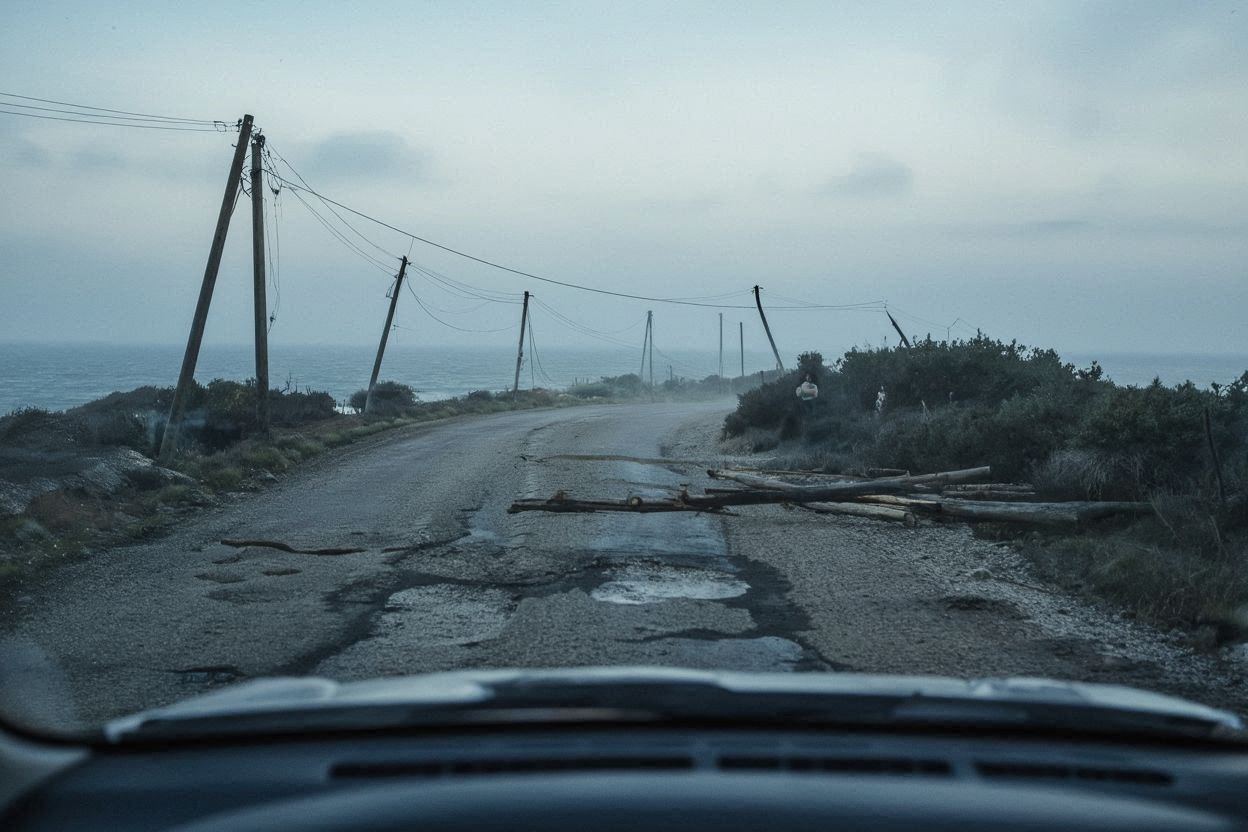
On this Atlantic side of St Catherine’s, the sea was wilder, dangerous for swimming. Spray whipped by the Alizé hung as mist; I could taste salt as I drove. Grey coral cliffs; spreading sea-grape like lettuce; a blue wooden house behind a white picket fence; tough men on wobbling bicycles; leaning telegraph poles overrun with wires like melted cheese—scenes that would later feel ordinary were then sharp with novelty.
At a crossroads marked Burnside, the main road narrowed and broke apart. I slowed to barely twenty. Ahead, boys—teenagers—played cricket or tennis on the ruined tarmac. A barrier of sticks and logs lay across the camber. Off to one side, half-hidden in the brush, an older man watched—arms folded, supervisory, like some self-appointed Mayor presiding over the road.
I stopped. One boy approached.
“Twenty dollars to pass, Mister.”
He couldn’t have been more than thirteen: shaved head, bare chest, pot belly, shorts and flip-flops. He held a coconut frond, flicking it like a whip.
I didn’t take him seriously.
“I don’t have twenty dollars.”
“Then you can’t pass.”
“Move the barrier and go away.”
The guidebooks had spoken of friendly Katitians, not shakedowns by children on coastal back roads. Still, I wasn’t frightened. This felt low-level.
“No,” he said.
“He doesn’t control you,” I said to the boy nearest him. Severe-faced, but wearing shorts with Patrick Starfish on them, he seemed the most likely to break. “You could let me go.”
“Never,” he said, turning his back.
These kids are hardcore, I thought. Maybe a nudge will scare them.
I turned the engine on.
“Turn it back off!” screamed Starfish.
I nudged the car into first.
“Move!” I shouted. “Or I’ll run you down!”
The older man in the brush was no longer visible. Now the crazy Mayor had disappeared into the bush, I thought. This was my chance.
“You done fuck up!” Starfish screamed, and as I rolled forward—no more than an inch—he threw himself in front of the car.
“Jesus Lord, you hit him! I see everything! Big man, you in trouble now!”
The Mayor emerged from the bush, close now, a hammer in his hand where the coconut frond had been.
“Ray-John, the white man hit Boycie! Go get your mum! Fast!”
Ray-John ran.
Starfish—Boycie—writhed on the tarmac, clutching his arm. The car hadn’t touched him. Of that I was certain. The performance was expert.
“Kadeem, break down the barrier,” the Mayor said. Kadeem kicked oil cans and cones into the undergrowth.
I shut off the engine and got out.
“Don’t move, big man!” the Mayor shrieked, waving the hammer. “We got your licence plate.”
I crouched beside Boycie.
“You okay?”
“Ugh! Ugh!” he cried, rolling.
“You run him down, you white bitch!” the Mayor screamed.
Ray-John’s mother arrived, breathless.
“What the hell you do?” Her voice shook with outrage. “You gonna pay for this.” She bent over Boycie. “Call an ambulance, Kadeem. This angel hurt bad.”
“He’s not hurt,” I said. “I didn’t hit him. He’s acting.”
“How you say he acting?” she cried. “He whole body twisted.”
“The white bitch a liar,” said the Mayor. “We see him hit Boycie. Right, Ray-John?”
Ray-John nodded.
“Pick him up,” the woman said. The road was too hot now for theatrics. Boycie couldn’t stay down. They dragged him into the shade.
I got back into the car and drove off fast. The salt mist that had felt fresh minutes earlier now clung to the windscreen like a net. My heart hammered. The road ahead lay empty, the barrier gone as if it had never existed.
A mile later, a police car pulled from a side road and signalled me to stop.
At the station they took my licence and passport and sat me beneath a slowly turning fan. The walls tinted limewash. The officer took a small pencil sharpener from a drawer and carefully turned the stub of his crayon, the shavings falling to the floor.
“You hit a boy,” he said, not bothering to look up.
“I didn’t hit him. He jumped in front of the car but I stopped in time.”
The crayon stopped turning.
“His mother say you hit him.”
“Maybe he touched the car but very lightly.”
“You a doctor?”
“No.”
He wrote this down.
I explained the whole thing – the barrier, the set up, the shake down. But in the heat of the station, my words seemed to lose weight, a kind of thinness in that fug.
He nodded once, only at the end.
“You must understand,” he said. “They all witnesses.”
He wrote a bit more.
The fan seemed to turn slower now, the whole contraption wobbling and rattling when one blade made a certain arc. I watched it stutter round and round, knowing that if it came apart, I wouldn’t know which way to dive.
First off, I suppose I have to explain why I decided to e-mail Dr. Petalman at all, what with him being the most famous mathematician on the planet and me just a nineteen year-old college drop-out.
Contrary to a lot of current gossip, it wasn’t the million dollars. In fact, I knew he didn’t have the million dollars. I was aware he had refused it. So it wasn’t that.
And it certainly wasn’t because of the math. Let me get that straight from the get go. Back then, I hated math.
And I didn’t want him to help pick a winning horse in the four thirty at Leyton Plains, or give me the number of next week’s Powerball, or the name of a tech stock to invest in, or any other of the crap you might have read on the internet.
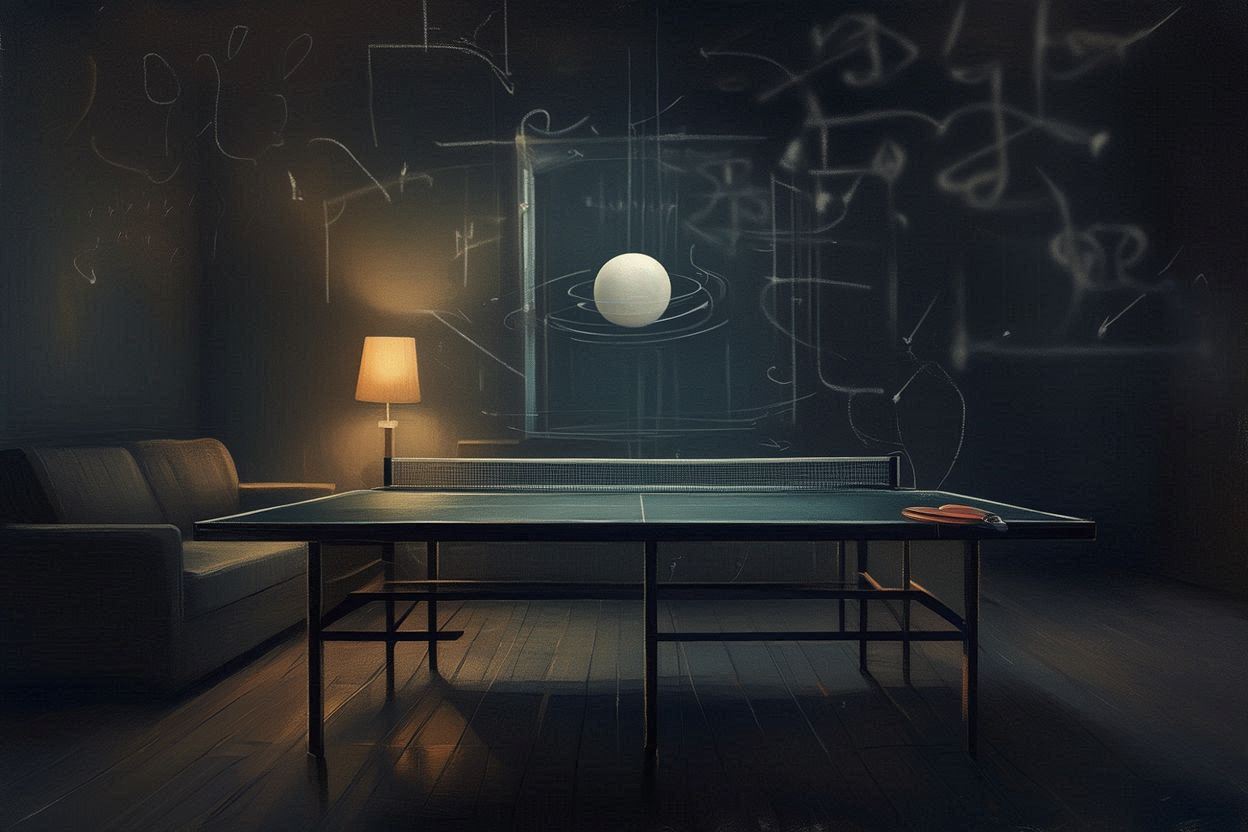
Really, I just had a question about table tennis. I was nationally ranked, but the coach had a grudge against me and wanted me off the team. So I needed Petalman’s advice.
But I can understand that you might not accept that, so let me explain properly.
I first saw Dr Petalman playing ping pong on NOVA, this science documentary they have on Saturday nights on PBS – fifty minutes of high-brow gobbledygook that my sister, Courtney, likes to watch in the hope that some of it will rub off and she’ll grow a brain and not fail integrated science.
Most times it’s on, I’ll be outside in the yard practising with the table pushed against the wall, but that night I was in the front room – I had the daily Sudoku to finish and I didn’t want to do it in the kitchen because Dad was there, eating his tuna sandwiches, making the place reek to high heaven.
So I sat with the newspaper in front of me, half a wary eye on the T.V., watching it distractedly – really there was no other way, because this NOVA episode seemed to consist mostly of a procession of bizarre computer images : brightly colored rubber balls spinning on gray backgrounds and then twisting into spirals and exploding, and fields of little arrows like a thousand tiny weather vanes swimming on a giant chin, and numbers, everywhere numbers, tsunamis of numbers, swarming over strange, bent shapes that looked like mutant vegetables.
“Are you really watching this crap?” I said to Courtney.
It was like something out of Alice in Wonderland.
“Shut up and do your Sudoku,” she said.
“Because there’s football on the other side.”
“It’s math. It’s fascinating.”
Fascinating is a Courtney word. It means she doesn’t get something, but she wishes she did.
When the trippy animation stopped, they showed eccentric-looking men talking straight to camera. They subtitled them, and Courtney read out the names in her sing-song voice – Professor Cornelius Crackhauser, Head of Abstract Geometry at MIT; Simeon Turnip, Emeritus Professor of Quantum Loop Gravity at UCLA; Dr David Bonkbasher, Reader in Abstracted Riemannian Surfology, St John’s College, Cambridge and so on – all these oddballs mumbling baloney at the interviewer, scratching their heads and showering the lens with dandruff.
I tried not to watch. I put my elbows on the coffee table and my head between my hands, hoping by ducking down I would streamline the flight of high-faluting bullshit as it soared over the top of my head.
But something kept drawing my eyes back to the screen.
This show was about mathematics? That’s what Courtney had said. But wasn’t mathematics arithmetic and algebra and numbers and things? If the show really was about mathematics it was mathematics like I’d never heard of – insane mathematics, ninja mathematics, mathematics in fifty nine dimensions and thirty seven different color schemes, mathematics with cubes and pyramids and tesseracts and floaty things that dissolved into shimmering metallic matrices that had four sides of Greek letters and another six in hieroglyph; mathematics that spun and whirled and flashed before your eyes. In short, coked-up math for tripped-out crackheads.
A man in his thirties came on the screen. He looked like his head had been stuck on his neck upside down – a great shaggy arc of a beard grew on his chin, the top of his head was totally bald and, to cap off the effect, the wires of beard re-emerged in huge, disconnected tufts right over his eyes to form eyebrows thick as hedgerows.
“Dr Misha Petalman,” said Courtney slowly, reading the sub-title with difficulty because at the same time she was texting, maybe even sexting, who knows these days with Courtney. “Lecturer in Advanced Differential Geometry, Slakov Institute, Moscow.”
And then they showed something really astonishing – footage of Dr Petalman playing ping pong at some academic conference with another mathematician. The two of them hammered away at each other while the narrator told us that they were geniuses, but that even geniuses must have outside interests and Petalman’s was table tennis.
That really got my attention.
I could see right away he was very good. He hit the ball with enormous sweeps of his hairy arms, dashing about the table in a fury, his eyes blazing with rage. He would move right up close to the table and then play dinky little lobs to the back line with huge spin on them so that the ball would curve away at impossible angles, bamboozling his opponent.
But it was really his serve that had me fascinated. There was something very strange about it. It seemed to be a variant of the back-spin cross-table, but Petalman was not pushing his arm forward and spinning the ball clockwise like I’d been taught – he was throwing it up a huge distance and then chopping it vertically.
It looked impossibly difficult but Petalman was like an automaton, whacking serve after serve and never missing the chop.
“You see him do that?” I said to Courtney. “I could never do that.”
“Because you’re dumb, Dennis. This is higher math. You can’t even add up a till roll.”
“Not the math. They’re not even talking about the math. Look, it’s table tennis. And watch the way he’s serving. That is awesome. The way he’s taking the ball and tucking it in the back of his hand and then slicing the bat down. He’s winning every point on that serve.”
“The show is end-to-end educational mathematics and the only part that interests you is the ping pong.”
“Because this guy, Petalman, is AMAZING at ping pong…” I said, and pushed the newspaper to one side so I could watch him properly, as he gave this astonishing exhibition of tip-top, high precision, technically perfect ball bashing.
Later, I googled Dr. Petalman.
Wikipedia was not helpful – the entry was long, all about his proof of the Poindexter Conjecture the year before, and how he had refused the million dollars Clay Prize, saying that he had no need for money and that the proof itself was reward enough. Nothing about the ping pong.
At the bottom of the entry, however, was a link to an academic paper, and at the bottom of that, below a mass of Greek symbols, was his e-mail address.
I know it was presumptuous and perhaps a little crazy, but I figured what the hell, I would really like to know the secret of that serve.
So I sent him an e-mail.
This was what I wrote:
Subject: That Serve!!!!
From: DennisNuts
Date: Jan 5, 2013 · 11:34 pm
Hi Dr Petalman,
Let me say straight off, I realize I shouldn’t be bothering you. I read on Wikipedia that you are famously reclusive and that you live with your mom in Moscow having turned your back on the world and the math community in particular (having had a run in with a certain Professor Lau over at Harvard.) Also, I know for a fact you must be getting a lot of unwelcome e-mails now that you have refused the million dollars Clay Prize, begging you to change your mind, and accept it, and then, I guess, give it right away again 😉
So I want you to know this is not that kind of e-mail, and I totally respect your privacy and your decision to turn your back on the world and in particular the math community (of which I can most definitely state that I am not a member having dropped out of math as soon as the district would allow – third grade.)
Really this e-mail is just a simple enquiry about table tennis.
Saw you on NOVA, playing, and you were awesome.
But how the hell do you get the ball to spin like that on a backhand cross-table? I’ve never seen that before. It is devastating.
Please fill me in.
Yours in admiration (solely of your table tennis skills)
Dennis Richards
Lost in Wisconsin
I sent the e-mail off and the truth is I didn’t think too much about again. At that time I had a lot on my mind, what with the team being selected on Tuesday, and Coach Grant being such a hard-arse about practice and everything, so really I forgot all about the e-mail to Dr Petalman. Until the next evening when I saw this in my inbox:
“RE: That Serve!!!! petalman@slakov.ru”
I didn’t immediately open it. I figured it was just some sort of automated response, or maybe an assistant at the university had got round to clearing the doctor’s inbox.
When eventually I clicked on it, this is what it said:
Subject: RE: That Serve!!!!
From: Petalman@slakov.ru
Date: Jan 10, 2013 · 10:15 pm
Hi Dennis,
You are the only one to ever ask me about that serve which I have worked so hard at. The only one to feign an interest in what it might involve.
Dr Petalman
‘Feign’ I had to look up.
Then I replied:
Subject: RE: RE: That Serve!!!!
From: DennisNuts
Date: Jan 10, 2013 · 10:43 pm
Hi Dr Petalman,
My interest is certainly not feigned. I am trying to improve my table tennis skills and would really appreciate your help.
All the best,
Dennis
One day later I got this:
Subject: RE: RE: RE: That Serve!!!!
From: Petalman@slakov.ru
Date: Jan 11, 2013 · 11:34 pm
Hi Dennis,
Perhaps I am too suspicious when it comes to strangers. Perhaps I have had too many run-ins with ‘admirers’ and have become a little paranoid as a result. Perhaps I am just Russian and miserable.
Really I was delighted by your interest. Nobody seems to want to talk to me about table tennis any more, after my small successes in mathematics.
I would be delighted to explain the serve to you.
But I must warn you, it is somewhat complicated.
However I do guarantee that if you make the effort, it will be worth it.
Truly it is devastating (as you state).
Yours kindly,
Dr Petalman
Subject: RE: RE: RE: RE: That Serve!!!!
From: DennisNuts
Date: Jan 11, 2013 · 12:23 pm
Hi Dr Petalman,
Complicated is just fine. I am county champion of Scottsdale and hope to make the Nationals next year.
Please go ahead and explain away.
Yours in solidarity with your principled stand against the math community,
Dennis
Subject: RE: RE: RE: RE: RE: That Serve!!!!
From: Petalman@slakov.ru
Date: Jan 12, 2013 · 5:34 am
Hi Dennis,
I am so glad that you are willing to undertake the program. Really I was searching for someone to pass the secret on to for the longest time, but nobody seemed at all interested. The fact that you approached me, after seeing the serve on T.V. (!) and recognizing it immediately for what it is, is truly a wonderful thing to me.
We will complete together the same program I myself undertook under the great Professor Goffendiek (since retired and lost to mathematics).
However, I warn you again, that it will not be easy. It will involve dedication on your part. There are mountains of differential geometry we have to climb: Clifford algebras in dimensions higher than nine must become second nature to you; we must further generalize the Yang Mills equations and then move beyond them, into semi-Riemannian non-commutative Lie Algebras and, after we have dispensed with those and mastered the Ricci and Levi flows, go further than Atiyah and Connes, into the Elysian fields that lie beyond where few have entered and fewer still have re-emerged with their faculties intact. But there are the most beautiful results waiting to be plucked and plundered for those who dare to make the journey!!!
If you are willing, we could begin tomorrow. (Sign in to Facebook about 4pm your time)
Yours enthusiastically,
Dr Petalman
Subject: RE: RE: RE: RE: RE: RE: That Serve!!!!
From: DennisNuts
Date: Jan 15, 2013 · 8:23 pm
Hi Dr Petalman,
Thanks for the e-mail and sorry to be such a downer, but I don’t think that I’m going to be able to take in all that advanced stuff you mention in your e-mail.
I’m just a college drop-out with too much time on my hands.
Really I am only interested in the basic technique of the serve as you did it on NOVA. I think if you just explain the rough mechanics of it, e.g. how to hold the ball, which way to spin it, and so on, I could probably get it very easily.
Otherwise in awe,
Dennis
Subject: RE: RE: RE: RE: RE: RE: RE: That Serve!!!!
From: Petalman@slakov.ru
Date: Jan 15, 2013 · 8:35 pm
Hi Dennis,
If I am going to teach you the serve, you must commit to the program. It is the only way.
I am sure you have doubts. I had them too before Goffendiek took me on as a student.
But it is essential that you commit to the program for you to understand fully.
Dr Petalman
Subject: RE: RE: RE: RE: RE: RE: RE: RE: That Serve!!!!
From: DennisNuts
Date: Jan 17, 2013 · 1:34 pm
Hi Dr Petalman,
I think you should know I failed high-school math.
Forget the high school math. It is not required. In fact, it is positively dangerous.
You have talent. You recognized the beauty of my serve. The ability to picture the spin from the fingers, the dip in the flight of the ball, the curving trajectory of the bat – this will serve you in better stead than any tedious math they may have force-fed you at school.
We are going to be travelling to a very different place than the flat landscape of Euclid. A much more interesting place. Preconceptions of its geometry would only have to be dismantled and rebuilt from scratch.
However, I understand you may still have doubts and to reassure you I am going to tell you a true story.
Read this carefully because inside this small tale is everything you need to know to succeed:
One spring, I was hiking in the hills outside Vlastok, in the Southern Caucusus, a remote place dense with forest, and home to huge packs of wolves, desperate for food after the long winter.
I felt desolate, lonely and frightened. I had taken a week out of my academic responsibilities at the Institute to come to this wilderness to be alone, so that I could devote all my thoughts and energies to the Poindexter Conjecture. But the week was almost over and I had made no progress whatsoever.
I made camp at night below the snow line on a spur of the great Mt. Arumank. I prepared a fire and cooked potatoes I had dug from the forest floor. And when I had finished eating, I went inside my tent, leaving the embers to burn.
I tried to sleep but it was impossible. My work, so promising initially, had come to nothing. The problems were intractable. There was no way forward.
Then as I tossed and turned within the tent, I heard noises outside – the howl of a wolf, the sounds of a scuffle, and then, unmistakably, a gunshot.
I pulled opened the tent flap as quickly as I could, desperate to see what was going on.
A man stood outside, holding a rifle. He was an amazing sight – hairy and naked, except for what looked like a bear skin draped around his shoulders. A dead wolf lay at his feet.
He stared at me a while and then he said, “You need to be more careful, Comrade. They smell your food.”
I was shocked. I had thought I was alone, the only human for two thousand miles. Who was this wild man who had come to my rescue?
He said he had been living in the wilderness for four years, surviving off the small game he caught by setting traps. (The gun was strictly for the wolves and he used it sparingly.)
He asked if I wanted to see his hut and when I agreed, he showed me to a clearing in the woods where a great log cabin stood.
I was amazed.
Through ingenuity and perseverance he had built a beautiful house complete with a stove fashioned from slate he had found in the mountain scree. It had a bathroom with hot water piped directly from a small boiler and there was even a greenhouse, with vegetables growing under plastic salvaged from a downed plane’s wreckage.
He was thriving in this remote and inhospitable wilderness.
I asked him how he had done it, how he had tamed the harsh waste of Arumank. Surely he must have had exhaustive training from a young age – perhaps he was the son of a great woodsman or the last scion of a tribe of nomadic survivalists because his resourcefulness and resilience were beyond extraordinary.
“It is nothing,” he said shrugging. “And in fact I am no one. Back in St Petersburg, I was an accountant. I have had no practical training. But I am alone out here and I have learnt. The fact is anybody can do anything if they have enough time on their hands. It is just that I have had enough time.”
The next day, we parted – the wild man went to inspect his traps, and I headed up over the spur to Vlodonk and civilization.
But as I climbed the mighty Mt Arumank, still fretting over my incomplete proof, I thought about what the wild man had told me – how he had said all things are possible when you have enough time. And without conscious thought, I found myself, instead of ascending the mountain, descending it and heading south to the open plains of the steppe.
And there I stayed for six long months, living off the land, eating the sweet potatoes that grew in abundance in the pastures, catching fish from the Varnusa, and sleeping outdoors with only the grass for a bed.
Instead of rushing back to Moscow I gave myself enough time to think and I saw the Poindexter conjecture unfurl before me, slowly, ever so slowly, disgorging its vast secret like a vine bursting forth its ripening fruit.
It was the most beautiful thing that has ever happened to me, and it happened to me because I had given myself enough time.
Dennis, you tell me you are a college drop out. Surely you too will have enough time.
So that’s how we started. Dr Petalman telling me about this wild man, the ingenious yeti with too much time on his hands, and urging me to think deep and not fast– to take the slow path, the less-travelled road, and above all else to concentrate on just this one problem, the problem of the ping pong serve, to the exclusion of everything else.
After I had made the commitment, it was just a matter of time.
I don’t want to tell you too much about the specifics of Dr Petalman’s program except it was conducted by Instant Messenger and webcam (any doubts I had that I might be speaking to a fake Dr Petalman were immediately dispelled when I first caught sight of his extraordinary and unique upside down face on the screen of my computer).
The program was also extremely practical.
To give you some small flavor, here are a few of the tasks he set me:
Combing the hair on a spherical dog (we used a real Alsatian).
Parallel transportation of the connection of a vector field around a closed manifold (plastic arrows and assorted rubber mattresses).
Winding number of loop integrals (homing pigeons).
The n-Sphere – (n plus one space hoppers and industrial sewing equipment).
We worked together for six months.
Initially the sessions were no more than thirty minutes, but as we continued and I began to make progress, they extended longer and longer, until more often than not we worked through the night – Dr Petalman explaining a new idea; my trying to understand it; Dr Petalman urging me onwards, schooling me through his practical experiments; the first inklings of comprehension; then a growing confidence and a final cataclysmic aha! moment when at last I grasped the concept in the whole – an extraordinary catharsis, more powerful than orgasm.
Thoughts of that table tennis serve that had initiated the tuition rapidly became subsidiary to the beauty of the math he was showing me. I felt he was guiding me through a new and wonderful world previously hidden to me – a multiverse of vectors and tensors and multi-dimensional manifolds, a dancing jamboree of pure abstracted thought.
Then one day, about six months into the program, after we had completed an extraordinary session on the perturbation expansions of Yang-Mills Quantum Field Theories involving copious use of tightly wound plastic hoses, Dr Petalman leaned forward into his webcam and said softly, “Dennis, you have been a wonderful student. It has been a pleasure working with you.”
“Thank you, Dr Petalman. But honestly really the pleasure has been all mine. You have been the most extraordinary teacher.”
“Truly you have worked hard. I think now you are ready.”
“Ready for what?
“The serve, Dennis.”
“The serve. Yes. I had forgotten about the serve.”
‘We were leading up to it.”
“Yes. We were.”
He moved back from the camera and I could see that the matt green blur that had always been present in the furthest corner of his room was now pulled into focus and resolved into the unmistakable shape of a ping pong table.
The doctor moved towards it and then pulled a bat and a ball from inside his tweed jacket.
He didn’t hesitate. He threw the ball high, giving it the extraordinary spin I had seen so many months before on the NOVA program, and then he slashed at it with his bat.
In that one motion, as the bat hit the ball, all became clear to me. All the teaching of the past six months filled my mind and flashed into clear focus. Immediately, I understood.
My insight was devastating.
The Petalman Program: Serve Dynamics
Active Manifold: Semi-Riemannian non-commutative Lie algebra Status:Waiting for serve…
Δ(Serve) = Yang–Mills term + mass gap
“You should write it up,” he said later, when he had gone over my interpretation three times, making small corrections here and there
“How do you mean write it up, Dr Petalman?
“Write it up as an academic paper. It is important work.”
“I can’t write up a scientific paper. I’m a college drop-out.”
“It is just a question of embellishing the original arguments. I will guide you.”
So I spent the next three weeks, with Dr Petalman’s help, writing up the results.
When we had finished, Dr Petalman decided it was good enough to upload to Arxiv.org, the mathematicians’ website, and when that was done, he announced his program complete, and told me he would be unavailable for tuition for the immediate future.
The paper caused quite a stir, and I’m afraid Dr Petalman may have encouraged it. Titling it, “Proof of Yang Mills and Mass Gap”, when really it was a simple little exercise in the interpretation of the dynamics of a closed physical system in three dimensions (the flight of a ping pong ball in fact) was, in retrospect, something akin to a red rag to a bull. The math community was lining up to laugh at it. But Dr Petalman had taught me well, and when the trivial rebuttals failed, the heavyweights took an interest.
Professor Lau at Harvard put his best team onto it and, unfortunately for me, after a year of going at it they announced to the world (through the New York Times) the proof was correct. The International Math Union called, begging me to accept a new Clay Prize.
I had no idea what to do. I felt like a complete fraud. The paper was mine and I had written its arguments, but only because I had followed the Petalman Program. When the world found out, I would be exposed and ridiculed. My sister Courtney, especially, would have a field day.
I urgently needed to speak to Dr Petalman, but every night I logged into hotmail, his status was offline.
Until exactly a year after he had logged off – it was now August 2014 – he came back online.
“Dr Petalman,” I typed furiously. “Thank God, I’ve gotten hold of you. The Millennium Prize Institute has been in contact. They want to award me a Clay Prize. It is a disaster. You have to help me out. You have to tell them what really happened.”
“But, Dennis, it is as they say. You produced a work of genius. You established the existence of the Yang-Mills theory with a mass gap. ”
“But it was not original work. I was only following your program.”
“In mathematics, as in so many other fields, almost nothing is truly original. We all, even the greatest of us, build on the work of others. How did Sir Isaac Newton put it? ‘We stand on the shoulders of giants.’ It was the same for me, following Goffendiek. And Goffendiek only followed Weyl. And Weyl, Riemann. And Riemann, Gauss. All the way back to Pythagoras. (Pythagoras followed somebody too, only the somebody’s name has been lost to history.)”
“But I can’t accept a Clay Prize.”
“Why not?”
“It doesn’t seem right. I’m not worthy. I haven’t paid my dues.”
“These are not valid reasons to refuse. You must accept.”
“How can you say that? When you were offered the Prize, you didn’t accept.”
“And it was the greatest mistake of my life. Goffendiek was relying on it. He owed money to Weyl.”
An uncomfortable suspicion came over me.
“You set me up for this, didn’t you, Dr Petalman?”
“Not at all. Your research was a natural extension of mine. It solved a second great mystery. I was merely your guide to fertile mathematical ground. You dug the truffle.”
“You want the money, don’t you? I’m supposed to give you some of the money, right?”
“Let’s call it a tuition fee.”
“You want the money but you don’t want to be seen accepting it. It would be terrible for your image. You’re famous for having turned the prize down after all.”
“I do want some money, yes, Dennis. My mother is sick and has medical bills. And it would be difficult, after getting so much publicity when I refused the original prize for me to now decide to accept it. It is not so much a matter of pride as a matter of practicality. I fear the storm created would destroy what little privacy I now enjoy.”
By now I was seriously angry. Who was Dr Petalman to use me like this? What manner of a man was he?
I stared long and hard at his hairy avatar and turned the computer off in disgust.
I refused the Clay Prize and I guess that is how you’ve heard of me. I’ve been told I upset a lot of mathematicians doing that. But actually that is something I’m sort of proud of.
Petalman vanished off the internet completely. He may be walking the Andorran Alps with Professor Goffendiek.
Courtney passed Integrated Science.
Now, here’s the pitch.
You may like to know I am still very keen on table tennis. I have a few videos up on YouTube – you could take a look at my channel if you like (DennisNutsPingPong). There is one wicked serve I am particularly proud of and if you take a look and think it’s cool, I would be very happy to teach it to you.
I figure right now, what with this recession and everything, you might have a lot of time on your hands.
I warn you though, the explanation is going to be complicated and it will require some work on your part to get the hang of it. But I do guarantee it will be worth your while to complete the program…
Rereading A House for Mr Biswas, I’m struck by how much of its comedy depends on pressure. Not whimsy, not eccentricity, not the genial observation of human folly that animates so many realist novels of the nineteenth century, but an atmosphere in which small events thicken into crises. Naipaul’s Trinidad is a place where the margin for error is narrow, and where a trivial humiliation can tilt the course of a life. It is precisely this tension that makes the novel’s funniest scenes stay in the memory: they’re comic because they are precarious.
The opening pages set the pattern. The drowned calf, the missing infant, the villagers circling around — superstition and omen, all of it narrated in a quiet, almost official tone, as though the calamity were being described by someone determined not to raise his voice. The humour emerges from the mismatch between the scale of the response and the prose that contains it. But nothing about the villagers’ panic is irrational in context. In a world where subsistence is fragile and the supernatural hovers at the edges of interpretation, a dead calf might very well be a sign. Naipaul does not invite us to laugh at the villagers; he invites us to notice how easily fear can widen into absurdity when the ground beneath a life is already unstable.
Something similar happens in the signboard episode, the great comic set-piece of the novel. On the face of it, nothing could be simpler: a young man is hired to paint a shop sign. But Naipaul builds the scene so that two conversations unfold at once. Biswas believes he is discussing lettering and ornament; the Tulsi household believes it is sounding out a potential son-in-law. Naipaul slides between these interpretive frames with an almost invisible control of perspective — a half-phrase shadowing into Biswas’s pride in his craft, a line of dialogue coloured by the Tulsis’ proprietary curiosity. The humour arises not from misunderstanding but from a surplus of meaning: everything said is doing double duty, and only the reader is aware of the doubled script.
When the comic energy dissipates, what remains is a new form of entanglement. Biswas leaves the conversation with obligations he scarcely recognises, folded into a network of expectations that will take years to loosen. The comedy here is not merely a stylistic flourish; it is the mechanism by which social pressure is exerted. A joke becomes an entry point into a life.
Later in the novel, at the rural estate, Naipaul turns inward. The scene in the shed, with Biswas alone and watching tar drip from the rafters, is narrated with the same refusal to exaggerate that governs the opening. The physical detail is obsessive — the tar thickening, congealing, stretching under its own weight — and yet the psychology beneath it is unmistakable. Biswas is terrified of the workers outside, of their possible resentment, of the isolation that has left him exposed. The moment is funny in its fixations and frightening in its implications. The shed is both shelter and trap; the mind that contemplates the tar is on the edge of collapse. Naipaul holds these tones together without resolving them. The pressure does the work.
Pressure is also what animates the Tulsi household, whose comedy has a different texture. The Tulsi brothers and sons-in-law puff themselves up like minor officials presiding over a directorate of cousins, servants, and ledgers, and yet their authority deflates the moment it meets reality. A boast sags under scrutiny; a reprimand fails to land; a plan collapses into domestic noise. Naipaul never pushes them into caricature. Their pomposity is credible because it is defensive — a performance of importance in a household where real power is diffused, ambiguous, and constantly renegotiated.
The sisters exert their influence in another register altogether: the collective murmur of commentary, judgment, and shared vigilance. A remark such as, “Well, she say that, but you must hear what they saying,” is enough to shift the climate of a room. Their power lies in this net of implications, the sense that no action is entirely private, no preference entirely innocuous. When Biswas asserts some tiny fragment of independence — a paint colour, a room arrangement — the reaction is disproportionate because the structure of the household makes it so. Here too the humour has a double edge: the sisters’ collective voice is both comic in its self-importance and perfectly suited to the maintenance of a fragile social order.
Even the late trip to Maracas Waterfall, often remembered as an odd digression, fits the pattern once one sees it clearly. It offers a glimpse of a Trinidad Biswas rarely inhabits: open, scenic, leisurely. The shift in register is brief but telling. It shows the gap between the life Biswas lives and the life he imagines for his children — between the narrow corridors of Hanuman House and the larger, less punitive spaces of the island. The scene widens the emotional frame of the novel without relieving its pressure.
What makes A House for Mr Biswas continuously rereadable is Naipaul’s ability to keep these forms of pressure in play without ever tipping the novel into despair. The humour is not consolation; it is diagnostic. It reveals the hidden mechanics of a society in which autonomy is always under negotiation and the smallest humiliation can have lasting consequences. Naipaul’s comedy does not lighten the load of the world he describes. It shows us, with extraordinary clarity, how the load is carried.
I read John Updike’s Rabbit novels almost backwards, encountering Harry “Rabbit” Angstrom first in middle age, long after his formation, his disasters, and the historical moment that produced him. That accident of reading order turned out to matter more than I expected, not just for how I understood Rabbit, but for how I understood what Updike ultimately does best, and where his intelligence is most at ease.
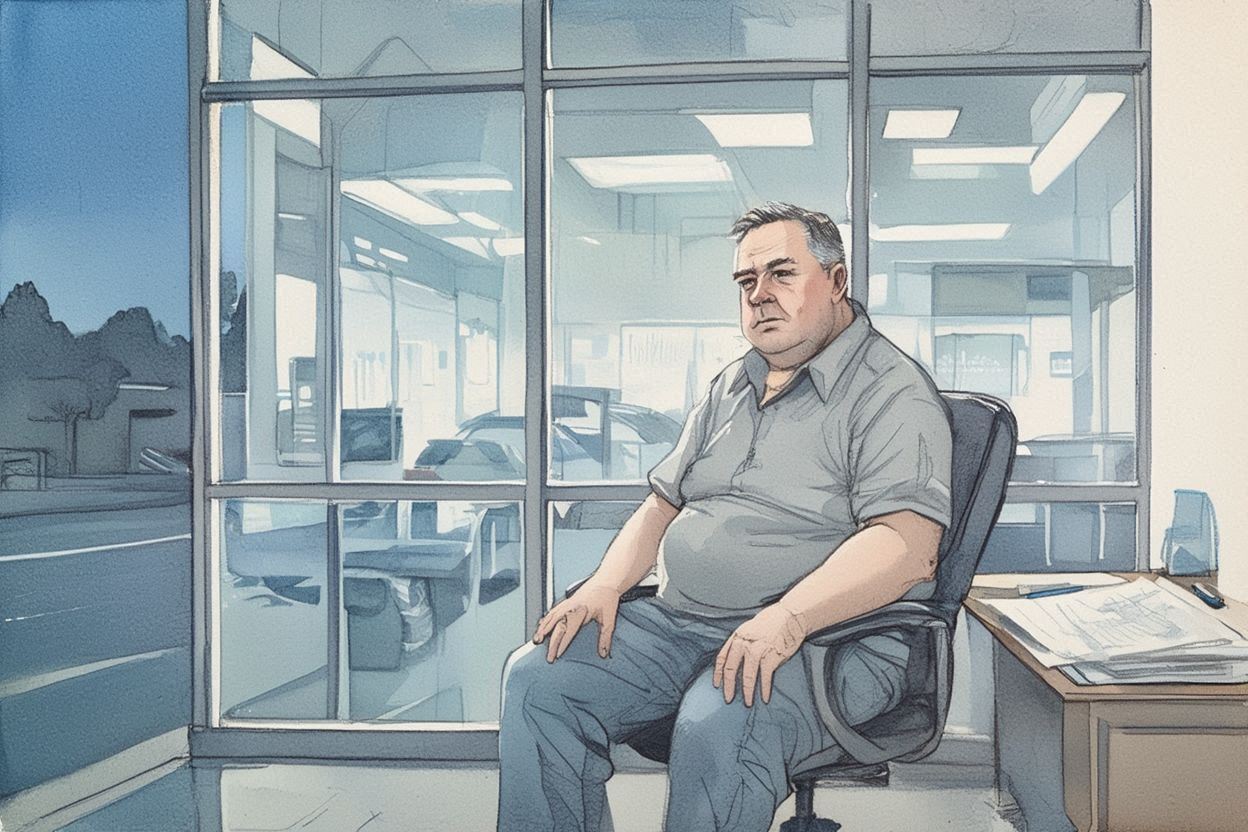
When I first met Rabbit, he was already settled: a middle-aged car salesman, thinking constantly, sharply, untheatrically. His mind felt lived-in. Not aspiring, not pleading, not trying to justify itself. This was not the restless, self-displaying male interiority that dominates much postwar American fiction, not Bellow’s performing intelligence, not Roth’s manic self-scrutiny, not Mailer’s theatrical aggression. Rabbit, at least as I encountered him, wasn’t staging his consciousness. He was inhabiting it.
That distinction mattered. Updike is often praised for sentence-level virtuosity, but what struck me was something quieter: Rabbit’s comfort inside his own thoughts. Vulgarity appears not as provocation but as casual cognition, an ice cream that tastes of vagina, a comparison that doesn’t announce itself as transgressive. These moments aren’t trying to shock or diagnose. They feel like the byproducts of a mind that no longer needs to make a show of itself.
The same is true of history. I remember Rabbit registering the Lockerbie plane crash not as symbol or moral pivot, but as an irritation passing through consciousness. It isn’t DeLillo’s media-saturated paranoia or Pynchon’s baroque conspiracy. It is smaller, duller, and therefore closer to how events actually arrive in ordinary lives. Plot recedes. Texture remains.
What distinguishes these late moments is not their subject matter but their handling. Updike often lets Rabbit register a thought and then move on before it acquires symbolic weight. A perception arrives, irritates, dissolves. The prose refuses to pause for interpretation. When Rabbit notices something, a woman’s body, a news item, a petty grievance, the sentence rarely widens into commentary or inward display. It stays brief, lateral, almost throwaway, as if the mind has learned not to linger over its own reactions.
This is where Rabbit begins to feel formally distinct from many of his contemporaries. In Roth or Bellow, a comparable observation is often metabolized, turned over, elaborated, made to yield insight or irony. Updike allows Rabbit not to do this. The thought is permitted to remain incomplete. Its value lies in its passing, not in what it proves.
By this stage, Rabbit resembles less the emblematic figures of postwar fiction and more a proto–Hank Hill: anchored by work, shaped by habit, politically and morally opinionated without turning those opinions into performances. For a writer often accused of aestheticizing male narcissism, Updike here produces something rarer: a character whose vanity, pettiness, and self-pity have become habitual rather than dramatic, no longer staged, but simply present. Rabbit does not become better; he becomes settled. His flaws remain, but they no longer demand interpretation.
Only later did I go back and read the early Rabbit books, and the shock was considerable.
Rabbit’s origins felt not merely younger, but stranger: historically saturated, morally loud, almost gothic in intensity. The baby’s death isn’t simply tragic; it carries the weight of original sin, a foundational trauma meant to fix Rabbit inside a moral drama from which there can be no clean escape. Skeeter reads now like a period hallucination, a figure dense with the racial, sexual, and political anxieties of the sixties, more emblem than person.
These early novels feel less like interiority than like context. Like much mid-century American fiction, they ask their characters to bear the freight of national unease. The prose strains toward significance; events demand consequence. Rabbit, here, belongs more to his era than to himself.
What startled me was not that Updike began here, but that he managed to move beyond it.
Updike was explicit, in interviews and letters, that his subject was not himself but what he called the American Protestant small-town middle class, “middles,” where ambiguity rules and extremes collide. Rabbit, Run was conceived partly in dialogue with Kerouac, not to romanticize escape, but to show what happens when a family man goes on the road and leaves consequences behind. Rabbit was not a self-portrait so much as a lens, a way of looking at a world Updike knew intimately without turning the novel into memoir.
That distinction matters. Updike’s letters make clear that he used personal experience freely as material, domestic life, infidelity, faith, irritation, but resisted the idea that his fiction was disguised autobiography. He defended sexual explicitness not as exhibitionism but as realism, part of the continuum of human behavior. Intelligence, in this conception, is not something to demonstrate but something to dissolve into lived texture.
That helps explain both Rabbit’s success and Updike’s occasional failure.
I became aware of this difference more sharply when reading some of Updike’s later, non-Rabbit fiction, particularly Terrorist. There the intelligence no longer disappears into consciousness but presents itself insistently, in the form of research: technical detail, procedural knowledge, the novelist’s command of systems and manuals. The effect is oddly performative, a continual assurance that the author has mastered the material.
What distinguishes late Rabbit from this mode is precisely the absence of that display. Rabbit does not explain the world to us, nor does the prose pause to credential itself. Knowledge appears only insofar as it has already been metabolized, dulled by habit, sharpened by irritation, folded into thought. The authority comes not from demonstration, but from saturation.
This difference also clarifies my relation to Roth. I like Roth largely for the jokes. His intelligence is theatrical, exhibitionist, openly self-regarding, and the comedy acknowledges the onanism. The performance is the point. Updike, at his best, avoids the need for such acknowledgment by letting intelligence vanish into texture. At his worst, as in Terrorist, it reappears as display without irony.
In retrospect, it seems that Updike had to write through the anxieties of his time, sexual guilt, religious inheritance, historical insistence, in order to reach a character who no longer needed to carry them so explicitly. The early Rabbit books work hard to make their protagonist matter. The later ones allow him simply to persist.
Reading Rabbit backwards made that evolution visible in a way a proper reading order might not. I met Rabbit after he had outlived his symbolic obligations, after he no longer needed to represent masculinity, America, or rebellion, but could instead continue thinking his thoughts.
This is not a claim about Updike’s superiority to his contemporaries. Roth, Bellow, DeLillo pursue different ends, often with greater formal ambition. But Updike accomplishes something quieter and less frequently acknowledged: he allows a major character to settle into a finished interior life, one no longer organized around crisis or revelation, but around repetition, irritation, and habit.
That achievement is easy to miss if one reads Rabbit as generational allegory or moral ledger. Encountered late—stripped of historical insistence, freed from explanatory urgency—Rabbit becomes something rarer: a consciousness that no longer needs to announce its significance.
I don’t think this is how the novels are meant to be read. But reading them this way revealed where Updike’s real strength lies: not in diagnosis, not in symbolism, but in letting a mind become inhabitable.