It was Madison’s fault.
If I hadn’t had to take her to Grandpa’s apartment I would have been about thirty seven blocks away from the clown selling the balloons.
This clown had huge winkle-pickers like his feet were sized fifty and his face was caked with powder with big red circles round his eyes so that he looked dazzled, like he’d dropped from space.
We stood on the sidewalk, me and Maddie, and watched him holding the strings of the helium-filled balloons in his gloved hands.
“Why’s he all dressed up, Trey?” she said.
“He’s trying to get people’s attention so he can sell them those balloons.”
“He’s selling those balloons? Really! Can I get one? I want one, Trey! Please!”
I don’t like to give money to creeps that stand on street corners dressed in clown suits, especially not this particular creep whom I recognized as a homeless guy living in a doorway by Clark Street Station, but I knew that if I didn’t buy the balloon Madison would get really fraught and start shouting and screaming and carrying on all the nine blocks to Grandpa’s apartment. When Madison starts, she really doesn’t stop. She can keep on for hours and hours. For instance one time, Mom didn’t let her have popcorn at the movies and she cried all through the first picture and then the next, being as it was a double feature. Then all the way back in the bus and another hour or two at home until Mom eventually had to pop a bowlful right there on the stovetop just to get her to shut up and go to bed.
So, although I didn’t want to, I asked her which balloon she liked.
“Really? I can have one?’ She started jumping up and down she was so excited. “Thanks, Trey! You’re the best brother in the whole, wide world.”
“Yeah, whatever. Which one do you want, Maddie?”
“That one!”
She pointed at a giant Scooby Doo.
“Why not just get a plain one, Maddie?”
“No, no, no, no, no, no, no, no….”
“The cute little blue one here.”
“No, no, no, no, no, no, no, no….”
“See that Scooby’s going to be really expensive…”
“Yes, yes, yes, yes, yes, yes…”
I sighed and then I had to look up to the clown and try and get his attention because he was staring right over me down to the cars on Clark Street.
“How much for the Scooby Doo, sir?” I said.
He bent down and I could smell the liquor on his breath.
“That’s going to be three dollars, son. That’s a special one.”
I sighed and reached inside my pocket, finding seven dollars left out of the money Mom had given me. I really needed to keep back five for the fare back home that evening so I wasn’t sure if it was sensible to buy the balloon at three dollars. But now I’d gotten Madison really excited like that it would have been unfair to let her down, and I figured if we took the subway back as far as Walden and then walked the last three blocks we could save a dollar so I could just about afford it and still get us back home that night.
So I gave the clown three dollars and he lifted the string from out of his hand and gave it to Madison.
I told her to hold it tight because if it blew away I didn’t have money for another and I made her wind the string carefully twice round her hand.
We walked all the length of the Promenade, Maddie’s hand with the balloon tied to it held out in front like she was sleepwalking and all the shoppers smiled at her. Little kids pointed and cooed at her and then got shushed by their mothers when they asked if they could get a balloon the same as hers. We took a left down the Esplanade and went all along the parade of shops so that Maddie could look at her reflection in the windows and smirk at herself holding that balloon. And then we cut south, down Hicks Street that runs into Atlantic Avenue, so she could show the balloon to the lady that works on the cosmetics counter at Macy’s who used to live in the house next to ours.
I felt good to have brought the balloon for her. It made me feel like my father must have felt when he bought us the Cadillac – powerful to have done something worthwhile with money.
By the time we got to Mr Stephanopoulus’ store about five hundred yards from the brownstone that housed Grandpa’s apartment, it was ten thirty.
And it was only when we got to that store that I remembered why I’d had so much money in my pocket.
It was Friday. Mom gives me an extra two dollars on Fridays to buy Grandpa’s newspaper so that he can check the racing schedule for the coming weekend. And now because I had brought the balloon, I only had four dollars left which was supposed to be our train fare back to New Jersey.
“Madison,” I said angrily. “Why didn’t you remind me? We were supposed to get Grandpa’s paper. What are we going to do now?”
“We can still get it from the store.”
“But I don’t have the money now. Because I brought you that balloon.”
“You do have money,” Maddie said. “You’ve got four dollars in your pocket. I saw it.”
“We need that for the train to get home.”
“Grandpa’s going to be really mad if he doesn’t get his paper.”
She was right. Grandpa would be really mad. He’d start calling up Mom and asking why we didn’t bring his paper, and Mom would tell him not to shout at her because she gave me the money for it, and then he’d start shouting at me, asking to see where the money was that I’d been given, and I’d only be able to show him the four dollars that I needed to get back to Harden, and so he’d call Mom back saying I’d stolen her money. All hell would break loose when I got back home.
So I figured the best thing to do for right now was to go the store to get the paper with the money I had left and then spend the rest of the day figuring out how we’d get home with only two dollars.
Mr. Stephanopoulus, the store owner, is Greek and has a huge handlebar moustache. He smells of candy and cinnamon. He knows me well because I’m always in there when I visit Grandpa, buying penny treats and sherbet fountains.
I found Grandpa’s newspaper in a stack by the shelves and then took it up to Mr. Stephanopoulous to pay for it.
He said, “Trey! You’re going to your grandfather? Here I have a package for him.”
He handed me a large, brown envelope and I took it carefully.
“Be sure you give it to him straightaway.”
“What is it, Mr. Stephanopoulus?”
“A special magazine he ordered that’s just come in. Don’t open it. Just give it to him wrapped like it is now. O.K?”
“Sure,” I said, a little puzzled as to why Mr Stephanopoulus was so concerned that the plain, brown envelope should not be opened.
I tucked the strange brown envelope under my arm, held the newspaper out in front and we started to walk back to Grandpa’s brownstone, Maddie with the balloon out in front, all dignified like she was walking a floating poodle on a leash.
We got as far as Cambridge and turned into the narrow passage by the canal that works as a shortcut.
We shouldn’t have gone that way.
I’d forgotten about the Bay and how it whips the wind that roars off the Atlantic, channeling it down the estuary and along the mouth of the Hudson, and blasts you like a hurricane.
When we got in the passage, crossing from the flagstones onto the wooden boarding that spans the inlet, I looked back for Maddie. She was right behind me, holding the balloon tight, pulling it down to get it under the stone arch that led us inside.
I walked on ahead, forgetting about the wind.
Then I heard the whooshing sound and remembered.
The whooshing sound is the noise the gust makes when it channels through the arch. It’s your first warning of what’s to come. Then the whoosh becomes louder, more like a roar, and you start to feel it push on the back of your neck. Then finally it smacks you with its full blast, bowling you down the passage, hitting you like a slug from a baseball bat.
The blast hit and I stumbled forward, dropping the package and nearly letting the newspaper go. I could hear Maddie scream and felt something wet and cold on the back of my neck that might have been spray from the waves lifted from the river.
I turned round.
Maddie was against the railings, the balloon in front of her out over the railings. She was leaning backwards and pulling at it like it was a marlin and she was a deep sea fisherman trying to reel it in.
I ran back to her and tried to grab at the string. But just as I reached her there was a second massive gust and the balloon made a sudden lurch and that’s when the string snapped.
Maddie screamed and jumped at the twine as it swung upwards. But too late. The balloon had broken free and was rising fast.
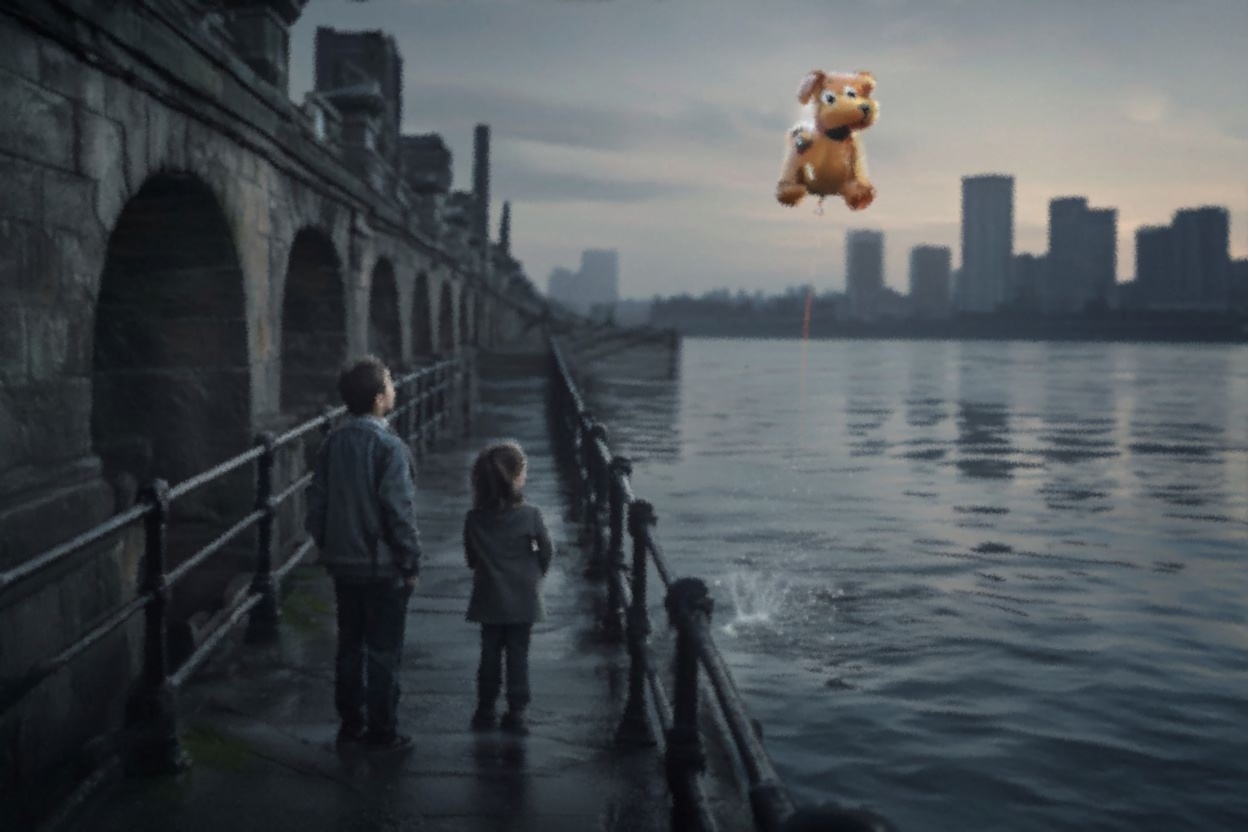
We watched it tacking out over the icy grey river towards Staten Island, lifting slowly above the docks, curling and dipping and ducking, it was almost as low as the river itself. Then it rose again, off over the Bay’s inky grayness, between the ferry boats, and up above the buildings, towards Liberty, like she was going to catch it in her hand, until it moved up again, higher than the skyscrapers on Manhattan and became the tiniest dot up in the silver sky.
When it had gone, Maddie bent down and started crying, little slow sobs at first, then louder and longer, until finally she was wailing uncontrollably, her little face covered in tears and red as a beetroot.
Like I told you before, once Maddie starts, it’s really hard to get her to stop.
I got down, put my arm around her and told her Mom would get mad with her if she didn’t stop; that there were always other balloons; that it was just a thing, made of rubber, and it was stupid to cry over a thing; that we needed to get to Grandpa’s house because we were already late and he’d be worried and, if he was worried, he’d call Mom. And finally, when all that didn’t work, I told her we would try and find the clown again when we walked home that evening so he could sell us another.
She looked up at me, her little eyes red as cherries, and said, “Promise, Trey,” and I said “Yes,” and she said, “Could I get that cute blue one?” and I said “Yes,” just to get her to come because in actual fact I had no real intention of getting her another balloon what with having no money and all.
She wiped her eyes and got up off the boarding and we slowly walked the five hundred yards or so to Grandpa’s apartment.
He was pleased to see us. Even more pleased to see the newspaper. And when he reached for it, I remembered about the package Mr Stephanopoulos had given me.
I didn’t have it. I must have left it in the passage where I’d dropped it rushing for the balloon. And now it would be gone, blown away into the Bay.
But Grandpa wasn’t mad with me because he didn’t know his special package had arrived at Mr Stephanopolous’ and Mr Stephanopolous had entrusted its delivery to me, and pretty soon, because he was so pleased having got the paper, and because Maddie had finally calmed down and stopped bawling, I forgot about the package too.
All that day, while I was watching television, while I was watching Grandpa slurp his oxtail soup and while I was playing with Maddie in the tiny vacant lot behind the apartment building, I was thinking about how we were going to get home without any money.
I figured maybe Grandpa might help, if I explained things to him properly, but whenever I opened my mouth to start, I caught this look in his eyes, like he was telling me not to go on. Mom says never get him angry; it’s bad for his heart. So all that day, I never quite had the nerve to ask him for the extra two dollars we needed to get home.
By five o’clock, when it was time to leave and he was shooing me and Maddie and out of the door back to my Mom’s house, I still had no plan.
We walked slowly, back down the same passage we’d taken when we lost the balloon and we both stopped to look over the railings out onto the gray water, out where Scooby Doo had made his lunge for freedom and broken free. The Bay looked different though – there was a gray flatness to it and the sun had fallen behind the skyscrapers so that huge rectangular shadows lay over us, like from tombstones, turning the procession of fizzed wavelets behind the barges into a kind of stillness. I leaned forward to look at the ferry that was plowing across to Battery Park and that’s when I saw it. In the garbage can between the railings and the second arch was Mr. Stephanolous’ package, wedged between a hamburger box and a bag of macadamias.
Some neat freak must have picked it up and put it there.
I said, “Maddie! Look! Grandpa’s package!”
I reached down into the can, pulled out the package and checked it over. It was perfectly preserved. Not wet or smelly or anything. I stuffed it in my pants. I would carry it to Grandpa tomorrow, when we came back with Mom, and he would be none the wiser about my having dropped it.
Then we walked back down Hicks Street, all along the Promenade, me kind of slow and deliberate because I knew what was coming, and Maddie excited and chatty, wanting to get back to the clown to buy her replacement balloon.
We got to the corner by the subway, but the clown had gone.
Maddie spent a while looking around for him and then, when she realized that I’d tricked her, she burst into tears.
Like I said, when Maddie starts crying, it’s really hard to get her to stop.
I told her that it was late and Mom was expecting us and if we didn’t hurry up, she’d be worried. I told her the clown would be back in the morning, and he would have a whole set of new balloons, maybe even a couple of Scooby Doos or one of them fairy witches from the Winx Club. I told her if she just lay here on a sidewalk bawling, the police would surely come for her and carry her away to a Children’s Home.
And finally, when the worst of it was over, I got down on the ground next to her and said, “How’d you like to play a skipping game?”
Maddie likes skipping games, only most times, I won’t play them with her, being fourteen and male and all.
“What kind of a skipping game?”
“You ever hopped a turnstile?”
“No. You can hop a turnstile?”
“You ever played leapfrog?”
“Sure. But that ain’t no skipping game.”
“Well, a jumping game, then. It’s going to be like leapfrog. But with turnstiles.”
The thing of it is, I’d never really tried jumping a turnstile before, although some guys at school said they do it all the time and made it sound really easy. They said it’s just a matter of confidence. People really aren’t too interested in other people dodging fares, maybe because they figure the trains are so dirty and unreliable nobody should really be paying a fare in the first place. So if you’re just straight up and bold about it, most people are going to ignore you.
The trick is to sidle up to the turnstile right behind someone so that it looks as though you’re with them and then just kind of crash into the barrier as they hurry through. Then you get your leg up and over and hurdle it like you’re at the Olympics or something.
Maddie said she’d try it, if I showed her how.
So we went down the stairs onto the concourse and looked around, scouting for the station guard or a ticket collector or anybody with a uniform, and didn’t see anyone, so I figured, it’s now or never, and got right behind this respectable looking couple. I told Maddie to stand right behind me and then I hit the turnstile as though I was trying to push through it. Then I had to lift my leg up and over. But I’d forgotten I had Mr. Stephanopolous’ package stuffed in my pants. So when I raised my leg, it just kind of froze at about sixty degrees, because that’s as much as the package would give, and I couldn’t move it any higher and I couldn’t get it back off. Then I felt something give in my upper leg like I’d ripped a tendon or something, and I started to lean some more on the barrier and that’s when I heard the bearings clicking in their housing and felt the turnstile turn a little more. I could feel the seam of the denim between my legs that must have gotten caught in the barrier getting tighter and tighter and then I think I might have started screaming and maybe I even blacked out a while because next thing I knew a ticket inspector, was standing over, saying, “Jeez, son, that thing’s almost ripped your balls off!”
Anyway they put me and Maddie in this office with a reflective glass front so we could see out but no-one could see in and they made us give the name and address of our parents and so on, then they kept us there until Mom and Dad came, and that’s just about the way everything happened.
Like I said. It was Madison’s fault.
MADISON’S VERSION
Trey said no, no, no, no, no — and then he bought a dirty magazine and got caught by the police with his pants down.